Showing posts with label leopard. Show all posts

Monday, December 31, 2018

Brutalizing The Wild

The picture of the crucified leopard depicts how we treat our wild brethren and glorify our deeds. It also tells us that the World is a human-dominated society where other life forms have no status. Well some of them have been labeled as endangered. 

At least the mauling of charismatic animals in India is duly reported by enthusiastic writers and newsmen aiming for victory reporting. 

The tigers and leopards are lucky because their demise is a matter of concern for those who are concerned thanks to reporting. The wolfs, jackals, deer, wild cats, antelopes, birds, insects, and snakes all are dying but their demise is mired in silence. Forests are being ravaged unseen. We do not know when it will be too late. Perhaps there will be an alternative as humans are good at finding.      

The picture also depicts what most of the humans in India perceive as predators and of course the benign species which are hardly ever reported dead. It tells us that humans engaged in this barbaric activity are illiterate and ignorant. Well, not me! Some of them may be, but definitely, they do not appear to be of the elite class! But who did the decimation of tigers and other wild animals in India before the legislation? The burra sahibs - brown and white, the Maharajahs, nobels, all upper class and literate. Believe me, if the legislation had not been in place these very elite now-turned conservationists would have shot them all down.      

Those we see in the picture indulging in shameless revelry did not have the privilege to decimate our wild animals in the past. Are they making up for it? 

No they are just expressing extreme threat perception...and their ignorance of course. We have not taken up the cudgels to instill an iota of sympathy among them for these so-called killer animals. The only thing they understand is what they see. A human gored by a leopard, a man eaten by a tiger, a child snatched by a wolf, and whatnot. These are stray incidents that do happen and can be avoided with extra vigilance perhaps or better management. Why not? We are not short of wildlife managers or experts in this country who have proved their mettle.      

Why Not? 

Because we live in a system that is only concerned with those with equity...purchasing power, voting muscle, wealth, clout, and all the desirable attributes that make humans a big success.

Because we are overawed by the development mantra and sizzling scales of the economy. We are indulging in luxury and comfort provided by material things. We do not care about the price we are paying for all that. We want more and more... 

Politicians do not care for lifeforms with the missing attributes mentioned above. Bureaucrats those who do care are simply subdued by the lords and the system. We the people are busy with day-to-day life and many for amassing wealth and power, wilderness and nature do not come into the picture or at the most a bit of concern. The conservationists, environmentalists, and nature lovers...this fraternity takes on all the load of the future to be. What happens when ecosystems like tropical forests are inhabitable? What happens whence the rivers dry out as consequence? What happens whence global warming cannot be checked? Wild animals and nature all are inextricably linked with the habitable Earth. Well, so many questions? 

Of major concern to me is, the answer that we will have to give to the next of next-gen....or it may be imminent. For our lethargy, greed, and neglect of the wilderness, a heavy price will have to be paid. And the bells have started tolling already!         

Read on Killing of A Leopard
======================
Uday works as a Naturalist Guide
Contact: pateluday90@hotmail.com
Mobile: 9755089323

Sunday, July 30, 2017

A Leopard Dies!

30/7/2017
Jabalpur

This was the second instance whence a leopard was found dead at Barha Forest Range near Jabalpur. The first discovery was that of a mutilated leopard body with paws, canines missing few months back.

The second instance that probably happened yesterday was reported by the locals. This was a young leopard cub probably one year old. Since the postmortem report is not out in the open the cause of the death could not be ascertained.  The presence of leopards in this area is a big surprise in spite of the available habitat. There is nothing there for them to feed on! May be the animals peripatetic by nature venture into such areas from pockets that still accord sustenance.  

Few years back a tiger was reported on a cattle kill in these forests. The animal was probably a vagrant in search of prey. There are none at all, the herds of chinkara and spotted that could be seen some years back have all been poached. Few barking deer do not make a meal for big cats. This leaves no option for them but to go for livestock and the ensuing man animal conflict results.  Some of the locals may be resorting too poisoning, or the killing could be the handy work of poachers or wood loggers which roam this forests in search of wild boar or anything that comes around. 

Neglected with lots of interference, the reserve forests are well known for their minor forest produce including tendu leaf. I have seen few poachers with guns moving around the forests without any fear, and wood logging is a frequent occurrence in these jungles. 

A part of the area was undertaken for some period by TFRI, an institution into forest research. A concrete wall was built for the purpose but this was for a limited period. Experimental plantations could be seen for some time - done for research. But anyway from what I hear the area is back to the concerned forest department.

Most of the visits are by birders like us since the Narrai Nala a perennial stream sustains many avian species. The stream is the lifeline of the ecosystem and supports impressive floral diversity in a limited area.          

The lean forests are mixed type with affinity with forests of Kanha and Bandhavgarh as they where once a part of the tracts which have been intensively inhabited by humans and extensively farmed. Small pockets scattered here and there comprise of good canopy rest need repairs badly. The area was full of wildlife during the period lasting up to late seventies perhaps but no more. A tiger could easily be sighted during that period but now literally not even a rat is visible.    

Well this is the story of most of the reserve forests in India leaving some of the protected areas aside. Once the country's finest ecosystems they now present only a skeletal picture - the wildlife is long gone. These are the pockets that sustained large population of tigers in India. They are devoid of all forms of wildlife in the contemporary period. In order to fetch the big cats out of peril these forest have to be reclaimed and due protection accorded. Such an action would offer extra space for the predators if carefully nurtured.

But do we have the resources and the will?         

Friday, March 31, 2017

Leopard Surprise

Pete & Kay Sutton UK 
Guests Courtyard House
Kanha National Park India 


It was in the previous evening round that we heard clamorous alarm cries at the cross road that leads to Sarhi Zone on left and Kanha Zone to the right. We had waited for a long time but nothing materialised. From the frequency of cries we could surmise that the sambar and chital deer had spotted a leopard in the thick canopy.  

Nothing emerged after waiting a long time. Disappointed we left so as to exit the park in time. Predators as shaped by nature are extremely unpredictable and can rarely be spotted at the same place twice. Well there are exceptions. 

Next day morning we were at Kisli Zone and were on mission to find Munna the ageing but dominant male tiger. Tracking tigers is an ultimate test of patience, split second decision and experience that one gets with due time and sincere application.

We were at Nainsingh Nala a wooden bridge that runs over a dried stream but does sustain water a few feet away in the neighbouring canopy. This canopy has become a vital point in our search for tigers and with great success. Two males have been spotted after a long long wait.     

So far there was no sign of Munna, and as usual we decided to score the neighbouring area. 

"Let us go to the crossroad where we had heard alarm cries last evening!" I instructed. This was just a surmise that something could wait so long.  Never give up easily and utilise all the time allotted for each and every search that you can make during the tiger safari. Jeeps arrived and departed and we waited. Our surmise was strengthened by the fact that a leopard had been sighted on this morning  round here.  

As the clamour of the jeeps ended a stony silence pervaded. The jungle sounds are incredible and challenge your hearing apparatus like no other situation can. In the mysterious wilderness of the Indian jungles sound waves from distance skim weakly over surface, and throw a challenge to your hearing apparatus. Long wait for big cats can be tiring and boring at times. I regaled my guests with the distant sounds that emanated from the jungle around us. "That's a barking deer! Probably sighted a tiger and going all bonkers!" 

Well in immediate surrounding it was all pin drop. If you as much make a rustle sound shifting in the vehicle you can lose valuable audible clues. But we sat absolutely still. It was a long wait but we did it.      

Then the cacophony erupted, a sambar called frantically, and the sound resounded amongst the still tall stands that were the object of our gaze.  As the calls continued we began to gaze between the stands, and it was rewarding. Our guide spotted what appeared to be a mongoose. "Pl hand me the binoculars." "Its a leopard!' The magic words all naturalists like to hear.  I peered hard and spotted the second cub emerging from the bush and heading into another.         

Excited but in full control we decided to park at a distance from where we thought the big cats will emerge. The strategy paid off. Thinking the jeep had left the leopard family continued to approach the jungle road. "Keep an eye behind," I told the guests. They did, and within a short span of time they called in unison "leopard!"  

Images by Pete & Kay Sutton 

Leopard Mother

Pensive Look 

Leopard Cub looking at us  

Panther Cub 

Cub Scurrying Past like a Mongoose

First to emerge was the mother. She came out, inspected the surroundings, and made sure that we were at a safe distance. She then signalled her cubs to continue following her. The first cub to arrive was probably male judging from its size. It stopped to gaze at the strange sight of the green monster.

This wild animal's threat perception is acute and ends up saving its lives amidst the tortured terrain of the dense jungles habituated by tigers. After a good look at us it began to crawl like a mongoose in order to enter the bush across the road.   

The second cub visibly smaller took no chances. It crossed over from a distance and scurried through. Cameras clicked. The wait was over. We had been rewarded with a magnificent experience that would take eternity to replicate.      

"Whew! Lets move on." And we did for another escapade in the wilds of Kanha National Park in India.

Thursday, January 21, 2016

The Elusive Leopard


Yellow fur dotted with rosettes black
Painted like an artist's board to attract
He is the nature's star Lo behold
Handsome creature with striking features that on one look unfold

Leopard is the cynosure of all the eyes
A jungle spirit that depends on guise
An animal strong and very wise
He lives in the jungle to survive

Of cunning and guile and ferocity untold
The ghost of darkness is a predator very bold
He kills only to eat for he is a carnivore indeed
He hunts only herbivores and some birds to feed
That is the nature's design eat only what you need

He hides in the jungle in between rocks and canopy
Seldom seen the elusive cat is camouflaged to the tee
To hunt the unwary prey in the night
He uses stealth and complete surprise
He climbs trees with liquid ease
To save himself he often flees

Full of beauty and grace
With striking eyes on charming face
Smaller than his cousin the tiger
But equally strong and much wiser

The spots change are never the same
They have brought him name and fame
Poached for fur and game
Struggling to survive and loosing space
An animal labeled vermin and disgraced
The beast is facing his last days
He will be extinct for sure
Lest we mend our greedy ways

Save the leopard save his life
Give him space and let survive

 Uday Patel

Photo Credit Dharamagiri

Monday, October 26, 2015

Tiger Safari: Rumble in The Jungle

Guests Mary & Andrew UK

Enthusiasm is the key to enjoying nature in the confines of dense forests. 

"We have come to enjoy all and make our holiday a big success," Mary said. "It's just not tiger, we wish to go back with happy memories," she continued.       

The evening was fun as we sat near the fireplace enjoying our sundowners, and the starry night at Courtyard House Kanha in Central India.   

As it was to be, we came across many birds, bison, and deer, and the guest enjoyed the landscape too. They were clicking nature's bounty with amazing finesse. Being amateur photographers they were well-versed in photography.

Hot and Spicy Food went down well with them ."A bit too much but we will bear it". "Ha! Ha". I was amused,  they were being sporty. Nevertheless wonderful evenings, amazing soups, and titbits with beer and my rum.    

One day too we did come across the tiger in the dense canopy of the Kanha Zone. "Sleeping like a drugged fellow", I whispered. "Well, a tiger lies there."    

Then what followed in the following evening was amazing.   

"A leopard went in the bush just now," excited tourists on the jeep informed us. "Wow"! We missed it or did we?
Ruddy Mongoose

Indian Roller
We drove a few yards ahead and waited. "It seems to have proceeded further into the jungle," the guide said with dismay. "No wait, "I said. The big cat may be lurking in the bush, I thought. And it was. : Like a peeping Tom it came out cautiously and looked straight at us. 

Sleeping Tiger
The mellow flare of the setting sun made it appear golden red as it came out in the open looking curiously at us. It was cautious and as we neared it went back into the bush. Well, it came out again and our guests could take more photos.  A great spectacle indeed.   

Jackal
Next Evening. 

Munna Tiger
Munna Looking at Us
Munna Male Tige r
Then came the big bounty. While returning from Sarhi Zone, Santosh our driver spotted tracks of a big male. "Turn around," I said.  
Nice Place to Spray

Munna as usual was ambling around at a leisurely pace with a bunch of jeeps in tow. That was it, a safari made holistic and exciting.


Scaly Bellied Munia 


Peeping Leopard
We came across many delights as you can see from the images Thanks to Mary & Andrew.

Friday, January 30, 2015

The Tiger Story - Bandhavgarh

Leopard

Tiger

Male Tiger

Injured Blue Eyed Tiger and After wards

Blue Eyed Injured

Blue Tiger Bandhavgarh


Injured Tiger

Jeep Safari

Long Billed Vulture

Big Male Tiger

Tiger & Tree

Ruddy Mongoose
Alarmed Sambar

Save Tiger

Spotted Deer

Bengal Tiger

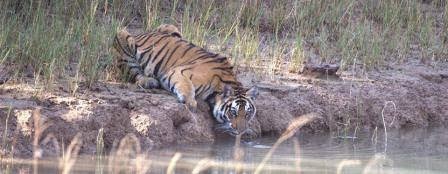
Tiger at Water

Tiger in Grass

Scent Marking Tiger

Snarling Tiger

Tiger Walk

Tige rin Bandhavgarh National Park

Wild Dog
Teerath Singh has been a great friend and client for website promotion. He is an equally great photographer, naturalist, and guide. Teerath Singh also operates a tour company called MP Tiger Safari in India.   

Bandhavgarh is a happening place and Teerath's Images keep telling exciting stories of the wild. Here is one incidence of a blue-eyed male tiger being injured in a fight and made to leave his territory. Well, this winter he is making a comeback. Territorial fights among the big cats could be a messy and bloody affair. See the images by Teerath Singh in this blog. 

Friday, February 21, 2014

Tiger Safari: Raining Big Cats

The leopard must have been waiting still for long completely frozen and hidden in bamboo stunts.  The big cats both the tigers and leopards have an incredible ability to stay still perhaps for hours in order to surprise and ambush their prey. 

In one instance it was all over the large spotted deer was grounded instantly. We heard the deer's last cry before the canines ruptured the jugular. We had reached the Kanha Ghat road from Raja Kachhar a water body in Kisli Region of Kanha some distance from the Chimpta Camp. 

The cry emanated from the direction we were heading. We waited to make out the right location of the cry and missed one of the most thrilling moment. The kill happened few yards ahead of us and we could not witness. By the time we  reached the spot the majestic antlered deer was lying dead in the pool of blood. The leopard we knew was hidden in the bamboo bushes. 

"There!" The guide on jeep ahead pointed the bush to us as they moved on ahead. 

We decided to wait. The kill was too precious for the hungry leopard to leave. With excitement overpowering us we managed to wait silently for the animal to emerge.  We could see him inch towards the kill and then retract a couple of times. He was in no hurry to forage. The prey was too big for him that meant he had to drag it in the bush and consume.      

We wanted to photograph him but he would just inch towards the carcass and retract. The cat and human game continued for some time then there was silence. Many jeeps came after us but unfortunately they could not see the Kanha leopard.

My guests from UK - Cavan, Grace and Gwayne had earlier seen two young tigers at Badrinath in Kanha Meadow and the leopard sighting was a bonus. But more was yet to come. 

The same evening we saw a male tiger in the bush at Badrinath in Kanha Meadow. This was followed by another fantastic leopard on the rock sighting. Incredible posture of the big cat was a big opportunity for the wildlife photographers - amateurs and professionals.  The guests from Mumbai at Courtyard House could also see the spectacle and were happy. They had come to relax and enjoy great food at Courtyard House and they did, besides the Leopard Darshan.  

The morning ride to Mukki Zone was uneventful till we returned back to Kanha Ghat and saw another leopard in the canopy near the Kisli Meadow. That same evening we saw a young male tiger emerge from the bush at Badrinath and proceed towards the rivulet to drink. It was an ethereal moment as the big cat quenched his thirst. Busy photographers, gawking tourists, happy naturalists and guides all witnessed this spectacle. The guest from Mumbai were missing so I had some story to narrate. Well I did.

"Really!"   

Monday, December 9, 2013

The menacing leopard of Kanha

Kanha Tiger Reserve - MP - India 

Our earlier trip to Mukki Range in Kanha National Park was devoid of big cat sightings. The range is unique since it holds extensive grasslands and two important water bodies. There is an old rest house built during the British times and worth a stay. The Mukki Gate is about 35 km from Khatia Gate and can be approached from inside as well as outside. The forests are much visited from people of Raipur in Chhattisgarh State of India and those who stay in hotels on Mukki near the park.  

Our recent trip to this range boiled with excitement. My guests were from Europe from a country called Slovenia. Both were professional photographers and one of them was also a tour operator. At Mukki we saw two tiger cubs near a water body. Probably the tigress was out hunting as we could not get any signs of her presence.    

Earlier we had seen two tiger cubs of Umarpani Female at Kanha meadow but the images where not satisfactory. The tiger family kept a distance and most often hidden in the bush. But the cubs near Babathenga Tank at Mukki were quite in the open and we could get some fine images. 

Satisfied and much happy we had a fulfilling breakfast of cheese and vegetable sandwiches, aloo paratha and fruits. Post breakfast we moved on to return to the Khatia Gate via a long stretch of jungle road. 

The unexpected happens, we were still in the confines of Babathenga Tank on the Zila Fireline in the Mukki Range. Driving casually and quite relaxed after having an onerous task accomplished we were ambling across that road at 20/km per hour. This is the prescribed speed of the park and allows your sensory apparatus to work more efficiently.     

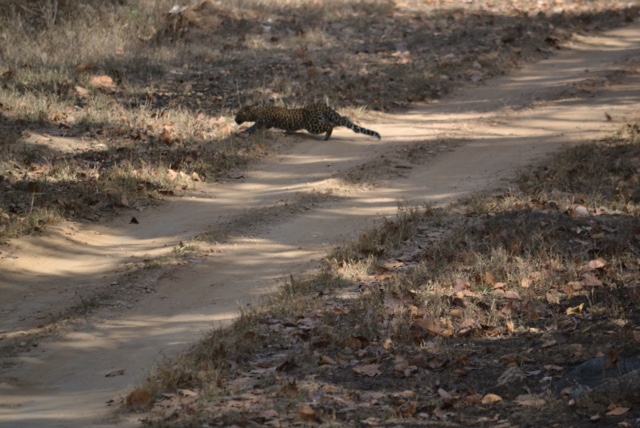
Somewhere across the Zila Fireline, I spotted a leopard crossing the road few feet away. There was just enough time to react and I asked the driver to stop right at the spot from where the crossing took place. I was expecting that the big cat would have melted away in the bush. This did not happen!!!!!!

The surprised leopard was starring at me. The guide, driver and two lens men were taken by absolute surprise. Stunned into silence by fear is what I will describe the scenario as. Having heard me shout, "Leopard" the big cat sat there in "about to spring" position starring menacingly at me. I was on the seat. The eyes shone bloody as cryptic patterns created by strands of sunlight  formed on the animal. The chiseled canines,  deadly claws and the musculature,...few would like to view from so close. Given a choice, I would maintain a safe distance.

This is what was least expected although big cats do behave aggressively at times. I slid down behind the driver unnerved. But the lens men though out of wits were at their job with such a wonderful opportunity knocking at their cameras. But the guide was apprehensive as he could sense my trepidation. And soon the leopard was encircling our open jeep.   

This was a dangerous moment for the spots could strike. At a distance of six feet we were a sitting duck. The guide sensed trouble and shouted full throat, "HAAT." The leopard slid into the thick bushes and vanished for good. The driver was already moving forward during the episode in order to maintain a safe distance of 20 meters but then things happened too fast.
Leopard Photo by Teerath Singh
For some time there was stunned silence as we got out of the big cats range. The leopard could have gone unseen but for my alertness (Ahem!).  I turn toward my guests, my face beaming with pride, "so" I manage to speak. Still in a state of surprise they poke fun at me...yeah...ok...good. They had got super delicious shots of the leopard which we could see at the Courtyard House.

The rest of journey was full of exciting moments as we came across many animals of Kanha National Park.   

Monday, October 14, 2013

Misssssssssssed the cat! By a whisker!

Brown Hawk Owl
Leaf Bird - Tirath Singh

Langur - Tirath Singh
The discovery of the Brown Hawk Owl (Ninox scutulata) a Northern Taxa was exciting. We were on the spot at Dumna Nature Reserve in Jabalpur on the usual Sunday birding. We could not see the owl that day but were satisfied by images taken by Prayut and Aishwarya Mandal. These two young guys have a knack for locating birds not checked listed earlier in Jabalpur in MP State. They have discovered Bar-headed Geese, Whimbrel, and a group of Ruff(?) besides this owl.   

Leopard - Tirath Singh
We spent a lot of time searching for avian species in the nature reserve. Dumna Nature Reserve is named after the Dumna Airport since it is on the way. The nature reserve encompasses 200 hundred hectares of mixed forest along with the Khandari Reservoir. The water body is large and is meant to supply water to some areas of Jabalpur City. But there are forests and small water bodies all around. 

The Khandari Reservoir is home to freshwater crocodiles, turtles, and various species of fish. In winter it is visited by many wintering and resident waterfowl. About five hundred Gray Lag Geese can be seen here alongside, wigeon, red-crested pochard, lesser whistling teal, nakta, northern pintail, common pochard, garganey, spot bill duck, and Eurasian wigeon. 

The surrounding forests are natural and once formed an intact ecosystem that was home to leopards and tigers. These forests formed a contiguous patch around the extant of the city. This is no more the case since the forests are badly denuded. The Dumna forests are subject to rapid construction hence another protected area for deer park has been earmarked for conservation. The fate of the forests now resides upon humans with greed for the land. The creation of triple IT or IIIT has denuded a lot of lands and continues to do so. There is a five-star hotel proposed for development by MPTDC? If true then it will be a further blow to the wildlife in the area. An immediate stop to all construction activity is a must in all green patches of Jabalpur.     

This is a stretch of about ten km and leads to the Dumna Aiport. There are some water bodies surrounding the airport as well as the reserve forests. This area is in the news for the regular sighting of leopards. A leopard has been filmed on the airport road by some enthusiasts. On numerous occasions, we have seen crocodiles in tanks, barking deer, wild boar, spotted deer, langurs, and rhesus macaque. In spite of regularly frequenting the area, we had not come across the big cat. A few years back I had seen a leopard with three cubs at Imzhar Ghati Forests near Pariyat Reservoir. 
     
Our birding trip led us to these forest tracts after we had a good look at the greenish warblers and a Eurasian Oriole family.  We came across several birds like shikra, white-eyed buzzard, white eye, rufous treepie, gray hornbill, and long-tailed shrike. It was a dull birding day on eve of Dusshera and we were busy discussing things besides birding. On our way back we noticed a group of people standing near the restaurant being built for IIIT.  Ignoring the crowd we moved on till Prayut called us back using the mobile. " Some guys have seen a leopard pair nearby" he informed excitedly. So we drove back to the spot but the big cats were nowhere in sight by then. 

The group was chattering excitedly and we could make out that they had seen the spots. "Just here, whence you passed us by. Look near the pole about hundred yards that were where the pair was idling," one of the guys informed us with baited breadth. Other people joined him in the confused chorus pointing to various directions where the big cats could have vanished. "You should have stopped upon seeing us," he spoke. "Your binoculars could have fetched them close."                          

We searched the canopy for some time and then gave up. We could not see the spots that day but there will be endless visits hence better luck awaits us I am sure. As we drove back in silence we traversed through huge buildings that are changing the landscape of these once pristine forests. Total disregard for our natural places is causing havoc and endangering prime forest animals in India. 

Tuesday, September 3, 2013

Leopard in Jabalpur - Video

These video speak of return of wildlife or beleaguered status. The leopard roams around the periphery of Jabalpur City towards Khamaria Forests, (Dumna) Airport Road, Mandla and Bargi Townships. It is heartening to note the animals presence. Much earlier tiger roamed around the periphery of this city. 

With reference to the second video why do newsmen not highlight humans making inroads into the home of the wild animals?  

Saturday, October 29, 2011

Save the tiger & leopard

From over one hundred thousand tigers in 18th century the population has plummeted down to a mere 1500 plus animals. This is also an indication of large scale transition of the natural land in India to agriculture and expanding human civilization. The land area has been overtaken by rural and urban societies for habitation, agrarian and industrial activities. The biggest decline was due to habitat loss and not the Royal hunting sprees.

Large scale destruction of natural land - the vital ecosystems - has reduced greatly, space for other life forms.   The grasslands and forests have suffered a major brunt due to human expansion. A small percent of total area has been left for other life forms, and even within that area tussle has been going on to deliver it to humans. This right and that right! Alternative solutions are seemed as too tardy.

Our constitution rightly points out:

Of the People
By the People
For the people

Literarily meaning for some - everything for the people, but other forms of life are a consideration in India as well. It was under Shrimati Indira Gandhi that a strong initiative was taken to stem the rot.  And it worked, the Wildlife Protection Act, Project Tiger all were the right measures. By her personal interest and involvement a strong message was sent to the marauders, - enough is enough.  A light was dimmed in infancy; there was great hope from Sh. Rajiv Gandhi. (The author is quoting factual observations and nothing else). Lot of conservationist will agree with my assessment.

The Project Tiger slithered down as Panna and Sariska fiasco stand testimony. Unable to visualize new threats the administration was unable to track the poachers and their heinous deeds. Was contribution there from corrupt practices/lethargy for the local extinction? Ask Anna?

Enthusiasm has died down completely. Much ignored the leopard in India is dyeing a silent death like many others who have inherited the Earth besides us. Media savvy people realize this. Even now conservation measures are implemented but they should wider in perspective.    Half hearted approach does not augur well; the country has more resources at hand   than earlier.

In keeping with the spirit of the Vedic scriptures and let live policy, a large number of protected areas were created.  These have provided succor to one and all forms, and act as respirators for our clogged lungs. She step her foot down to prevent any intrusion into the silent valley and many other ecosystems. She left a strong legacy behind, unfortunately barring few it was never followed from strength to strength. A section obsessed with development can go reckless and maneuver over all constraint in order achieve the objective - eco- friendly or not.          

There still exist a voice of sanity; people dedicated to conservation, many concerned administrators/politicians and NGOs. The number is growing every day, an effort to salvage whatever can be. Research helps, but in order to survive the tiger/leopard urgently need solutions that mitigate man animal conflicts, prevent intrusion in natural lands, poaching, wood logging and more.These animals are vital to forest ecosystems and environment as whole.  

Unfortunately all solutions are visualized through human angle. Sometimes the middle path does not work and as very little is left now. Those at helm should resort to strong conservation measures and not dilly dally.  Justice and proper compensation to those relocated, penal action against those involved in wildlife crimes and keeping industry to lost denuded lands far away are the right steps. 

Involvement of people who can voice for the voiceless is the need of the hour. The big cats are not just for tiger safaris or photo shoots though this helps. People should contribute in whatever way they can? Raise awareness, act as voice for the voiceless perhaps.       

Tuesday, October 25, 2011

Jim Corbett the invincible hunter

I have read most of the hunting episodes of Jim Corbett the legendary hunter and conservationist. I have been much impressed by his word by word account of innumerable hunts. He gained reputation as a valiant hunter of man eating tigers in Northern India at Uttaranchal that was once part of Uttar Pradesh.  

He  was born at Naini Tal in 1875 and rose on to become a colonel in the British Army.  Being an ace marksmen he was frequently called by the then United Provinces Government to shoot man eating tigers that had created havoc in the hills of Nainital and elsewhere. 

The incidents happened mostly in the districts of Kumaon and Garhwal. His popularity rose with each success and he soon became famous among the villagers as Carpet Shahib. It was his fascination for forest life that turned him into a hunter. Late in life he shot only man eating tigers and leopards and game for food. 

He shot around thirty three man eating leopards and tigers during his life time. Jim was fascinated by jungle life and its denizens. He also loved the rustic populace whom he saved from tormenting scourge of man eaters.  The small museum at Choti Haldwani stands testimony to life and times of the hunter turned conservationist. 

Some of his accounts slaying man eating cats are published in the following books.

Panar Leopard
Leopard of Rudraprayag
Champavat Tiger
Chowgarh Tigress
Temple Tiger 
Man eaters of Kumaon 
Bachelor of Powelgarh

Corbett warned about the dwindling numbers of big cats in India and turned into a conservationist. He also took to wildlife photography and filmed the magnificent cats using his camera.    

The Corbett National Park & Tiger Reserve is named after him.

Sunday, March 27, 2011

Why big cats kill humans in India ?

Man eating by big cats is not a new phenomenon, somewhere down below man could have been in the food chain. But as the species (homo sapiens) evolved into a more intelligent form they removed themselves from the instinctive arena.

The personae of modern man is indeed intimidating - especially the upright posture which animals always perceive as larger. The gregarious behavior of humans living near tigers could be another reason. Or long back humans must have succeeded in proving themselves as superior beings in conflicts. Then series of senseless brutality by hunters did the rest. The destructive weapons/guns became an object of fear which passed on to the coming generations instinctively.

The tiger and leopard finds man as naturally threatening. As tertiary carnivores, tigers and leopards have limited energy and always go for larger kills that can be obtained easily. Another factor is the mass to energy spent is not always favorable, with average weight of rural malnourished women in India being 50 to sixty KG or perhaps much less. Women wander deeper into the forests in search of fire wood and minor produce.E.g. Corbett.

Throughout evolution genetic coding changes and the tiger instinct changed too. Hence somewhere along, the instinct made tigers/leopards distance themselves from humans. But instances of man eating continue, though the initial attack is in self defense out of sheer fright and surprise.  Extreme hunger due to inability to kill prey also induces tiger to kill anything that comes easily including wandering humans. 

Most of the man eating cases subsequently turn into premeditated attacks. By stealth and surprise is how the tiger hunts - so does the leopard. But the latter can be more damaging since it lives near the confines of villages.  

I do not believe that man eating is an aberrant behavior always. This can happen in case of drastic reduction in prey base, the animal than looks for alternative food. Young animals rarely turn man eaters by intent.  In old/injured animals man killing may be need based as often it is in the case of cattle lifters. The bold term I find as pressing further ignominy on the beleaguered animal since fact is the cattle are intruders.  Tigers never eat stones as it is not their food, so why would they eat humans if we do not constitute as food?

Humans and big cats often came in close proximity whence forests were widespread. Due to large forest cover the spacing mechanism kept humans and big cats apart most of the time. But this does not work anymore. The forests are scarce and you have humans intruding everywhere. Accidental killing and territorial clash (breeding females) do the rest of the damage. Due to political urgency it is the animal that suffers since no alternative is provided in time. Corbett is prime example of women being killed by tigers.the recent news of another kill in Sunderkhal in Corbett is troubling. Which tiger did they eliminate? What are they doing there?

Whenever I have encountered a tiger, I have seen its stress level rise out of fear. Though there have been sudden aggressive charge often, but the distance is maintained. This is a protective instinct that make big cats withdraw. Their genetic coding passed on from generations induces fear of  man naturally thanks to past experience - a natural protective mechanism.   

The tigers and leopards always move away from man as I have experienced except whence on some purpose. There is no such thing as greater degree of acclimatization with man. Even in remote depth of forests where tigers rarely come across man their behavior is more or less the same. By instinct they shy away from man. But I have heard many times of tigers sitting for long, blocking the roads near forests in spite of the fact they were not conditioned as in tiger reserves (?). When on work the animal ignores man completely in cases like territorial marking and on search of female. This applies to non conditioned tigers as well. Being nocturnal it is always less seen.

The problem with human society is that we have not learned to treat other life forms as equal. The best we treat them is as pariah or vermin an excuse to ravage their home land. Mining in India is the worst scourge followed by carcinogenic industries -  all a short term solution for burgeoning unskilled populace. Populace surviving on infertile soils and denuded forests.          

Amazing India will cease to stress its point the way we are destroying natural lands in pursuit of short term economic gains. Everywhere forests and other remaining habitats are being destroyed recklessly or at unseen pace. It is humans first!

Jago re India Jago re!

Wednesday, September 8, 2010

Leopard in India:What About it!

Big Cats Too Near

It is a sad story, all the euphoria created by the Project Tiger is gone. Tiger lovers, conservationist, NGOs are having a nightmarish premonition - a mini doomsday. The leopard in India is facing the same fate, perhaps worst. All the attention is centered around the tiger and nothing wrong about it. But it is high time same status is provided to the leopard in India. 

When the Nation talks about Cheetah relocation it only suggests that our conservation is tourism oriented and perhaps leaning on jingoistic pride. There is nothing wrong with well managed tiger tourism since its benefits  are impressive. And there is nothing wrong with possessive approach towards our wild heritage ...but is this enough?   

We who boast so much of belonging to an oldest civilization on Earth. Especially with all shorts of conservation ethos ingrained in the Vedas and Hindu scriptures. Yet we are struggling to save one of the most ecologically important animal on Earth. 

In spite of all the efforts - lot many constructive - we are not succeeding in preserving tiger footsteps from vanishing. Why so? Perhaps if we delve deeper into conserving the leopard lot  more truth will surface. In fact active leopard conservation will open more innovative methods to save the tiger.

The leopard is known to exhibit immense survival extinct, but in spite, it is loosing ground fast in India. The major conflict is with the our society that is concerned about itself and presumes ownership of the Earth as a human prerogative.           

The man animal conflict as regards to the leopard is more intense than with the tiger. By natural instinct the animal avoids conflict with tigers and hence many are forced to survive in outer areas of our forests with dense human population. 

Lets be sure human settlements near forest areas live  with scant regard or even in abject fear of wild animals... more so due to myth, unseen fear and sometimes actual conflict and sufferings. That we have encroached in their land (other life forms) has become a hearsay. The perspective remains the same as it was whence the animals were declared vermin and shot ruthlessly by butchers of the past.     

I have interacted with many villagers around the periphery of tiger habitats,  most of them have no love for the tigers or leopards - expect those benefiting directly from their existence. We have to understand that they are in the same mold as lot many of us are...a snake to be conserved is fine ....as long as it is not in our garden or house. The tigers and leopards are very much in the garden of locals around the periphery of the reserves.  The threat perception exists, walk down to a village where cattle lifter is present or human tragedy has occurred and you will soon find out. Locals can act as big deterrent to poachers.

Only people benefiting from tiger's existence have interest in its survival for the rest it is their own survival that matters and nothing else. (And oops! Tiger lovers, conservationists, NGO and all like minded people are sincerely making efforts to save the species in India).

Would the direct beneficiaries have the same feel for the leopard? Not  so much since the animal is less publicized and less sought after as a  visual delight. Let us be sure people rarely understand ecosystem and food chain concept...it is sentiments that are fueling their conservation ethos. And why not? A large number of people are acting as pressure groups today than earlier. This is thanks to tiger tourism. that imparts  benefits to unemployed  - as forest guides, resort workers, Jeep owners, accommodation providers, retailers and many others. An example of value added conservation for sure.  (Ask a guide at Taj and you will know how much he values the monument.)

In recent news more than hundred fifty leopards have been poached or killed in India. 

The news article will assure you that the leopard is a neglected cousin. Perhaps if we strive hard to conserve this extremely beleaguered animal in India it may throw open new insights in big cat conservation as whole. 

In the present circumstances tiger crisis reeks of multifarious angle - human society, democratic urgency, poaching, Chinese medicine (sic), inherent corruption, conflict and self centered priorities. Our attitude is shameless as perceiving the the Earth as our prerogative... take a peek in every day life opinions, it  will confirm this.  

Where does the buck stop! Will we frame rules that says this is our and this is theirs and this is for sharing. Properly defined extensive inviolate areas are key to wildlife conservation in India. Protected areas mind you cover barely two or three percent of 32 lakh sq km that is India.

Why properly defined? Anyone who has been to Kanha in earlier times knows that some areas were habitats of Indian wolf, hyena and other open country animals. The protection status was created totally bereft of the presence of these animals - areas were humans have moved in now. The animals are scarce now by all means.

Monday, March 1, 2010

An awkward kill

The leopard must have been very hungry to go for a kill twice or thrice his o her size. When we reached the spot we could make out that the kill was not severely injured or dead.

The awkward attack suggested of a young leopard male or female. It was difficult to make out from few pug marks that we could trace.The cattle was lying totally floored to the ground with not much loss of blood,  but its vertebral column was damaged. From the charge we could make out the the attacker was not a tiger. 

The attack took place around seven or eight in the evening and the alarm cries brought the owner to the spot. The leopard had remained rooted to the spot where it had made the charge. The cattle had staggered to about fifty yards before it was grounded.  

The alarm cries alerted the owner, and perhaps the leopard hesitated as many a times the owners must have been summoned quickly. The owner and some other people gathered around the cattle and tried to raise  the animal but could not. They than sat around the animal whole night in order to keep the big cat away. 

The kill had been made a few yards from the luxury resort at Kanha National Park in Boda Chappari village. We walked down to the spot at noon. The forest guard had been summoned and he was taking stock of the situation. There were claw marks on the back on both sides and the neck had been gnashed from the top. This had resulted in breakage in the vertebral column.  

The owner of the eco resort an experienced man about forest matters accompanied us to the spot. The cattle bull was undergoing great sufferance but there was hesitation in letting the animal finish and consume it or use some other method for a swift death. Eventually the bull was carried to a spot near to the villagers house for observation and prevention of poisoning of the kill.   

The leopard must have been very hungry and must have been unable to make another kill. It approached the cattle in the night and consumed it. It was later chased away in wee hours of the morning. The dead cattle was than cremated. The leopard  was a female with cubs as we found out later and hence the desperation for food.   

This is a frequent occurrence in the buffer zone of Kanha National Park in Madhya Pradesh in India. This reflects upon the man animal conflict and challenges the management capability of the department. In spite of good prey base big cats find live stock an easy target as compared to the fleet footed deer. Every year a large number of cattle are killed whence the venture into the forest.

The villagers receive compensation, it would not a big surprise if the cattle owners have made this a opportune business since I am told the proportion of bulls is higher than the cows in the Kanha buffer. This also explains scarcity of fresh milk in the buffer. 

Wednesday, April 30, 2008

Man eating tigers of India

Every since Jim Corbett published accounts of man eating tigers in Kumaon region, the phenomena of man eating tigers and leopards reached the World.

Tigers are top predators in the food chain. They are tertiary carnivores and hence indicator species of the forest ecosystems. The main prey base of the tigers and leopards are the herbivores albeit the big cats eat anything that walks on four legs. In Indian forests the tigers hunt spotted deer, sambar deer, swamp deer, wild boar, langur monkey and at times bison, elephant calf and porcupine. Tigers are known to predate on leopards but that is more of a territorial conflict than the quest for food.

Tigers are dense forest animals and avoid open or scrub forest. They need cover to hide since they hunt by ambush. They need lot of shade as they cannot bear the heat. Hence good prey base, dense forest cover and water is essential to a tigers habitat.

By nature humans are not included in tiger's food. The reason is that tigers are afraid of humans and avoid them always. The jungles of India once harbored a large number of tigers before deforestation, unchecked hunting and poaching took its toll. Susbsequently it affected the prey base or the population of the herbivores. The scarcity of prey base put the tiger under a major stress and some resorted to man eating by accident in these circumstances. In quest for food, tigers in forests with inadequate prey base wandered near human habitation. In search of food they began to lift cattle. In the conflict with man it sometimes resulted in accidental killing of humans. On discovering the ease with which humans could be killed the tigers emboldened with this finding went on killing spree where lot of humans lost their lives.

Tigers also turned into man eaters when injured by hunters to such an extent that they could not hunt their natural prey since their hunting prowess get affected. Unprofessional adventurous shikaris where the main culprits behind this man killing by tigers.

Once the tiger turns into a man eater it goes after humans with amazing efficiency. A man eating tiger is difficult to track and kill as it moves swiftly from one place to another in order to avoid alerting humans. A man eating tiger can cover a range of as much as hundred kilometers during the period. The incidence of man killing has come down drastically as there are hardly any tigers left outside prime habitats. The incidence of man killing by leopards is still higher as the leopard is more stressed out due to want of space and prey base.

Rarely do tigers kill by intent. There are accidental killings taking place by tigers and these rarely result in tiger turning into a man eater. The accidents happen if humans venture too close to an unaware tiger, a tiger on kill or to a tigress with cubs. The first instinct of tigers is to move away from human beings. But in certain circumstances this is not possible and the animal is forced to attack in self defense.

Tiger is a gentleman and follows the law of the jungle to a tee. Man eating under all circumstances is an aberration as even the most powerful of the tigers are known to fear man.

If tigers are conserved in India and their habitats are kept intact there would be no man killing incidences. The tigers face a road uphill, and their survival seems to be a deep uncertainty.

Labeling tigers as horrible and cruel man killers without understanding the real cause results in hatred being created for the animal. It is labeled of as vermin (as in earlier times) in minds of the human society which further escalates its chances of facing extinction in India and elsewhere.

Thursday, December 6, 2007

Tiger Articles and stories

Find interesting account of tiger adventure

Tiger Sighting

The above articles offer interesting account of wild adventure in Indian forests. The author enjoys jungle life and is fond of endangered Bengal tiger and the leopard in India.