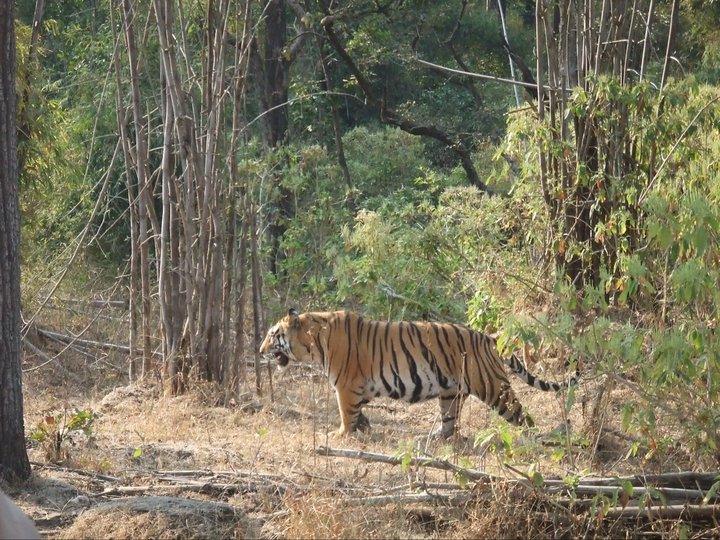
Showing posts with label project tiger. Show all posts

Wednesday, March 30, 2011

Few tigers more

The tiger estimation report 2010 by the ministry of forest and environment released recently cites an increase in tiger population by 200 + tigers. This report was released by MOEF in Bhopal recently and attended by top bureaucrats and who is who in nature conservation. It was heartening see there a lady ( Belinda Wright) who has sacrificed her whole life in favor of the endangered species and perhaps some who could speak.       

What is evident that under Hon Minister Jairam there has been new initiative taken. There is very little doubt that he is a friend of nature as whole in the country. The minister exhibits energetic and palpable  commitment to nature conservation and environment protection in India. But is he is as enamored by the economic, political and democratic urgency as anybody? Time will tell.

The report albeit does not create any euphoria in our minds ..it should not. The ground situation remains the same perhaps worsened by impetus on rabid economic growth. The animal remains endangered, still and ironically the leopard is in the worst case scenario as tiger already is. Let us give credit if the numbers have really increased in spite of the fact that there is still no credibility in the process - camera trap or whatever. But experienced field biologists should always be relied upon.

If the numbers have really increased and auger further increase than it is a heartening news. What it implies is that we have learned to govern ourselves and our Nation better. The debacle at Sariska and Panna have created doubt in our governance itself. If right in the control of highly paid and privileged administrative system a population of tiger can be wiped out..and fact to be discovered much later in a farcical manner...it is nothing but humoring ourselves in front of the whole World..what more.

For a laymen who does not understand political maneuvering, administrative lethargy, corruption and inability, it is difficult to understand the plight of the tiger and hence the whole environment. In my years of wandering in the wild I have yet to see the top brass actively engaged in the field, though there are few exceptions. But few exceptions do not make a tiger.

Sunday, March 27, 2011

Why big cats kill humans in India ?

Man eating by big cats is not a new phenomenon, somewhere down below man could have been in the food chain. But as the species (homo sapiens) evolved into a more intelligent form they removed themselves from the instinctive arena.

The personae of modern man is indeed intimidating - especially the upright posture which animals always perceive as larger. The gregarious behavior of humans living near tigers could be another reason. Or long back humans must have succeeded in proving themselves as superior beings in conflicts. Then series of senseless brutality by hunters did the rest. The destructive weapons/guns became an object of fear which passed on to the coming generations instinctively.

The tiger and leopard finds man as naturally threatening. As tertiary carnivores, tigers and leopards have limited energy and always go for larger kills that can be obtained easily. Another factor is the mass to energy spent is not always favorable, with average weight of rural malnourished women in India being 50 to sixty KG or perhaps much less. Women wander deeper into the forests in search of fire wood and minor produce.E.g. Corbett.

Throughout evolution genetic coding changes and the tiger instinct changed too. Hence somewhere along, the instinct made tigers/leopards distance themselves from humans. But instances of man eating continue, though the initial attack is in self defense out of sheer fright and surprise.  Extreme hunger due to inability to kill prey also induces tiger to kill anything that comes easily including wandering humans. 

Most of the man eating cases subsequently turn into premeditated attacks. By stealth and surprise is how the tiger hunts - so does the leopard. But the latter can be more damaging since it lives near the confines of villages.  

I do not believe that man eating is an aberrant behavior always. This can happen in case of drastic reduction in prey base, the animal than looks for alternative food. Young animals rarely turn man eaters by intent.  In old/injured animals man killing may be need based as often it is in the case of cattle lifters. The bold term I find as pressing further ignominy on the beleaguered animal since fact is the cattle are intruders.  Tigers never eat stones as it is not their food, so why would they eat humans if we do not constitute as food?

Humans and big cats often came in close proximity whence forests were widespread. Due to large forest cover the spacing mechanism kept humans and big cats apart most of the time. But this does not work anymore. The forests are scarce and you have humans intruding everywhere. Accidental killing and territorial clash (breeding females) do the rest of the damage. Due to political urgency it is the animal that suffers since no alternative is provided in time. Corbett is prime example of women being killed by tigers.the recent news of another kill in Sunderkhal in Corbett is troubling. Which tiger did they eliminate? What are they doing there?

Whenever I have encountered a tiger, I have seen its stress level rise out of fear. Though there have been sudden aggressive charge often, but the distance is maintained. This is a protective instinct that make big cats withdraw. Their genetic coding passed on from generations induces fear of  man naturally thanks to past experience - a natural protective mechanism.   

The tigers and leopards always move away from man as I have experienced except whence on some purpose. There is no such thing as greater degree of acclimatization with man. Even in remote depth of forests where tigers rarely come across man their behavior is more or less the same. By instinct they shy away from man. But I have heard many times of tigers sitting for long, blocking the roads near forests in spite of the fact they were not conditioned as in tiger reserves (?). When on work the animal ignores man completely in cases like territorial marking and on search of female. This applies to non conditioned tigers as well. Being nocturnal it is always less seen.

The problem with human society is that we have not learned to treat other life forms as equal. The best we treat them is as pariah or vermin an excuse to ravage their home land. Mining in India is the worst scourge followed by carcinogenic industries -  all a short term solution for burgeoning unskilled populace. Populace surviving on infertile soils and denuded forests.          

Amazing India will cease to stress its point the way we are destroying natural lands in pursuit of short term economic gains. Everywhere forests and other remaining habitats are being destroyed recklessly or at unseen pace. It is humans first!

Jago re India Jago re!

Tuesday, March 22, 2011

Wolf in Seoni Hills - Pench Tiger Reserve

Extremely rare due to persecution everywhere the wolf in India is still considered as vermin. The animal is a livestock killer by circumstances. The wolf in India is an open country scrub animal. It is less found in dense habitats. Most of the protected areas as tiger reserves cover only the forests, the open scrub country in the periphery is neglected. This brings the animal in direct competition/conflict with live stock, dogs and their keepers. There are many myths around the animal which create an impression of being dangerous and a bad omen.     

Indian Wolf (Canis lupus pallipes) is an extremely endangered carnivore. There are about two to three thousand wolves in the country. The animal survives in Madhya Pradesh, Gujarat, Maharastra, Rajasthan, Uttar Pradesh, Haryana and Karnataka. It is known by local name in each state. There have been cases of attack on young children the reason being loss of prey base. Most of the attack has taken place in UP and Bihar where habitat damage has been extensive. 

In MP the carnivore is rare and survives in few areas.  It is found in Pench Tiger Reserve in the periphery. Its known habitat in Kanha was Moccha where a number of resorts flourish now. I have not seen the animal there since a long time. The animal is subject to prosecution everywhere, and hence the animal migrates locally in case of disturbance.     

I have seen the animal in Pench two years back. This was the time my friends hotel in Pench was being built. The luxury accommodation was some distance away from Khawasa and we could see the pack of four on the way. They are not seen anymore but I hope they have shifted habitat and not killed.

Well known Pench in Seoni Hills is an excellent tiger habitat. It is home large diversity of flora and fauna. It is a remarkable birding destination as well. Known as Kipling Country after Rudyard Kipling who penned the World famous "Jungle Book" which portrayed the exploits of the wolf child Mowgli. Mowgli is no more and so would be the wolf pack if conservation measure are not taken immediately. 

Sunday, March 6, 2011

Will it? or Will not?

It is an animal with head under guillotine blade. And the question asked is, will it or will it not become extinct? In fact the situation is so precarious that there is no surety as to what the next population count will reveal. The animal once roamed in large numbers as the King of forests now lives as a pet cat in protected areas.  

This year I saw few tigers on birding trips in Corbett and Kanha National Parks. But there was hardly any joy or thrill the sighting generated remorse and lot of thinking.  For it is now a possibility that coming generations may not see this magnificent animal in the wild.. The burgeoning humanity and political wranglings have made the protected area insecure. 

One visit to Kanha and Corbett periphery will give you and idea of what I am trying to confer through my blog. In seventies a visit to Kanha would have been an experience sans humanity around it. There were few small tribal villages but not the urbanity you see today. Though land had been opened up there were present pockets of pristine forests which made your journey towards the park an enchanting experience. 

Tourism is good for conservation but it certainly needs a looking into. This kind of congregation should certainly be reduced around all parks. If it is urgent to relocate tribal villages from within the confines of the Buffer and core zones than it is also imperative to relocate budding establishments and private houses a respectable distance away. The latter may not happen since it is impractical keeping the costs in mind. But henceforth further construction should be stopped immediately. They new construction should be pushed back far way at least a radius of ten km from any ecosystem taking into account that open scrub constitutes an ecosystem for hyena, wolf, Nilgai and other open country animals.

Managing such large human populations is not easy but then we have usurped so much area that constitutes natural home for other life forms. And the savage ingress goes on... Can we not increase some more area wherever possible and reduce the interference of this destructive species Homo erectus? 

In cities land has been taken over by the Government in order to build wider and better road networks. A due consideration has been forwarded. Can we not find solution for villages around areas of natural heritage. Such that relocation succeeds and is permanent. But the local politics does not understand all this. Many are not capable of understanding or appreciating natural phenomenons. For most such places are more of an irritant a challenge to their management capabilities. The worst - Vote politics.

The buffer zones are no more secure from poachers and wood loggers then they were before. Although it is impossible to guard such a vast area but there should be some mechanism in place. There was lot of controversy in Kanha regarding discovery of deadly metal traps or snares within the core. Although by all means Kanha is one of the best managed parks in India. But than we thought nearly the same of Sariska and Panna - look what happened.

The beat guards and foresters are helpless whence confronted by goons or organized gangs of poachers. Some of them are in league with poachers. Many wrong doers may have political shelter or be powerful enough themselves. I keep on reading that very few people have been convicted in wildlife crimes.  Why? The crimes are rampant the media informs us.        
 

Monday, January 31, 2011

Wild Clicks

Tiger Waali - Vidisha Desai
Discover photos taken by my nieces and nephews on recent tiger tour of Kanha National Park in MP.. Images by Vidisha Desai, Parag Desai in company with Ruchi & Andy.....   This is a superb example of what amateur photographers can come up with. The images not only comply with essence of photography but are a fine example of what enthusiasm and spontaneity can fetch.

The camera is simple and so is the approach. Wild Safari creates awareness about nature and the endangered animals like the tiger. The young brigade learned about nature and to make effort to preserve and nurture it throughout the course of humanity.

SAVE THE TIGER    

Territory Markings - Clawed on Soft Bark


Bison in Grasslands
Magnificent Kanha
Kanha Sunset
Tiger Brigade

Thursday, October 28, 2010

Death of a tiger? News

Ever since the down slide of the tiger in India has become apparent the casus belli has created deep consternation. First it was the Project Tiger which elated then depressed. Then NTCA and what not. The down slide continues till today.

We keep on reading about death of a tiger or tigress here and there. The same goes for the leopard albeit more extensive. The situation is so precarious that a loss of one tiger in present circumstances is equivalent to hundred. The poaching of tigers in Panna and Sariska is a frightening spectacle since it happened right under the eye of the administration and that too in the core zones. How many poachers have been caught and how many of negligent staff punished. I would love to know!

Question: Who was responsible?
 

The poachers of course &......(sic)?

Question: Tourism (sic)?

Question: Migration?  

Where to? No forest left. 


Question: Disturbance by tourists?

Tigers have bred well in popular tiger reserves despite tourism. Nobody knows what happens in reserves not visited.

Question: Why it happened?

Since 1971 we are still learning and finding.....How to save the tiger?   The down slide continues.

Tiger deaths elsewhere ---- sans territorial fights.... Thank God! They are dying only because of  latter now He! He!   

The down slide continues. Power circle really is more concerned of its vote bank than the tiger? People first...Who owns the Earth?  

Once I had an argument with an important official in conservation regarding search and  punishment of all poachers big and small.

"Put into action law and order!" I suggested.

He just brushed my question aside as absurd. "What are we doing? He said.

But believe me I once mentioned this to FD of a park. He told me bluntly, "The area is so big what can I do?"

We did not discuss "Power Protection" "Negligence" "Political Apathy" "Corruption" "Punishment Posting".

Yes we did discuss "Dilapidated Protection Machinery" "Public Apathy" "Vermin Syndrome" "Pest Syndrome" "Fear of Animals".....  I told him how ineffective beat/forest guards are whence confronting local goons and gangs.

That time there did not appear to be any  regular night patrolling and intelligence collection. Is there now?"

"More concerted efforts sir?" I said.

He just looked at me silently.        

Our last hopes rely on parks like Kanha which have hitherto shown excellence in management. 

The fact is that most of the tiger deaths in India are due to poaching, thanks to our neighbor's eating & treating habits. Man animal conflict is a serious problem. Habitat Loss! Human apathy is one more. Encroaching construction is turning out to be a death knell, a complete shrinkage of natural ecosystem - habitat. Political apathy and management crisis at places. (Read lethargy & negligence) - Death due to negligence - electrocution of tiger in Pench a short distance from Karmajhiri RH.     

How to save the tiger?

Jago re India Jago re!

Tuesday, September 28, 2010

Micheal Vickers - Save Tiger - Jhurjhurra Tigress

He is an acclaimed wildlife photographer and  a conservationist by heart. His works have been published by reputed organizations like BBC, The Born Free Foundation, Care for the Wild International, The David Shepherd Wildlife Foundation and EIA.

Micheal is a lens man with a difference, he clicks for tiger conservation in India. Recently he has passionately appealed to conservationists, tiger lovers to keep pushing for justice for Jhurjhurra tigress and her cubs.


It is heartening to note that in our fight to save the tiger in India we are not alone. People like Micheal from all over the World are tackling this incorrigible system alongside to save the tiger from what appears to be a certain extinction.  

I have met many people from other countries besides many of us who are in for tiger conservation and contribute in whatever manner they can. Some name that are familiar to me are Face Book friends.

Amy Goldstein Cohen: Volunteers at local zoo and is up against those who confine tigers in private custody not up to order. She desires to go full steam ahead as to whatever she can do for tigers in India. She wishes to unite all nature lovers, conservationists active in tiger conservation.   

Phil Davis: Runs a charity called Tiger Awareness. He is active in tiger conservation and does a lot good for humanity  around tiger reserves. His website: http://www.tigerawareness.co.uk

Jen Dowdy: is fond of animals and is active campaigner for tiger conservation in online platforms. Passionate about wildlife and tigers she strives hard to save species from extinction. 

There are many other people who do not find mention in this short write up here. They are truly global activist who love and care for all life forms on Earth - God's creation.

Wednesday, September 8, 2010

Leopard in India:What About it!

Big Cats Too Near

It is a sad story, all the euphoria created by the Project Tiger is gone. Tiger lovers, conservationist, NGOs are having a nightmarish premonition - a mini doomsday. The leopard in India is facing the same fate, perhaps worst. All the attention is centered around the tiger and nothing wrong about it. But it is high time same status is provided to the leopard in India. 

When the Nation talks about Cheetah relocation it only suggests that our conservation is tourism oriented and perhaps leaning on jingoistic pride. There is nothing wrong with well managed tiger tourism since its benefits  are impressive. And there is nothing wrong with possessive approach towards our wild heritage ...but is this enough?   

We who boast so much of belonging to an oldest civilization on Earth. Especially with all shorts of conservation ethos ingrained in the Vedas and Hindu scriptures. Yet we are struggling to save one of the most ecologically important animal on Earth. 

In spite of all the efforts - lot many constructive - we are not succeeding in preserving tiger footsteps from vanishing. Why so? Perhaps if we delve deeper into conserving the leopard lot  more truth will surface. In fact active leopard conservation will open more innovative methods to save the tiger.

The leopard is known to exhibit immense survival extinct, but in spite, it is loosing ground fast in India. The major conflict is with the our society that is concerned about itself and presumes ownership of the Earth as a human prerogative.           

The man animal conflict as regards to the leopard is more intense than with the tiger. By natural instinct the animal avoids conflict with tigers and hence many are forced to survive in outer areas of our forests with dense human population. 

Lets be sure human settlements near forest areas live  with scant regard or even in abject fear of wild animals... more so due to myth, unseen fear and sometimes actual conflict and sufferings. That we have encroached in their land (other life forms) has become a hearsay. The perspective remains the same as it was whence the animals were declared vermin and shot ruthlessly by butchers of the past.     

I have interacted with many villagers around the periphery of tiger habitats,  most of them have no love for the tigers or leopards - expect those benefiting directly from their existence. We have to understand that they are in the same mold as lot many of us are...a snake to be conserved is fine ....as long as it is not in our garden or house. The tigers and leopards are very much in the garden of locals around the periphery of the reserves.  The threat perception exists, walk down to a village where cattle lifter is present or human tragedy has occurred and you will soon find out. Locals can act as big deterrent to poachers.

Only people benefiting from tiger's existence have interest in its survival for the rest it is their own survival that matters and nothing else. (And oops! Tiger lovers, conservationists, NGO and all like minded people are sincerely making efforts to save the species in India).

Would the direct beneficiaries have the same feel for the leopard? Not  so much since the animal is less publicized and less sought after as a  visual delight. Let us be sure people rarely understand ecosystem and food chain concept...it is sentiments that are fueling their conservation ethos. And why not? A large number of people are acting as pressure groups today than earlier. This is thanks to tiger tourism. that imparts  benefits to unemployed  - as forest guides, resort workers, Jeep owners, accommodation providers, retailers and many others. An example of value added conservation for sure.  (Ask a guide at Taj and you will know how much he values the monument.)

In recent news more than hundred fifty leopards have been poached or killed in India. 

The news article will assure you that the leopard is a neglected cousin. Perhaps if we strive hard to conserve this extremely beleaguered animal in India it may throw open new insights in big cat conservation as whole. 

In the present circumstances tiger crisis reeks of multifarious angle - human society, democratic urgency, poaching, Chinese medicine (sic), inherent corruption, conflict and self centered priorities. Our attitude is shameless as perceiving the the Earth as our prerogative... take a peek in every day life opinions, it  will confirm this.  

Where does the buck stop! Will we frame rules that says this is our and this is theirs and this is for sharing. Properly defined extensive inviolate areas are key to wildlife conservation in India. Protected areas mind you cover barely two or three percent of 32 lakh sq km that is India.

Why properly defined? Anyone who has been to Kanha in earlier times knows that some areas were habitats of Indian wolf, hyena and other open country animals. The protection status was created totally bereft of the presence of these animals - areas were humans have moved in now. The animals are scarce now by all means.

Wednesday, June 16, 2010

Panna National Park

Situated in Panna District of Madhya Pradesh in Central India this beautiful preserve has been much in the center of controversy. Contrary to claims made by the CCF of MP there were no tigers left in the reserve as declared by a committee report in June 2009. Of late tigers from Bandhavgarh and Kanha have been relocated here in order to restore tiger population. The trans location program is showing success as a tigress has given birth to two cubs. Another tigress is expected to reproduce. 

Panna National Park also tiger reserve along with Sariska highlights the state of tiger conservation in India. The 543 sq.km park lost all its tigers. No attention was paid to dwindling number of tigers as per alarm created by researchers. The authorities were busy with counter claims as usual and in the process the remaining number of tigers fell prey to the poachers with ease.  

Besides tigers (Oof) the park is home to leopards, sloth bear, chinkara, spotted deer, sambar, wild dog, jackal, caracal, wolf, four horned deer, hyena, fox, nilgai and jungle cat. There are more than two hundred bird species that can be found in the reserve along with reptiles and large number of butterflies. 

The dry deciduous forest type are unique with Kardhai forest zones, besides, teak, tendu, mahua, char, kullu, bel, harra and other species. The grasslands are extensive with tall and short grasses.    

Ken River Sanctuary is the life line of this ecosystem and is the habitat of mugger and gharial. The number of gharial is low in this pristine river. More reptiles are being released here in order to restore the ecological balance and save the endangered species. 

Though tiger sightings may not be possible any more in this tiger reserve one can see many wild animals and enjoy bird watching. There are many jungle lodges, hotels and wildlife resorts that offer accommodation outside the park. For inbound tourists package tours are available by tour operators in India. These packages are affordable and well designed.   

Next interesting destination is the Khajuraho Temples which are around 45 km from the National Park. One can easily drive down from Panna to the temples at Khajuraho for sightseeing. The temple complex town has an airport connected with New Delhi, Mumbai and other major towns in India. 

Panna is connected with Satna, Katni, Jhansi rail heads and is about seven hours drive to Bandhavgarh tiger reserve. Panna can also be reached via Jabalpur which is connected to New Delhi by rail and flight service.     

Monday, June 14, 2010

Kanha Wildlife

Though the tiger is the main attraction in Kanha the park is home to many wild animals in India. The most attractive mega fauna is of course the rare hard ground swamp deer. This sub species of deer is found only at Kanha and is surviving precariously after a remarkable come back from brink of extinction. The deer was saved in the nick of the time. 

Indian bison or Gaur is an ox race  and is doing well in the park. Around 1976 disease rinderpest and FPL either of the two wiped out a large population. Thankfully the population has recovered and herds can be seen at Kisli range in summers. There has to be strict implementation of inoculating live stock in the surroundings. 

Samabar deer the largest in the Asia survives in good numbers here and can be seen often especially in the evening hours. Sambar along with the ubiquitous spotted deer constitutes the main prey base of the tigers in the wild.     

On tiger safaris one can see barking deer, four horned deer and of late the mouse deer has been discovered in the park. The leopard is often seen with luck and so is the sloth bear. Wild dogs are seen more often in Kanha and Kisli ranges. Langurs, wild boars, rhesus macaque, jackal and peacock are widespread in the preserve and regularly seen.One can take a peak at the Indian python around the numerous water holes.

During a night safari outside the park confines one can come across many nocturnal animals - civets, hare, ratel, porcupine and perhaps hyena or wolf. Late evening hours are ideal for sighting leopards on night safaris. Park safari inside the park is not allowed hence one should drive along common roads in the periphery. Using flash light is not advisable. 

The ensuing tiger chase prevents experiencing the over all diversity of flora and fauna in the preserve. The focus of attention on tiger safaris is the tiger. This is understandable as the animal holds mesmerizing charisma and a mystic appeal among most humans. Nevertheless once you have encountered a tiger then go in for a holistic appraisal of the landscape, wildlife and bird life in order to make your visit meaningful. 

The tiger is usually sighted on jeep safari in four or five rounds but in most cases  tiger sighting would  take place in one and two rounds. Tiger show much touted as cola show lets many tourists have a close look at this nature's wonder. The sight of the tiger is the wild is amazing experience and turns many into sympathizers of our wilderness.         

For regular visitors the park offers a chance to study Kanha wildlife and birds as amateurs this is good. Awareness of our nature helps us conserve better. There are many wildlife photographers visiting the National Park especially during the hot months of summer.  Summer sunshine and animal congregation  around  water holes is ideal for wildlife and tiger photography.

Birding is exciting in the park with more than two hundred species to be seen during winters. Of late bird watching trips are being organized by tour operators of India. Kanha offers the best in Central India forest birding.

Sunday, February 28, 2010

Images from Kanha Tour

These are the images taken by the group (earlier blog) on tiger safari at Kanha Tiger Reserve. The works though amateur portrays Kanha's wilderness in an excellent manner.  
Barking Deer
Bengal tiger
Bison Fawn
Bison female
Male Bison Kanha
Hidden tiger
Indian wild dogs
Dhole at Kanha
Sambar deer female
Gaur female
Tiger at Bison Kill
Bison mating

More images to be blogged soon....

A trip to remember

It is said that a tiger brings heart and soul together. Sometimes a trip for tiger safari gels simply because  interest matches. Driven by enthusiasm me and my friends from Gujarat drove into Kanha National Park and enjoyed wild safaris like never before.

At Krishna Jungle Resort 
At Bamni Dadar Kanha National Park


It was a fun trip in serious pursuit of tigers, other wildlife and birds. In one way or another it was a learning experience. Safaris are the beginning of the end to convert people into nature conservation. What could be better than a tiger safari in heart of Kanha. We went on night safaris on the Mukki road without breaking the law  and yes no search lights. The uninitiated express wonder and surprise at the work of nature ...and there creeps in an instant urge to save this valuable heritage of ours. 

By no means uninitiated the group has been to many National Parks and wildlife sanctuaries.  It is a deep seated interest that creates awareness and  certainly in time to come some more voices to be raised in favor of our beleaguered wilderness.

We enjoyed a holistic tiger safari at Kanha and left with a stronger bonding for all things bright and beautiful - tigers, leopards, deer, birds, other wild animals and beautiful tress herbs and shrubs.     

Monday, February 22, 2010

Bandavgarh Tiger Safari

Gopal - Bapu

Gopal is a cousin, friend and fellow wild lifer. He is much more - a businessman, nature photographer and birding enthusiast. Since years of our association, he has matured into an interesting person especially when it comes to wildlife and nature.

He relishes good life and leaves no stone unturned whence it comes to enjoying nature. 

Apart from his interest in nature he is an excellent photographer ....amateur if you call him since he is not full time into it. Here are some images he and his friends captured on tiger tour to Bandhavgarh. It was difficult to sort out from the lot since all images carry heart and soul.

The images have been captured by Ila Ben S Dalal (nee Ambani), Shrujal and Gopal Desai.

Patdi Durbar

Apart from interest in tigers, he is knowledgeable about flora, fauna and bird life of the Little Rann of Kutch. He is regular visitor to Patdi Estate near Ahmedabad in Gujarat where they own a beautiful palace as erstwhile rulers of the Desert Kingdom. Patdi Durbar as the family is known are enthusiastic nature lovers and Gopal tops the list.

His experience and adventures of desert life....of things and places, fills one with envy. Besides the luxury tents, camp fire and sumptuous food he has many an experiences and wild tales to narrate. He is  a generous host and can give you the wildest adventure of the Desert Kingdom. True to his Royal Blood, he lives life King Size!  

He is a regular visitor to Kanha Tiger Reserve and Bandhavgarh and other tiger reserves in Madhya  Pradesh and elsewhere where he photographs wildlife. He has been visiting Gir National Park and other sanctuaries in Gujarat often. He has an interesting collection of photographs of wild animals and birds from the tiger reserves and National Parks.

I will blog more images with time to come.....