Showing posts with label female. Show all posts

Saturday, February 3, 2018

Intruding Male Tigers Killing Cubs

With the sad demise of Budbudi female, her cubs would have perished as well or perhaps eaten by the intruding male tiger. An impressive number of cubs are born every year, but few survive to repopulate the reserves in India.

The males that sire the cubs do not kill them but rather protect them from attacks and often meet and share meals with the family as a matter of assurance. It is the duty of not only the female but the male as well to see the cubs through the two plus years of vulnerability.   

The territorial hold of dominant males is porous and is often intruded on by transgressing rivals. This is bound to be as male tigers are peripatetic, busy patrolling their territory leaving females and cubs vulnerable to an attack by an intruding male. It is difficult to manage large territories that the dominant cats hold. They may have mated with other females in their area in order to ensure a healthy population of their species. Darwin's survival of the fittest is very much evident in tiger landscapes where the battle for space and food is intense.    

The killing of young ones is a natural phenomenon and insures the transfer of better genes. Well, this can not be often as many times the intruding male is sent packing or is unable to kill all the cubs. Death of all the cubs could mean females coming back into oestrus. This is what the intruding males seek. By killing all the cubs they are able to transfer their genes. 

The big cats are possessive mothers and go out of their way to protect young ones. Not only protection but also impart skills for survival in the wilderness. In order to remain safe they keep on shifting their territories but the shifting process may make them more vulnerable to attacks by rival males.  

Whence the tigress is able to resist takeover it could ensue into an internecine battle often resulting in the death of the female. The male is hurt too but being stronger and larger is able to fend off death. This is what happened in the case of Budbudi tigress in Kanha National Park. The male eventually consumed the female which again is not surprising.     

Tigresses do mate with more than one male to ensure fertilization as well as avoid conflict with a rival. This often happens whence the males are siblings and hence allowed to stay in the vicinity. The big cats show greater tolerance towards their siblings than towards strangers.     

Within a spate of a couple of months about ten cubs have been killed at Kanha National Park. This is a regular occurrence and those that have lost young cubs may soon give birth to another litter. These events certainly do not call for human intervention since is nature doing its bit.  

The loss of young ones is certainly sad since we are losing tigers fast due to other factors chiefly lack of habitat, electrocution, and poaching. But many times hundred percent survival rate is experienced in well-managed parks, and this is what maintains a population balance in the ecosystem.

The cubs are vulnerable for two years but take more time than that to learn and gather experience. This is essential to fend off dominant males hence they have to find uncharted territory. In case of space restriction, they have to face humans which are more dangerous than rival males.      

Tigers are prolific breeders and swiftly replenish their stock if adequate protection and space are provided.  Winters are preferred for mating albeit it goes on throughout the year as and when the opportunity arises. This is the period whence conflicts are accentuated including territorial fights among the males. 

Generally, the core undisturbed area is sought after by dominant males. The high prey base, water, and adequate shelter make the core inviolate area preferable to the buffer which is littered with settlements and farms.             


Thursday, January 18, 2018

Tiger Cannibalism - Budbudi Queen Lost

Loud roars were heard during the morning safari at Karai Ghati road. But no tiger was seen and the commotion was made out to be a kill by a tiger possibly a Dhamangaon male who frequents the area. 

Whence we heard about the incident we explored the area nearly an hour later. The jungle had fallen silent and there was no sign of any life forget the big cat. 

During the evening safari, I advised guests staying at Courtyard House Kanha where I freelance as a naturalist and host to inspect the spot. They sighted what was actually Sangam male a visitor to Karai Ghatti.  

Sangam Male
Pranav Ade & Pratik Mudholkar are wildlife enthusiasts and keen photographers who have taken some excellent photographs of the killer male. The partially eaten carcass was later dragged towards the road and it was discovered to be that of another tiger. On inspection by the forest department, it was found to be that of Budbudi female the star of Kisli Range and Queen of Kanha. 

Much is conjectured about the incident but it is assumed that the male killed her as she was not willing to mate. Or it could be that he was after her cubs? In defense of the cubs, she gave up her life. But it is not certain that she had cubs albeit a search is going on. 

Often seen at Kisli Talao and Budbudi fire line she was very popular with guides, naturalists, and regular visitors to Kanha National Park. 

Another tiger lost, a sad story but what is more saddening is the fate of the cubs? Search will reveal the true status of the female and I hope soon.        


   Image Courtesy Pranav Ade

Friday, March 31, 2017

Leopard Surprise

Pete & Kay Sutton UK 
Guests Courtyard House
Kanha National Park India 


It was in the previous evening round that we heard clamorous alarm cries at the cross road that leads to Sarhi Zone on left and Kanha Zone to the right. We had waited for a long time but nothing materialised. From the frequency of cries we could surmise that the sambar and chital deer had spotted a leopard in the thick canopy.  

Nothing emerged after waiting a long time. Disappointed we left so as to exit the park in time. Predators as shaped by nature are extremely unpredictable and can rarely be spotted at the same place twice. Well there are exceptions. 

Next day morning we were at Kisli Zone and were on mission to find Munna the ageing but dominant male tiger. Tracking tigers is an ultimate test of patience, split second decision and experience that one gets with due time and sincere application.

We were at Nainsingh Nala a wooden bridge that runs over a dried stream but does sustain water a few feet away in the neighbouring canopy. This canopy has become a vital point in our search for tigers and with great success. Two males have been spotted after a long long wait.     

So far there was no sign of Munna, and as usual we decided to score the neighbouring area. 

"Let us go to the crossroad where we had heard alarm cries last evening!" I instructed. This was just a surmise that something could wait so long.  Never give up easily and utilise all the time allotted for each and every search that you can make during the tiger safari. Jeeps arrived and departed and we waited. Our surmise was strengthened by the fact that a leopard had been sighted on this morning  round here.  

As the clamour of the jeeps ended a stony silence pervaded. The jungle sounds are incredible and challenge your hearing apparatus like no other situation can. In the mysterious wilderness of the Indian jungles sound waves from distance skim weakly over surface, and throw a challenge to your hearing apparatus. Long wait for big cats can be tiring and boring at times. I regaled my guests with the distant sounds that emanated from the jungle around us. "That's a barking deer! Probably sighted a tiger and going all bonkers!" 

Well in immediate surrounding it was all pin drop. If you as much make a rustle sound shifting in the vehicle you can lose valuable audible clues. But we sat absolutely still. It was a long wait but we did it.      

Then the cacophony erupted, a sambar called frantically, and the sound resounded amongst the still tall stands that were the object of our gaze.  As the calls continued we began to gaze between the stands, and it was rewarding. Our guide spotted what appeared to be a mongoose. "Pl hand me the binoculars." "Its a leopard!' The magic words all naturalists like to hear.  I peered hard and spotted the second cub emerging from the bush and heading into another.         

Excited but in full control we decided to park at a distance from where we thought the big cats will emerge. The strategy paid off. Thinking the jeep had left the leopard family continued to approach the jungle road. "Keep an eye behind," I told the guests. They did, and within a short span of time they called in unison "leopard!"  

Images by Pete & Kay Sutton 

Leopard Mother

Pensive Look 

Leopard Cub looking at us  

Panther Cub 

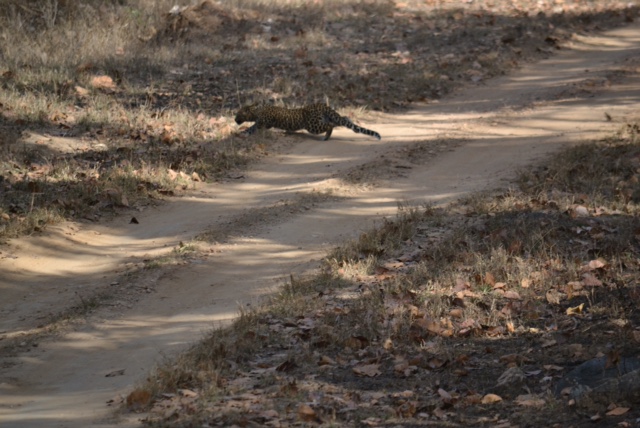
Cub Scurrying Past like a Mongoose

First to emerge was the mother. She came out, inspected the surroundings, and made sure that we were at a safe distance. She then signalled her cubs to continue following her. The first cub to arrive was probably male judging from its size. It stopped to gaze at the strange sight of the green monster.

This wild animal's threat perception is acute and ends up saving its lives amidst the tortured terrain of the dense jungles habituated by tigers. After a good look at us it began to crawl like a mongoose in order to enter the bush across the road.   

The second cub visibly smaller took no chances. It crossed over from a distance and scurried through. Cameras clicked. The wait was over. We had been rewarded with a magnificent experience that would take eternity to replicate.      

"Whew! Lets move on." And we did for another escapade in the wilds of Kanha National Park in India.