Showing posts with label cubs. Show all posts

Tuesday, March 24, 2020

Tiger Conservation: Story of Breeding Tigers and Territory Take Over

In all my years as a naturalist in India, I have realized that tigers are prolific breeders. Their life cycle is fine tuned to an extent reaching biological perfection only seen among the wild species and certainly not among humans and their livestock. 

Long time back in the forests of Kundam Range near Jabalpur in MP, I stayed awake listening to the mating cries of tiger pair from the Rest House at Kundwara. Aaaaaaaaaaoooooooooon!Aaaaaaaaaaaaooooooon!

Having seen them earlier it was a dream come true to hear this magical sound. The big cats were breeding in a badly denuded ecosystem outside a protected area.  

Working as a naturalist, I had learned to recognize some sounds emitted by the big cats few among a mind boggling repertoire. Sleep took over amidst feeling of extreme euphoria naturally!

I have not been to the forests of Kundam again and do not know the state of conservation of these big cats in an area not at all under strict protect and subject to poaching and pilferage. A visit will certainly enlighten you as regards the deprecation of forests on Central Indian Highlands.

The breeding pair would have certainly mated and given birth to young ones. Unfortunately no news percolates about the status of reserved forests outside the PA or the popular tiger reserves/National Parks.

This vast stretch of forests is home to a small prey base, few reptiles like the marsh crocodile and plenty of livestock. It does not form a perfect corridor anywhere since a large number of human settlements have creeped in since ages. Now the urbanization is taking a heavy toll and in few years perhaps only remnants would be found as evidence of once intact ecosystem.

The nightly incidence was an eyeopener how the big cats find each other for mating otherwise solitary. The other means of location is spraying of pheroharmone especially among dense populations like in some of our reserves. Sound is a greater facilitating factor among sparse populations. But these could be a giveaway to poachers.


Another meeting point among the cats separated by a large distance is search for water where they can congregate in summer. Unfortunately most of the water bodies are surrounded by human settlements and hence are completely out of reach or only accessible during the night. Hence all forests in India should comprise of an inviolate core however small out of reach of humans but this is wishful thinking. 

The big cats usually start breeding whence they become adults. Females are ready at the age of two and half years and the males whence nearing their fourth year. The males can breed easily by the time they reach their fourth year or earlier depending whence they have ousted the dominant male there. They are at their peak strength at four years and can manage to dislodge a ruling male. And this is usually a violent take over with the killing of cubs sired by the earlier male. This hence brings the cub survival rate down by fifty percent in the protected areas. 


In areas outside the PAs with few intruding males survival could be hundred percent but then we have to take into account lack of prey base, limited area and constant threats from humans as a limiting factor.  This can have a negative impact on breeding.

The worst threat for these predators in unprotected areas is due to man animal conflict whence the cattle killed by them is often poisoned. A livestock kill is also a giveaway as an evidence of presence of the big cats in the neighboring settlements. In modern times we have increased intolerance for the predators. The consternation leads to translocation or killing of the animal for example sometimes leopards are mauled by large gatherings out of fear. 

Mating is a noisy affair and rarely witnessed since the couple move into dense confines to avoid disturbance. The gestation period is of ninety days on the average.

The female during the estrous would mate with the dominant male but then she could be mating with intruders as well in order to achieve the best genes. Polygamy also insures greater safety for the progeny as other males take the cubs to be carrying their gene.

Even when the female is with growing cubs she can falsely lead the intruding male away or go in for false mating in forced circumstances where in conception does not take place.

But young cubs from a dominant male are usually killed on encounter with an intruder whence he manages to creep in. It is up to the capability of the mother to save as many as she can. Males are stronger and can overpower females on many occasions. They have been found to kill females not willing to mate or whence defending their cubs. The dead are consumed not because of being cannibals but due to the fact that in the wild no valuable protein is left to rot!

The litter size is of four cubs but two or more can also be the case but rarely. From three months onward the cubs start moving along with their mother as it is a learning phase. They have now started to eat meat and quickly learn the purpose of their existence at the top of the food chain.

Learning is in phases. They become familiar about the terrain as they move along and then the mock fighting begins eventually learning to hunt after one year as spectators. In very late stage they learn to kill a badly mauled fawn or a small wild boar etc. Following this they eventually learn to kill by the time they have to separate from their mother two year onwards.

After separation the cubs form a group as they have still not mastered the art of hunting hence kill together. They linger on in their mother's territory or adjacent forest protected by the male who has sired them. But as they become confident separation is evident.

Female make their territory with the mother's space on in nearby confines. The males move further and are constantly in process of creating their own space in areas with sparse population of their brethren. Using chemical signals they carve out a space with very little presence of a foreign intruder.

In Kanha empty spaces are filled by young males using chemical signals till they are about four years and at the peak of their strength. They rarely challenge their father and the conflict is usually with a male in the area they have been pushed into. 

Territory take over is a constant process but rarely based on impulse. An impulsive move usually leads to death at the hands of the dominant and experienced male. In order to avoid bloodshed, detrimental to healthy population, often males are seen in the same area avoiding conflict using their spacing instincts. Presence of many males in a given area assures conception perhaps with the best gene.

A new territory takeover is announced by extensive vocalization. A hold on territory is usually for four years or more but by this time sidelining of dominant aging males is evident.

An exceptional hold on territories was held by legendary Munna male who successfully moved to takeover adjoining areas whence dominated in erstwhile territory. He ruled over parts of Kanha core for perhaps sixteen years before being finally relegated to the buffer. He is now in Bhopal Zoo. He is perhaps the oldest living Bengal tiger in the wild in India.

Conflict is not deadly on the first instance but usually begins with a roaring match if that does not settle the matter a push and pull plus sparing has been observed. This will usually mark out who the boss is and if not the fight to death occurs usually by serious injuries or sometimes a straight kill.  A young male tiger was killed by a dominant upon intrusion. The fight was supposed to have raged over night and the young male was eventually killed and eaten. 

================
Uday works as a naturalist in Central India and also loves to write on tiger reserves and conservation.
He also provides SEO Services and Website Content in English. He organizes summer classes in Digital Marketing in Jabalpur his hometown.
Contact: pateluday90@hotmail.com
Mob: 09755089323


Thursday, December 20, 2018

Breeding Tigers!

Guests Colin & Lynn & Family : Angela UK
Courtyard House Kanha

Banno Cubs!
Tiger - Uday Patel 

Reaching the spot where we missed seeing two tiger cubs a day before was again a disappointment. But I had decided to keep the spot under the scanner. So as always happens we began exploring the nearby area for the tiger frequents. The male tiger was nowhere and we moved back again there was no sign of the cubs....disappointment. Have they moved away as predators always do...   

Tracking tigers is a game of patience and logical thinking, and it tests your skills using the sensory apparatus. We were waiting at the nearest crossroad since all the jeeps had exhausted their search for the cubs at that spot and there was no hope. The waiting made me think. Yesterday whence we had missed the cubs there was no sign of the mother. Today also she was untraceable...that meant she was probably out hunting as six months old tigers could have a voracious appetite. So I began speaking to the guide explaining to him that since the mother was not around for two days the cubs would probably be there hidden in the bushes at the same spot.  A questioning look on his countenance made me speak further. 

"The cubs would not move without their mother or until unless she calls them," I said.

This was unlikely to have happened. So I decided to station our jeep near the spot and not at the crossroad planning for a search elsewhere. As we were reversing...on the rock sitting silently was a tiger cub staring curiously right at me the jeeps having gone it felt reassured to savor the warmth of the rock heated by the emerging sun. It had rained the previous night and hovering clouds made the matter worse. 

"Back," I shouted." 

The cub kept on looking at us curiously and a bit surprised. He changed his stance and angle to have a good look at us. Oh! "Mother never told of this weird animal!"  

My guests could photograph it well before the arrival of the second jeep pushed it back into the rocky bush never to emerge.        

This tigress had two cubs aged six months. Banno is one of the shyest animals in the park, and I have been spotting her paw prints for the last two years but could never see her.   

Breeding Tigers 


Kanha National Park has provided an excellent breeding ground for the big cats...but in my years of searching for tigers, I have always found the cubs within the periphery of the core zone. A core zone in the protected area of the tiger reserve is devoid of human settlements, agrarian activities, and trespass. 

In this area, only the staff are allowed to reside while tourists maneuver in twenty percent of the area and exit whence the time is over. This means there is little disturbance to breeding tigers from the activities of people. Surprisingly they have immense tolerance for jeeps...probably they consider it as another animal, and in time to come after frequent encounters...harmless.     

While rearing cubs the mother has to move the family frequently albeit in the territory controlled by the male whom she has mated with. Though her territory is usually small there is ample space for moving cubs from time to time to keep them safe. 

Tigress With Cub Courtesy Navneet Maheshwari


In the core zone the prey base is very high and within reach. The growing cubs have to be fed frequently and the mother has to eat too frequently too. A low prey base would definitely affect the breeding.  In fact, tigers breed corresponding to the available prey base. 

Discounting internal mortality between the specie due to conflicts, predation of cubs, and breeding prerogative amongst the strongest, the survival rate is very high and at times it can be a hundred percent. This has been seen in the tourism area since the rest of the core is out of bounds for the public.   

Buffer Zone 

All this is not possible within the buffer zone of a protected area as human settlements, agriculture and commercial activities abound. Though tigers live here too, but they are there because of territorial implications. Breeding if any is surely limited.      

Big males frequent the area as some of them prefer livestock that offers more meat per kill. Females frequent areas adjoining the core but their presence is very weak as I have noted. Creating a buffer zone for tourism is a good step as it will accord additional area for the big cat movement in time to come. Unfortunately, livestock still plunders the buffer tourism areas and there is a distinct shortage of water. For the fear of poisoning by habitual poachers water holes or saucers are not created. Hence the prey base is extremely thin because of the dry terrain, water shortage, livestock grazing, and frequent human movement on foot and vehicles. 

Ironically in order to sustain tourism in the buffer zone they will have to be turned practically like the core zone. Only then the big cats will move and breed in the buffer favoring tourism as well. Till then the core will sustain breeding populations, but the extra space required for the increasing population in the protected areas is a dim possibility with the buffer being just a namesake. 

Friday, March 31, 2017

Leopard Surprise

Pete & Kay Sutton UK 
Guests Courtyard House
Kanha National Park India 


It was in the previous evening round that we heard clamorous alarm cries at the cross road that leads to Sarhi Zone on left and Kanha Zone to the right. We had waited for a long time but nothing materialised. From the frequency of cries we could surmise that the sambar and chital deer had spotted a leopard in the thick canopy.  

Nothing emerged after waiting a long time. Disappointed we left so as to exit the park in time. Predators as shaped by nature are extremely unpredictable and can rarely be spotted at the same place twice. Well there are exceptions. 

Next day morning we were at Kisli Zone and were on mission to find Munna the ageing but dominant male tiger. Tracking tigers is an ultimate test of patience, split second decision and experience that one gets with due time and sincere application.

We were at Nainsingh Nala a wooden bridge that runs over a dried stream but does sustain water a few feet away in the neighbouring canopy. This canopy has become a vital point in our search for tigers and with great success. Two males have been spotted after a long long wait.     

So far there was no sign of Munna, and as usual we decided to score the neighbouring area. 

"Let us go to the crossroad where we had heard alarm cries last evening!" I instructed. This was just a surmise that something could wait so long.  Never give up easily and utilise all the time allotted for each and every search that you can make during the tiger safari. Jeeps arrived and departed and we waited. Our surmise was strengthened by the fact that a leopard had been sighted on this morning  round here.  

As the clamour of the jeeps ended a stony silence pervaded. The jungle sounds are incredible and challenge your hearing apparatus like no other situation can. In the mysterious wilderness of the Indian jungles sound waves from distance skim weakly over surface, and throw a challenge to your hearing apparatus. Long wait for big cats can be tiring and boring at times. I regaled my guests with the distant sounds that emanated from the jungle around us. "That's a barking deer! Probably sighted a tiger and going all bonkers!" 

Well in immediate surrounding it was all pin drop. If you as much make a rustle sound shifting in the vehicle you can lose valuable audible clues. But we sat absolutely still. It was a long wait but we did it.      

Then the cacophony erupted, a sambar called frantically, and the sound resounded amongst the still tall stands that were the object of our gaze.  As the calls continued we began to gaze between the stands, and it was rewarding. Our guide spotted what appeared to be a mongoose. "Pl hand me the binoculars." "Its a leopard!' The magic words all naturalists like to hear.  I peered hard and spotted the second cub emerging from the bush and heading into another.         

Excited but in full control we decided to park at a distance from where we thought the big cats will emerge. The strategy paid off. Thinking the jeep had left the leopard family continued to approach the jungle road. "Keep an eye behind," I told the guests. They did, and within a short span of time they called in unison "leopard!"  

Images by Pete & Kay Sutton 

Leopard Mother

Pensive Look 

Leopard Cub looking at us  

Panther Cub 

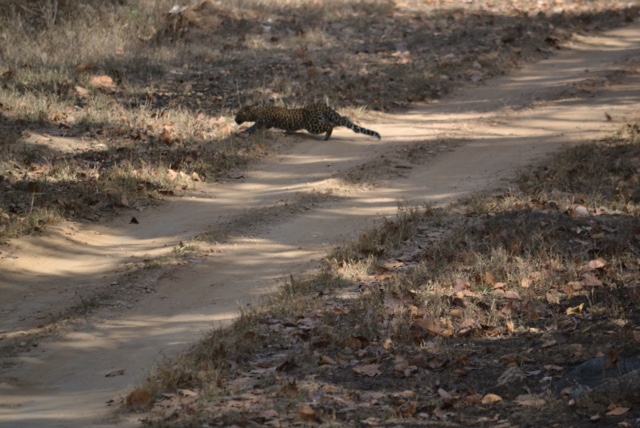
Cub Scurrying Past like a Mongoose

First to emerge was the mother. She came out, inspected the surroundings, and made sure that we were at a safe distance. She then signalled her cubs to continue following her. The first cub to arrive was probably male judging from its size. It stopped to gaze at the strange sight of the green monster.

This wild animal's threat perception is acute and ends up saving its lives amidst the tortured terrain of the dense jungles habituated by tigers. After a good look at us it began to crawl like a mongoose in order to enter the bush across the road.   

The second cub visibly smaller took no chances. It crossed over from a distance and scurried through. Cameras clicked. The wait was over. We had been rewarded with a magnificent experience that would take eternity to replicate.      

"Whew! Lets move on." And we did for another escapade in the wilds of Kanha National Park in India.

Monday, May 23, 2016

Mother Tiger Epitome of Womenhood

Ruth & Clive Williams UK  
Photographer Guests: Courtyard House Kanha


We had searched the tigress and her cubs thoroughly for many days but with partial success. My earlier guest was not interested in a glimpse at all. Well that is what we could get. The family was often seen near waterholes in depth of Kanha forest but would be conspicuous by its absence in between.      

Anyway we could not get a proper sight during our last tiger safaris.

Tigresses are possessive and protective mothers and keep shifting from one place to another. This is done to teach cubs to survive in the vast ecosystem and get familiar with things around. Other reasons for regular shifts are to avoid male tigers who have not sired the cubs, avoid other predators, and yes the prey as well. The latter is a practice among the hunters to deceive prey such that they are unaware of  the predator's presence.    

In our recent tiger safari we stationed ourselves near a bridge over a rugged nullah which was favored for its ample water during the blistering summer. For some time there was no big cat in sight nor any alarm cries. My heart thumps with disappointment when the jungle is silent. 

We were thinking of our next move whence the jarring call of deer stilled us into silence.

"Alarm cry." I blurted, out well it was obvious the sound was loud and clear. The call was from deep inside, a bit away from the stream. Then silence again. We scored the neighborhood for signs of the tiger but none. After a long wait the calls erupted again this time further back.

"Where to?" I asked the guide. That was enough for him. We drove to a grove beside a Banyan Tree. There we waited till we heard the mother calling her cubs. A strange call more like the langur. We drove ahead for a surprise that lay ahead. And what a surprise. "Tiger!"         

At a distance from us the tigress, three cubs were resting on the jungle road. With his long lens Clive began to work till the big cats eventuality vanished into the woods. They then emerged well ahead in the grassland challenging our eyesight by their camouflage. The the big cats continued, perhaps on the hunt as we left for the exit.        

After a couple of days we visited the area again. Thinking that the family has moved to another area we were not going to wait for long. But the ways of the jungle are strange they had come back as the pug marks indicated some distance ahead. As we drove further we came across the mother's spoor. "They are still near somewhere here." I whispered to the guide.  

"Lets check the Banyan tree and the surroundings." The guide instructed. We did but there was only stillness that greeted us. "Back!" I said.

The roars were anxiety filled as we saw the tigress scampering madly, constantly calling loudly. "She is looking for the cubs/cub," I spoke. I could observe the desperation on the mother's face as she came onto the road and then began moving towards the Eco-tone.     

I was moved beyond words, the missing cubs/cub create loads of anxiety for the mother. She then headed towards the bridge on the nullah roaring continuously.  

Out of nowhere emerged the cub. He ran frantically towards the mother. There were howls of greeting and the writ of relief ran large on their countenance. Together they moved towards the favored spot and vanished.

"The other cubs are already at the spot near the stream." I said."Well lets wait."

A number of jeeps had arrived to witness the solemn moment. And it did happen. The tigress and cubs emerged and proceeded towards a large puddle and began to quench their thirst.

For my guests photographers this was an absolute bonanza. They were witnessing and capturing the moment with gusto.                  

Work done we moved on memory of the spectacle etched etched forever.

The images are awaited. 

Thursday, March 31, 2016

Debacle at Pench - Poaching of Tigers

The poaching of Bagin Nala Tigress and her cubs reminds me of my first visit to the park at River Pench. 

In that bright sunny day I could feel that I was in a tiger heaven just as Kipling had penned in his famous Jungle Book. I could imagine Mowgli along with the wolf pack waving at me from behind the dense canopy that lined attentively all along the road to Karmajhiri.  

The forest ranger had given me a lift generously from Khawasa but was in no mood to elaborate what lay all along us. In his deep husky drawl he informed me, "animals here are larger." And then there was silence as we moved on to the final destination the forest rest house.    

Those enamored by negative fall out of tourism..there were no hotels then as tourism was in infancy.  Few people from Nagpur made day visits for excursions.  

Seoni Hills and surrounding forests of Chindwara were once abode of the tigers and teemed with wildlife. Most of the forests have been denuded in the last few decades, but the ecosystem is still intact in the Pench Tiger Reserve that engulfs Madhya Pradesh and Maharashtra border region on the Jabalpur Nagpur highway.  

The tiger was in the precarious state whence I arrived at Pench. Along with the tiger, other animals were being electrocuted using the 11 KVA line that passed through. The villagers had access through the park, possibly translocation had still not taken place?

The charred remains of the tiger unnerved me no end, the seat of the administration at that time was Karmajhiri barely two kilometers away. Other animals besides a poacher were charred to death using this hideous method.

The countenance of those responsible for protection of  wilderness was, at best could be described as shocking. There were more explanation for the events than action...
Tigress Pench

Tigress with cubs at Pench
and as we see in India all things gradually fizzle out. It did.

The shocking incidence at Pench is suggestive of prevailing presence of  the poaching fraternity, and nothing has been done regarding this. The wildlife is still in danger thanks to ineffective mechanisms and lack of will to foresee what threats are emerging. Is there a proactive strategy in place?   

The animals are surviving somehow, but a noose hangs around them all the time. After engaging abundant resource we could not prevent the murder of the most popular tigress. The fate of  many a big cats hangs in balance...entirely at the mercy of humans. 

Photo Credit: Dharmagiri

Tuesday, December 22, 2015

Tiger Family on Wildlife Safari

Guests: Tirjmen & Miranda - Netherland 


Munna Tiger the beloved was our target for that eventful evening. I was bit apprehensive about his appearance as in this season water is well spread and so is the prey. Munna supervises and marks his whole territory in order to remain as the dominant male. Winters is also abuzz with mating big cats hence busy time for them. 

Nevertheless we took a chance. Me and my Dutch guests.  

"Digdola" I said as the driver turned into the act. Air was high with expectancy and we were fully alert. This hillside is part of Kisli Zone at Kanha National Park and home to very many tigers big and small. The picturesque range is preferred zone of those on tiger safari. The approach road is from Khatia Gate, it eventually connects with the road to Kanha Zone. The wildlife park has three main entrances other two are Sarhi and Mukki.

The unique feature of this terrain is presence of many water bodies, dense Sal, mixed forests, bamboo and grasslands. Most of the water bodies are on the right of the approach road while one large body is situated at the end of Digdola Hill with extensive meadows.

Kanha contains many table top mountains with plateaus having unique vegetation. The meandering rivulets are striking especially Sulkum at Sarhi Zone.  Termed as nalas in Hindi these are spots where tigers get localized during summers since water becomes a precious commodity in the scorching heat. 

As we proceeded towards the Sambar Nala we came across some jeeps waiting in expectation. Fortified by alarm cries we could make out the presence of a predator. 

"Tiger," the guide in jeep ahead of us whispered. We looked towards right only to see the dense bush. We moved back some distance and tried to have a better look. Meanwhile the jeeps heading for Kanha Zone also began arriving.    

"I can see the tiger" Miranda whispered and so could Tirjmen. Relieved, I told the driver to move forward some distance away from other jeeps. "We will wait," I said.    

There was a momentary cluster of jeeps but they soon departed after having a look at the big cat. Those with Kanha permit had to go and many in our zone did not wait, much satisfied after having seen the tiger in the bush. We could see the tiger from one point while others did from other."Two tigers," whispered the driver.   

The logjam soon cleared and only one jeep with a bunch of young photo enthusiasts waited along with us. 'We will wait right here at a good distance from the tiger," I said loud enough for the occupants in the other jeep to hear so they would follow suit. I put my hand on the driver's shoulder...stay put. My intention was not to hoard around the animal and push it out of sight. 

We waited with baited breathe in the deafening silence. Then there was a scuffle and growls. Mating? I was bubbling with excitement at the very thought.  The animals could go either way...slip down the hill or cross the jungle road. The guide informed us that there was water down the hill. "Good," I whispered if they have satiated their thirst they will either hang around or cross the road. 

We waited. 

Then. 

"Look there!" the lady pointed towards the bush. A large head emerged and in walked a male in order to cross the road. "Kankata," I hissed. This is a big male who commands territory next to that of Munna and sometimes dares to overlap.  "King of The Jungle" master of all he surveys...If this cliche let it be.     

I have learned one amazing fact that males rarely intercede into each other's domain. They get the message from scent marking on trees and other vegetation. On instance whence one male decides to take over anther's territory the scuffle begins with loud thundering roars and eye contact...glaring. If that does not settle the issue then a frenzied bout follows with minor injuries.  

If that is not enough the scuffle turns into a real fight. In case the domination is established the loser runs away else there takes place grievous injuries often resulting in death. This happens less since the domination is quiet often settled in less violent manner. This is nature's way of mitigating specie loss while deciding upon the strongest gene.    

Kankata with a dent in the ear emerged from the bush and stood on the road. The dominant males though aware of humans are rarely affected whilst on their task. The male then crossed over the road and began to drop foul smelling scat on the edge. Totally oblivious of us he cleared the neighborhood of the scat and entered the forest to lie down. 

We stayed at a safe distance...more was expected. 

"What next!,"I hissed. Ha!Ha!   

The next was emergence of an aggressive female grimacing fearfully at us, and quickly crossing over to enter the forest behind the male. The aggression among this species is often due to fear and uncertainty and whence in the company of female with cubs. Else they are extremely distrustful and frightened of humans...well who isn't?     

"So that's it," I said."The story ends here. I am sure you clicked some amazing shots." I said to my guests brimming with happiness. Earlier trips to Corbett and Ranthambhore were devoid of tiger sightings for them.

"There is another," the guide exclaimed. Well there was more in the store for us on that amazing evening. 

When in the dense jungle, swarming with predators around you, the nerves are taut with excitement and  the heart beats with fear...you can make out on the countenance of those not well versed with jungle life. 

I was expecting a courting ritual but this put that to rest. Are there two males seeking the female? Well all sorts of bizarre strike your brain as consternation develops.     

We peered into the bush at the far end and sure we could make out movement. 

Whence the tigers move there is no sound thanks to the thick padding on the feet...not even a crackle of dried leaves. The animal moves on the digits. Impression of upper pad/sole and digits is visible on ground and we describe them as pug marks. The fifth toe is way up...this is evolution and adaptation in a given habitat where speed and stealth is the order of the day. But sometimes you  can see turbulence in the grass and the vegetation, and thin sound emerges whence the body brushes against the twigs and leaves.    

For tracking tigers in the wild, a highly sensitive and trained sensory apparatus is required apart from experience. The animal belies simplicity in all terms and far out wits humans and its prey. Regularity in movement to some degree is seen near water holes in summers.     

Well patience pays and out came a young cub obviously a male. Family!. In the far out wilderness surprise belies belief. This is what was happening to us. Utter disbelief on my countenance I could see in the rear view mirror. 

The cub walked out nervously but steadily since we were at a good distance. Beauty is grace all entwined in natures magic. Pure Magic. The cub carried an expression of innocence much like our children do. It was perhaps seeing a new creature in a bewildering contraption that was not part of the ecosystem and his food chain. Fear engulfs logic and rather then waste time pondering over us he slithered into the dense canopy besides his parents.          

And Then. 

"Withhold your breathe," I said to the crowd... well on two jeeps. "There is another."

A young tiger of dimension little less the cub we saw emerged from the bush. Upon seeing the disproportionate size I could quickly infer that this one was a female. The cubs were about six to seven months old judging from the size. Fear and consternation was visible on her face.      

The young cub walked out but was still bit distant from the road. But it could not gather courage and went back into hiding. "This is a female and hence very cautious as per their basic nature. The cub though at good distance from us decided to go further ahead to cross over.     

There was a chatter of excitement as more jeeps arrived. They could see the female in the halo created by intertwining twigs and leaves. We could see both the tigress and male who was lazing upturned on the bed of grass. The tigress though on full alert was nevertheless at ease assured that her cubs were safe and at a distance from us.     

Stop Press. 

An Encounter With Tiger Family

The fearful tribe of killers, murderers in cold blood and perpetual enemies of humans (sic). The headlines said in the news papers.  Well nearly.

Such associations of majestic beast are encountered on notably very few occasions. This was a moment of discovery of natural history at work.  

You feel great and bloated over an encounter like this and even while describing. Why Not? 


Male Tiger

Tigress
Photo Credit Tirjmen & Miranda - Netherland 

Monday, February 3, 2014

Tiger Photos at Pench

Tigress and Cubs following at Pench National Park in MP.

Photograph by Ramesh Rana..who lives in Seoni

Wednesday, January 2, 2013

A beautiful tigress and her cubs


It was an eventful tiger safari with my guests Dianne and Christopher from Australia. Avid birders they wished to see the tiger as well. 

The first safari on X'Mas in the Kanha Zone at the evening was uneventful. I could see disappointment as it usually comes about. The next day was Wednesday and there were no safaris hence we went birding. The guests were very happy with the outcome in the buffer Zone of Kanha National Park

Thursday fetched some luck as we saw a tigress as she was being flushed out by the trained elephants. Birding at Kanha is exciting and we could come across many interesting species. The last safari on the 28th December was  most exciting, we were cruising along in the bitter cold that morning without much to see. Eventually at one of the water bodies we met a jeep who had seen a tiger cub before we arrived. 

We waited for the tigress and cubs to surface but without luck. We decided to drive ahead to the spot were we had seen the tigress and her cubs. There were ten jeeps waiting there to the family since rampant calls were being heard.     

I told my guests that we will see the tiger and asked the driver to drive back to the water body. This is were the strayed cub was and the mother would certainly fetch him back. As luck would have it we came across the tigress running at full speed in our direction. Fear took over, I knew if the female took us for the cause of disturbance then she would surely charge. Luckily with one graceful leap she dashed into the bush. She was gone perhaps with the strayed cub following her in the dense canopy.   

We heaved a sigh of relief and turned back stunned by the amazing spectacle. The cubs and the female were not seen again but gave me an excuse to boast my experience. At the hotel in Kanha the guests said. "You can keep boasting. You are excused". So I went on to narrate more such events in my jungle adventures. 

Tracking tigers is a tough job and things do not work out well all the time. Tiger chase is like looking for a needle in a hay stack. Sometimes the events arise favorable and they are lifetime moments. This is what my experience has been at Kanha and other National Parks in India.   

Friday, November 25, 2011

Bandhavgarh: Breeding tigers

The last nights telltale event was clearly etched on the soft jungle road. The sordid saga of survival in the tortured terrain of Bandhavgarh National Park. We followed the drag marks for a long distance till they crossed over into the dense forest.  

The predator had killed a chital doe and dragged it to the spot where her cubs were located. The struggle was evident, the drag marks formed a narrow strip of depression on the road turning and twisting in a bizarre fashion. The tigress had put it all in to take the dead prey all the way along to her cubs. 

Ignoring the bitter cold of early morning we waited at a spot at Churbohera Road in expectation. The kill was probably consumed and she was likely to emerge near the rivulet or her favorite perch next to it. After some time we decided to check the large slab of igneous rock which was her favored retiring place.     

We could see nothing till two cubs decided to play. The mother had carefully placed herself behind a clump of bamboo and the cubs stayed alongside her as she lay asleep. We could see the three little tigers about 3/4 months old but it was not possible to photograph them. Kankati had at last brought her cubs out of hiding, The challenging race for survival in the wilds had begun for the cubs, the tigress will mentor and tutor them for two years before making them independent.  This is necessary since this predator is a solitary animal and does not live in pair or a pride.

It was heartening to see the cubs as they loitered around close to their mother. I had seen small cubs before but after a gap of ten years perhaps. The spectacle is a memorable event, the cubs threw a cautious inquisitive glance at us and quickly retracted behind the bamboo. The hide and seek game went along for some time before they vanished out of sight alongside their mother. They where probably seeing humans and their bizarre contraption for first time since birth.

We were on tiger safari at Bandhavgarh National Park - me and my French group.  We saw more than the tigers - birds and mammals - a successful nature photography tour. Bandhavgarh is a prime tiger habitat in Central India with high rate of success in breeding. I could find evidence of about sixteen cubs in the park during my visit from 20th November to 23rd November. A new generation of tigers was emerging in this nature preserve auguring hope for the survival of its race. Sound policies, effective protection and positive conservation may fetch this species from jaws of extinction in the country.   

There was a mother with four cubs at Tala Zone on a kill. We could hear the squealing and mock fights but failed to see them. A just delivered litter of four was discovered in Magdhi Range besides sighting of tigress with three cubs probably 6/7 month old. Three cubs were seen on Mahaman Road by the guards. 

There may be more breeding tigresses in this little paradise. This augurs hope for the tiger's survival in India - thanks to good conservation measures. The topography of this park provides excellent security and privacy to the tigers besides a good pray base. Most of the hillocks in the preserve are inaccessible and provide safe breeding grounds for the pregnant females. Unfortunately there is disturbance in the buffer and the periphery of the core due to number of villages and livestock.     

Inbreeding threat exists in all the tiger reserves of Madhya Pradesh since they are no more interconnected with each other. A viable corridor is a must for gene transfer, this relates to all reserves in India.    

Saturday, October 8, 2011

It is Now or Never

Tigress & Cub Mr. Navneet Maheshwari
Chimta Camp Kanha National Park MP India

This tigress with cub was captured in camera by Mr. Navneet Maheshwari the owner of Kanha Village Eco Resort. The property is luxurious, built using guide lines of responsible tourism. The lens man is committed to nature conservation, and is an acclaimed wildlife photographer.     

The subject matter though elates is also a grim reminder of the fate of this extremely majestic animal that sits at the top of the food chain and is an indicator species. The terminology denotes a vital element, and does indicate the impact of constructive or destructive activities in an ecosystem. The tiger's absence from tropical forests in India is suggestive of a badly fragment ecosystem with no beneficial effect on our environment.  No rivers, no food, no water ...mother Earth without a womb. 

We have to come to understand the correlation between natural lands their vital elements and myriad life forms that play major roles to preserve our environment. This complex web of linked elements as whole are crucial to our environmental stability. When we understand this, the tiger's role on Earth becomes evident. 

Nature conservation is not an elite prerogative as many people believe, nor is love for mega fauna a fad. Nature conservation is a serious dedicated effort in order to leave a beautiful healthy and stable environment for our generations to come. Unfortunately short term goals and pecuniary greed negates all positive steps and  sacrifices humanity  has to make in order preserve whatever is left. Making amends for the continuous destruction the human society is causing today, seems an impossibility almost chimerical. But we can preserve the fragments of natural lands which are still alive, which means saving this apex creature.      

The image of mother and cub accords human touch and sensitivity. The tigress rears her cubs just as humans do with kindness and caring love. The growth is signified with intuitive development augured by the  dedicated instinctive learning process at the behest of the mother. By examples and trials. Yes just like we do for our children to survive in this rat race. The natural world is more disciplined with very little instance of aberration, yet survival instincts are ingrained and impregnated for the cubs to survive in a terrain full of natural enemies.  The limiting factors that justify the survival of the fittest.     

Will the posterity capture such images there is a big question? Only the voice for voiceless will help those beleaguered but with the right to own the Earth as much as we do.  Live and Let Live.   


Friday, August 15, 2008

Tragedy at Kanha

The most gentlemanly creature on Earth is tiger. This fact is well enumerated in wildlife journals and story books. But yet man fears this creature the most due to myths and mystical beliefs.

The tiger is an enigma and mystery and many describe the animal as most fearsome creature with spiritual powers that can wreck havoc on its enemy - man.

But in my years of scouring tiger forests, I have never come across an incidence of wanton killing by this magnificent beast. The explanation is forthright...tiger kills only for food. This sentence on tiger facts should sum it all for logical beings who understand the meanings of written and spoken words well.

The incidence took place this year when a "chara cutter" (grass cutter) had gone into the forest in early morning hours to fetch the elephants that track tigers and carryover tourists to the spot where the tiger has been located by mahouts or elephant riders.

It was the wee hour of the morning with visibility near zero. The chara cutter had moved into the forest right up to the Kanha Meadow...laboriously following the elephant spoor. Whence he reached the meadow he realized that the elephant he was looking for was deeper inside.

Kanha meadow is the prime tiger country and is at present a grassland habitat for a tigress with cubs. Death was lurking in the darkness for the poor man. He had no idea that he was close to the tigress with cubs. Tigresses are over zealously protective mothers and charge at anyone who dares come threateningly close to the cubs.

The defense mechanism of tigers is simple...run away or move quietly from all dangers, and in other circumstance offense becomes the best defense. The latter was the case of the chara cutter of whose intentions the tigress was unsure. In order to defend herself and the cubs near by see charged. The chara cutter could see the tigress moving aggressively towards him. His last word over the wireless communication set was a desperate call for help.

It was all over in seconds and the mahouts who landed up on the spot later found him lying in pool of blood - dead. Death is instantaneous in a tiger attack as the canines target the neck region in order to rupture the blood vessels and the vertebrae is crushed completely on impact.

Had the tigress been alone she would have quietly moved out of the picture, but with the cubs around it was not possible, hence she charged at the two legged creature. In local folklore it is said that the tiger marks its prey much in advance by sound, but I have on many instances seen tiger surprised by other animals and man. This is because of preoccupation at times. She may have come to know of the man's presence but had no idea that he would come so close. She must have missed his approach as her attention was riveted on the cubs.

Had she enough time to move the cubs into a hiding, I am sure a life would have been saved.

I saw the tigress on many wildlife safaris later, carrying over her tiger business of finding prey or just relaxing after a successful hunt. There was no aggression or blood thirst on her countenance.

"It was pure self defense man," she seemed to inform me apologetically.

The false beliefs about tiger cruelty and about the magical healing powers of its bones has put the graceful and beautiful animal unto sad plight.

God Save The Tiger!

Monday, June 9, 2008

Tiger Cubs

This year has been good for Ranthambhore tiger reserve in Rajasthan and Pench tiger reserve (Seoni Hills)in Madhya Pradesh. Tigers are prolific breeders but the extent to which their population has been decimated in last hundred years that this fecundity is hardly noticeable.

The reckless poaching has resulted in extermination of population all over India and has even resulted into skewed sex ratio at places. Combined with stress of human interference and continued threat of live stock and prey base depletion tigers survived in reserves and bred well. There was a marked rise in population of tigers in some National Parks. But when places which are disturbed and suspected of being under attack by the poachers - as Ranthambhore - report fourteen tiger cubs being born in the park, it is indeed heartening news. This also shows that the sex ratio among male and female tigers there is in balance and mating is taking place regularly.

Similarly at Pench nine tiger cubs where born recently. Pench is an upcoming tiger reserve in terms of sighting and successful breeding of tigers has resulted in good tiger sighting in the wild in recent times.

Another benefit of larger number of tiger reserves reporting good tiger sighting is that the tourism pressure will spread even and let off some air from Kanha and Bandhavgarh. The lodges and resorts at Pench and Ranthambhore tiger reserve will also see greater number of visitors if this trend continues.