Sunday, May 28, 2017

Diamond Mining: Lure of the Lucre & Tigers

Eventually, after much hullabaloo, the diamond project in the Bunder Region of Madhya Pradesh was shelved by Rio Tinto. Citing financial reasons the concern handed over the project to the Government of Madhya Pradesh along with all the assets.   

Obviously, the Bunder Region was not good enough take for the company despite which they got the approval to go ahead. The project was mired in controversy right from its inception as the land contained a biodiversity-rich profile. Situated near Panna Tiger Reserve and Nauradehi Wildlife Sanctuary, the area is a link between the local ecosystems and constitutes a vital tiger corridor. The diverse floral habitats are home to leopards, sloth bears, chinkara, and other mammals, birds, and reptiles. 

Tiger experts unanimously agree upon the status as it falls under the tiger landscape. Under the stalled project more than five lakh trees were to be felled spelling an environmental disaster. Under severe opposition and administrative hiccups, the project viability was deemed poor. Eventually wiser council prevailed.    

The project envisaged the reaping of the rich harvest of roughs up to the extent of 27.00 million carats of rough. The open cast mining was discouraged and the company was advised to employ alternative means to dig for diamonds.  

But the disaster still seems to be in waiting since other investors are being sought by the concerned bodies. It seems the major discouragement is the environmental bye-laws in India. Nevertheless, projects which are ecological disasters should in the first place never be envisaged. By the time the mining would reach the end cycle we would have lost a substantial forest region forever.    

Central Indian States MP and Chhattisgarh are rich in mineral wealth including diamonds. Encouragement is being accorded to major global players to explore extensively and mine the invaluable ores.   

But the lure of the lucre would fetch in the loosening of laws in order to enable global players to mine with ease. India has an impressive diamond polishing industry but most of the roughs are obtained from Belgium. Finding substantial deposits for large projects is enticing for Governments aiming to become of the major diamond-producing regions in the World.       

Hence the sword of Damocles hangs over our valuable resources some of which are situated in the finest wildlife habitats.  

Saturday, May 27, 2017

Tiger Conservation: Tiger Corridors in Muddle

Though a lot has been done for the survival of the tiger, it is still not enough. The growing population of tigers in some protected areas is throwing new challenges to wildlife managers. The population of this big cat is nowhere from the brink of extinction.  

Tigers need more space if their populations have to increase. But most of the space is taken over by human settlements including those in the buffer regions, and in vital corridors adjoining protected areas. Most of the corridors in India are mired in conflicts especially those that are hindrances to massive road projects aka development.

As per law, no development activity is allowed within 10 km of the mandatory buffer.    

The Pench - Kanha corridor was mired in such conflict between the Green Tribunal and the Nagpur Bench of Mumbai High Court. The Court was in favor of the expansion of the highway that transacts through this crucial corridor meant for the migration of tigers and other animals.

Tigers migrate a long distance if the prevailing conditions do not favor them in their place of residence. This is applicable to other animals as well. The migration provides additional shelter to animals and enables gene transfer which is vital activity since it prevents inbreeding which could be fatal to come generations of the big cats.

Pench - Kanha corridor is one of the few unfragmented patches of forests which has made interbreeding possible between big cats of both the tiger reserves. Widening NH7 was proposed in spite of that it would result in substantial damage to the forests as result of axing of trees. As a mitigating


solution elevation of the highway had been proposed, but that still involved the axing of a large number of trees.

Well, to cut it short development has won what with MOEF easing clearances for developmental projects that transact through niche habitats. A number of corridors vital for the survival of tigers are facing some other kind of dilemma in India.  These connecting forests are home to a wide variety of flora and fauna including endangered species.

The muddle is formed between Green Tribunal, Courts, NHAI, WII, and MOEF. The tug of war continues over large swathes of forests that could be vital for saving the beleaguered animals that constitute the wildlife of India.

Though those in favor of saving wildlife have proposed mitigation measures albeit at a substantial increase in the cost of the projects. But this is the correct approach even if there is an increase in the cost since the eventual aim is to save endangered animals from extinction and thus protect our environment and inheritance.

Conservation of our vital forests is mired hopelessly in developmental projects. These include not only highways but industrial belts, mining, settlements, and other resource utilization.

Very few viable corridors remain in the country and most of these are not privileged enough to have a legal status akin to the protected areas.

Interesting News Articles

Expansion of Pench Kanha Corridor 

MOEF & Tiger Corridors

Tuesday, May 16, 2017

Tiger Surprise: Out of The Tunnel!


UK Guests at Courtyard House: Emma
Tiger Safari At Kanha National Park

Water Body - Uday Patel 
It was one of the difficult evenings at Kanha Zone. The tigress and her four grown-up cubs were not being sighted for some time and suddenly there was gloom. This is one tigress that is easily sighted and guides take easy credit whenever she is seen. 

So the first move that is made upon entering Kanha Zone is to drive straight to Link No.7 and explore all the water bodies. It is most likely that the big cat family would be there and bingo your guests are all smiles. Many times it does not happen that way especially whence the family migrates to nontourist areas.    

It was a bright and sunny summer evening whence we arrived at Kanha Zone. 

"What shall we do?" the guide asked. "Should we look for Neelam?"

There was little possibility of catching up with the Umarpani tigress and her grown-up cubs. They were not seen for some time. 

"That's a good idea!" I exclaimed. "By the time we run through Link 7, there is no time for excursions in another area." 

So that was it and we began moving towards Schaller's hide where Neelam and her four little cubs are seen. They are seen less frequently since the cubs are small and hence the mother keeps them hidden, 

A dull evening I thought. There was not a single vehicle on this tract and we were cruising alone. On safari it is always sensible to drive at a slow speed else you will miss a lot of signs that would lead to a tiger or other animals. And birds as well.     

We covered a long distance with no luck. We were making halts at many places to look for birds and animals. My idea was to kill time and wait for the Sun to mellow down. Tigers dislike heat and direct sunlight whence it is at its peak.    

Eventually, we were to reach the culvert near which the tigress keeps her cubs whence in the meadows. A stream flows underneath in between the grasses that are a unique feature of Kanha Meadow.

It all happened in a flash. As we reached the culvert out popped a huge tigress from the tunnel through which the stream flowed... I could see her flying away from us. She landed on the ledge of the stream gnarled viciously at us and then trotted down to the grass patch amidst the stream. She kept looking at us as curiously as cats do.   
Tiger in Marsh - Uday Patel 

We kept looking at her as amazing as we can be upon sighting this majestic creature no less a wonder of the World.

It seems that the big cat was resting in the cool confines of the tunnel in the culvert. Tigers love water and the stream flowing underneath must have been comforting in that blistering heat of the summer Sun. The noise of the engine awoke her from her slumber and surprised her. Well anyway, the Sun had mellowed down and it was time for her to reach her cubs. We could not find the cubs around her. Well never mind Ha!   

My guest was spellbound by the sudden encounter but did take pictures as well as they could. Excitement rose towering over calm and composure as it usually happens upon exciting finds. It was amazing the big cat slid down amidst the grass and it became difficult to see here. Anyway, the evening had been made. A tiger sighting for our esteemed guests Emma and her husband.    

Tuesday, May 2, 2017

Booking Tiger Safari - MP Online Details

The details available on MP Online Website are in form of details FAQs, letters and notifications. The most searched information is the availability of permits. There is an option to book the  safari permit then and there.  Online payment facility is available on the portal hence you finalise booking then and there. Booking for other types of entry permits are also available. 

Most of the information provided is about the various aspects of tiger safari in Kanha, Pench, Bandhavgarh, Satpura and Panna tiger reserves in Madhya Pradesh or Central India.  

If you are looking for the reservation page than you have to click on citizen services and then slide down to click on reservation after which the option to enter the National Park page will be visible. The Pandora's Box will then open for you.    

In the announcement section you will see the entry and exit timings, and the fee structure which is important for the visitors. 

If you click on the save the tiger logo you will reach the page on Madhya Pradesh Tiger Foundation Society. This non profit organization works towards wildlife conservation with emphasis on tigers along with its registered members. Further reading will enlighten you more,  Other links on the page point to Project Tiger and related aspects of tiger reserves.
Tiger Photo - Dharmagiri

On the page with logo you will find FAQ's on each  of the tiger reserves mentioned. This is important if you wish to know rules and regulations and various aspects of tiger safari in the reserves.   

The Faq is all encompassing hence tourists planning a safari to the reserves should read the respective information thus provided. The FAQ also offers information on Government  accommodation at Kanha but only the one at Khatia gate is available to public. It is basic accommodation. 

Hence tourist planning a visit should search for accommodation in Kanha on the SERP. This will lead to a large number of hotel websites offering a stay. The Kanha buffer contains five star, luxury and budget accommodation hence choose your pick.       

For more information visit MPOnline Website.

Thursday, April 27, 2017

Tiger Conservation: The Mayhem Continues

Tiger Poaching in India

With the electrocution of tigress at Sanjay Dubri National Park in Madhya Pradesh another ghastly incidence unfolds. The electrocution of tigers in India continues unabated since more than a decade.

A pick on newspapers will reveal how frequent is this menace. Taking advantage of high voltage electric lines passing through and near the conservation units this form of poaching is a regular affair with the system having no answer to curb.
Tiger By Teerath Singh

Poachers small time or big time do not understand the National loss of an inheritance invaluable. This also sums up the fact that in spite of active and continued conservation efforts the beleaguered animal is not out of danger. This is also suggestive of ongoing man animal conflict in areas harboring the big cats. 

There are no answers even after decades of existing of this method of killing tigers and other wild animals. Taking into account the critical status of the predator one would have expected a quick reprisal or prevention exercise such that the menace is stopped for ever. On the contrary it seems that such incidents are considered as isolated and hence have no effect on the conservation fraternity in India.      

Compounded by other threats like poisoning and snaring facing the tiger, this is going to result in reduction of its population on long lasting basis or even extinction. 

In spite of all International hullabulloo we have not woken up from slumber. The animal requires proactive concerted and compounded efforts to brink it back from the brink of extinction.

For the political fronts at various level this issue lacks imperative as compared with more inviting actions that fetch votes. This has weakened the administrative impetus required to save wild animals in this country.

The legal system too is to blame as many culprits go scot free due to lacunae in the framework. The required punitive measures harsh enough to discourage the marauders never take place. The lethargy entwined in our legal framework further vitiates the atmosphere.

For example the recent electrocution case in Kanha buffer has not resulted in punitive action thanks to myriad of legal loopholes in our system and administrative lethargy.  

If a methodology to curb this menace is not found soon, we are going to lose large number of tigers. A nation bent upon cow protection needs to pay heed to this majestic animal in dire need of attention. Least we lose this valuable inheritance forever and lose our pride as well not forgetting the inimitable part it plays in the ecosystems across the country.  

The sad end to the recent case of electrocution at Sanjay Dubri was the subsequent death of her cubs. Taken into intensive care at Bandhavgarh Reserve they were unable to cope with infection in absence of the immunity accorded by the mother's milk.. 

Friday, March 31, 2017

Tiger in The Brook

Mr. Sivaraman & Family USA + TN 
Guests Courtyard House Kanha

The move belied all logic. The stream was full of deer and langur. There was no sign of the magnificent tiger all was magical, serene, and fairytale-like. After taking the morning round of safari at Sarhi Zone of Kanha National Park we were returned disappointed that the big cat had eluded us. 

I looked at my watch there was more than an hour to go. Nobody was expecting a tiger now since the sun had risen the animal does not like heat as we all know. It arrived in India from somewhere in Siberia or China about ten thousand years ago. The animal could not reach Sri Lanka as the Island had distanced itself from the mainland and was too far for the tiger to swim.  

We were returning via Karai Ghati Road famous haunt of magnificent male tigers, Munna, Dabang, Dhamangaon male, Saunder male, and new arrivals. The Budbudi female has been irrevocably etched in our minds by its presence at Budbudi Nala or the stream where we had come to a halt. 

We stood there admiring our surroundings, the enchanting stream full of life and the beautiful birds hidden in the shadowy crevices of dense leaves and twigs. That was all. 

Some jeeps arrived and looked at us with question marks. They did not bother to stop. Why should they with a bunch of deer and troops of langur all around the tranquil stream?

At Kanha, the mornings are chilly even in summer but the heat of the noon makes all run to the cozy comfort of climate-controlled environs of the wildlife resorts.  

There was an air of complete despondency with no expectations. But we waited. Since the time was with us the guide did not force us to move.  We spent time watching the antics of langur babies and the deer enjoying blissful cool environs of life-sustaining water in the stream.   
We at Courtyard House utilize full-time in the park during the safari. This is an unwritten rule. Hence we waited. I was expecting some thirsty tiger, leopard, or sloth bear to arrive and quench.  Well if wishes were tigers I would jump with joy!

Well, nothing happened for a long time till the silence was disrupted by two-alarm cries of the spotted deer. In my mind, hell broke loose. "Where exactly? I asked the guide. We drove right to the spot a few yards ahead to the spot from where the cries had erupted.  Frantically I began peering into the bush containing bamboo, shrubs interspersed with rock, and yes puddle of water. Still, there was no expectancy. This could be a call of the deer spooked.     

Well, it was not to be. I was searching for a predator in the shade with a puddle. Tiger! Tiger! I whispered with confidence which usually belies my circumspect nature.  Right in front of us, I could see the yellow and black stripes. Heart thumping with excitement, I pointed to the guest who was amazed as well as bewildered. Of Yes! The guide said.  

"It is a young tigress!"

When the animal raised its head to look at us we were all thrilled. It went back to quench in the brook in the cool shade. I could make out that the big cat was shy. It stared at us thrice but was so thirsty, it went back to gulp loads of the life-sustaining liquid. It was an enchanting moment as we witnessed through the thick canopy of bamboo, vines, shrubs, and trees, we were witnessing a spectacle most astounding.     

Our guest tried to photograph the moment but could achieve little in the shady brook. "Well this is how the tigers are always hidden and well camouflaged, and we were witnessing an activity in its natural surroundings."

"Not a cardboard cut out this," I appraised the guests in absolute wonder. The wild cat took a long time to quench and then it moved uphill and was seen no more.  A sighting had been made for visitors who had never seen a tiger in the wild.  
Image By Blissons - France 

Leopard Surprise

Pete & Kay Sutton UK 
Guests Courtyard House
Kanha National Park India 


It was in the previous evening round that we heard clamorous alarm cries at the cross road that leads to Sarhi Zone on left and Kanha Zone to the right. We had waited for a long time but nothing materialised. From the frequency of cries we could surmise that the sambar and chital deer had spotted a leopard in the thick canopy.  

Nothing emerged after waiting a long time. Disappointed we left so as to exit the park in time. Predators as shaped by nature are extremely unpredictable and can rarely be spotted at the same place twice. Well there are exceptions. 

Next day morning we were at Kisli Zone and were on mission to find Munna the ageing but dominant male tiger. Tracking tigers is an ultimate test of patience, split second decision and experience that one gets with due time and sincere application.

We were at Nainsingh Nala a wooden bridge that runs over a dried stream but does sustain water a few feet away in the neighbouring canopy. This canopy has become a vital point in our search for tigers and with great success. Two males have been spotted after a long long wait.     

So far there was no sign of Munna, and as usual we decided to score the neighbouring area. 

"Let us go to the crossroad where we had heard alarm cries last evening!" I instructed. This was just a surmise that something could wait so long.  Never give up easily and utilise all the time allotted for each and every search that you can make during the tiger safari. Jeeps arrived and departed and we waited. Our surmise was strengthened by the fact that a leopard had been sighted on this morning  round here.  

As the clamour of the jeeps ended a stony silence pervaded. The jungle sounds are incredible and challenge your hearing apparatus like no other situation can. In the mysterious wilderness of the Indian jungles sound waves from distance skim weakly over surface, and throw a challenge to your hearing apparatus. Long wait for big cats can be tiring and boring at times. I regaled my guests with the distant sounds that emanated from the jungle around us. "That's a barking deer! Probably sighted a tiger and going all bonkers!" 

Well in immediate surrounding it was all pin drop. If you as much make a rustle sound shifting in the vehicle you can lose valuable audible clues. But we sat absolutely still. It was a long wait but we did it.      

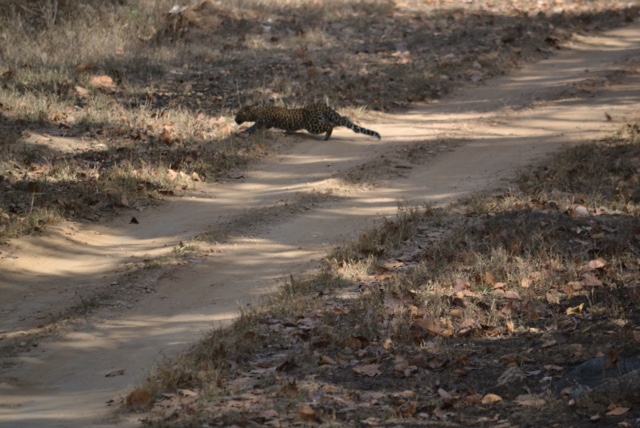
Then the cacophony erupted, a sambar called frantically, and the sound resounded amongst the still tall stands that were the object of our gaze.  As the calls continued we began to gaze between the stands, and it was rewarding. Our guide spotted what appeared to be a mongoose. "Pl hand me the binoculars." "Its a leopard!' The magic words all naturalists like to hear.  I peered hard and spotted the second cub emerging from the bush and heading into another.         

Excited but in full control we decided to park at a distance from where we thought the big cats will emerge. The strategy paid off. Thinking the jeep had left the leopard family continued to approach the jungle road. "Keep an eye behind," I told the guests. They did, and within a short span of time they called in unison "leopard!"  

Images by Pete & Kay Sutton 

Leopard Mother

Pensive Look 

Leopard Cub looking at us  

Panther Cub 

Cub Scurrying Past like a Mongoose

First to emerge was the mother. She came out, inspected the surroundings, and made sure that we were at a safe distance. She then signalled her cubs to continue following her. The first cub to arrive was probably male judging from its size. It stopped to gaze at the strange sight of the green monster.

This wild animal's threat perception is acute and ends up saving its lives amidst the tortured terrain of the dense jungles habituated by tigers. After a good look at us it began to crawl like a mongoose in order to enter the bush across the road.   

The second cub visibly smaller took no chances. It crossed over from a distance and scurried through. Cameras clicked. The wait was over. We had been rewarded with a magnificent experience that would take eternity to replicate.      

"Whew! Lets move on." And we did for another escapade in the wilds of Kanha National Park in India.

Monday, January 30, 2017

Phen Wildlife Sanctuary - A Diminished Tail Light

Phen WLS - Micro Core (KTR)

Courtyard House Guests (Kanha) - Sudhir Pawar & Family

The bright sparkling sun hits us as we emerge from the dusty Raipur Highway and enter Phen Wildlife Sanctuary a verdant paradise and heaven.  Albeit smaller than its neighboring core Kanha Tiger Reserve, the forests are connected to some degree by buffers Motinala Supkhar Range, & Garhi Forests.  The natural corridor (Kanha Achanakmar) formation is reminiscent of the era whence the Central Indian Highlands was one large tract of forests teeming with wildlife.   

We are greeted at the Gate by the forest staff who gave us a much-required brief on the forests and their wildlife. A pair of gold-mantled chlorosis welcome us alongside. Filled with exuberance we leave for the safari after a short repast.    
Phen Ecosystem

This was my first visit to Phen, and the scope of making new discoveries was exciting. Barely one hundred and eleven square kilometers in the area the conservation unit is full of promise.    

"A good place to sight leopard, sloth bear and wild dog". The staff informs us. 

"And the tiger?" I butt in needlessly. 

"We can make a presence of two from roars and pug marks."  Sure enough, we come across generous lay of pug marks of a tigress on the game round.   

The guardians of the ecosystem number only two or four if you add vagrant or un-traced tigers. Anyway, that did not dampen our excitement as we believe in a holistic experience. The tigers, like at many places in India have lost ground here, but a more promising future can be accorded with the right conservation efforts.  

Phen WaterBody
Hilly, and packed with dense canopy, the topography is a turbulent terrain with hills, grasslands, and deep valleys. The forest comprises tropical moist deciduous mixed, Sal and bamboo. Intermittent water bodies in form of Phen River, smaller rivulets, water holes, and moist grounds are the lifeline of the ecosystem.  

While relocation of some villages has already taken place some are yet to be trans-located. 
  
The park is vital for tiger conservation in Central India. The health of the ecosystem and minimal disturbance is suggestive of a perfect tiger landscape, albeit the prey base is poor - probably due to extensive hunting and poaching in the past.  With an improvement in the prey base, the big cats will get more space for survival. Large herds of spotted deer have already been trans-located from Kanha. 

Phen Canopy
Phen Wildlife offers excellent scope for birding besides safaris. The trip can be accommodated along with a tiger safari at Kanha National Park. The distance is two and a half hours of drive from KTR along the Bicchia, Motinala Raipur Highway. The micro core is at a distance of 15 km from Motinala.  
Phen Images 
Bamboo

Directors Picturesque Cabin


Forest

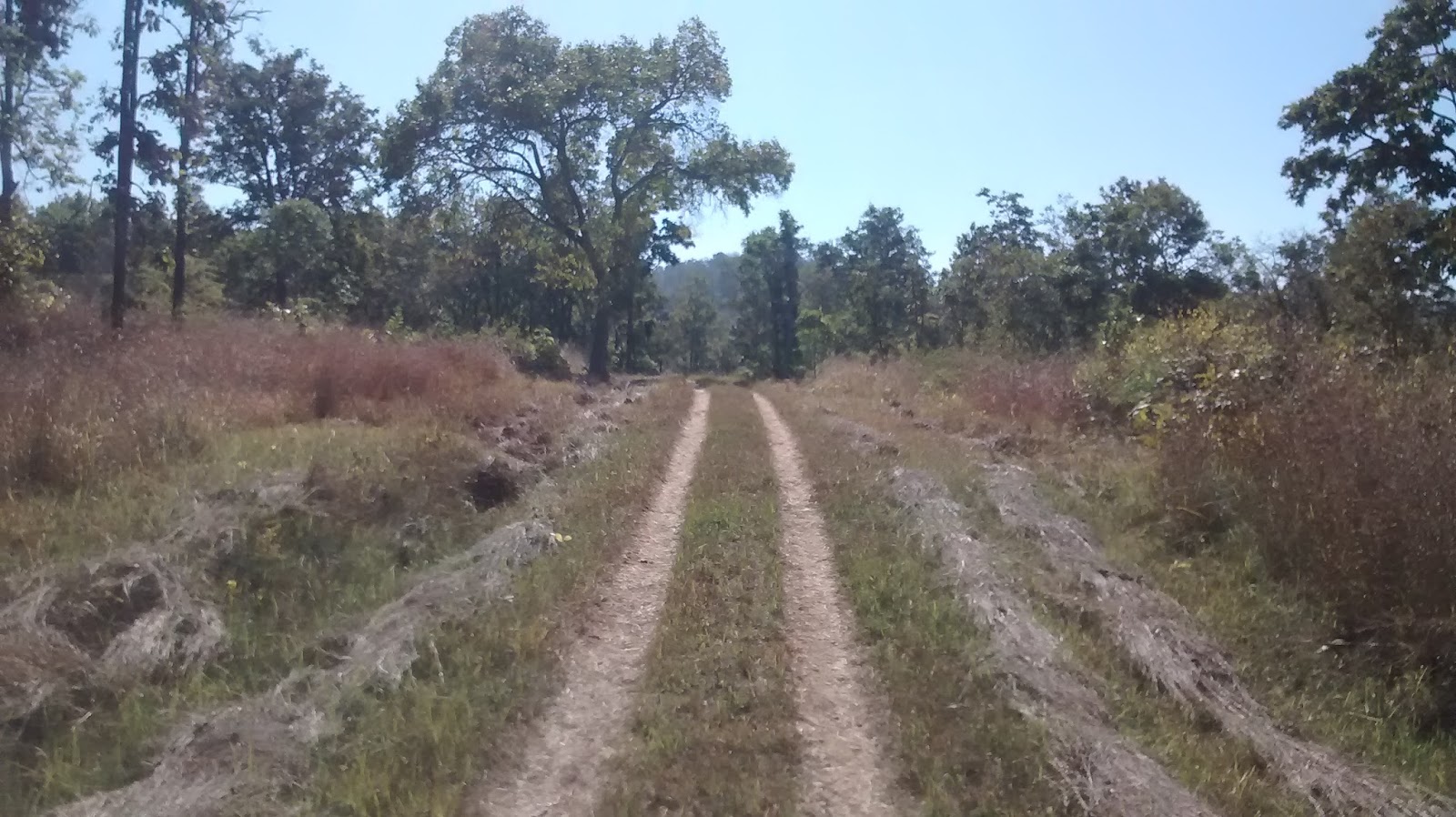
Jungle Road


Grassland

Rest House View

Water Body
Trip &  Accommodation

Highly recommended for leopards, sloth bears, and wild dogs alongside great birding. There is no accommodation at Phen, but a rest house at Motinala can be availed.

Accessible from Kanha Tiger Reserve this is a good way to spend a day off from a hectic safari routine. Also, visitors without entry pass at Kanha can make a day here. Full-day and half-day safaris are available at less cost.  Please contact Kanha FD Office at Mandla.    

Please carry all eatable that can be consumed at the rest house and at the Gate. Jeep availability can be made from Kanha. 

More Information Phen  Micro Core

Wednesday, January 11, 2017

Wildlife Photos India


I have here a collection of photos of wild animals and birds. These are images belonging to my friends and acquaintances. The intention is to display hard work that goes into the imagery and yes the cost involved.


Striped Hyena - Ghanshyam
Langur Monkey - Dag Larsson


Desert Fox - Ghanshyam Singh
Leopard - Marie & Andrew
Indian Wolf - Monu Dubey

Tiger Teerath Singh 
Bison - Money Dube

Tiger Teerath Singh 
Wild Dog - Nandita Amin

Kanha Tiger  Teerath Singh 
Cinnamon Bittern - Prayut Mandal 

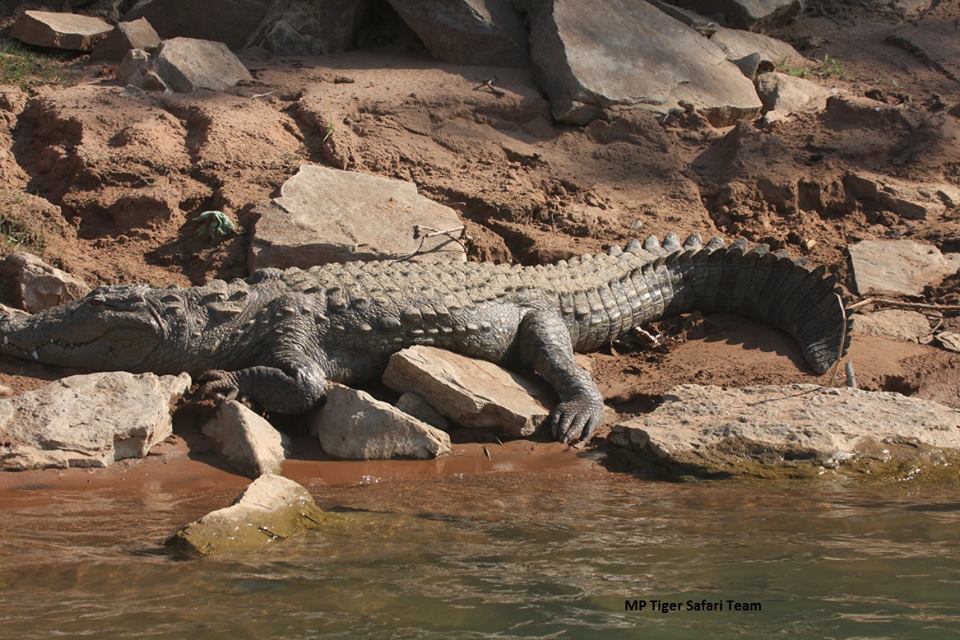
Marsh Crocodile Teerath Singh 
Swamp Deer - Ruchi Patel

Sambar Deer Teerath Singh
Shreyas D - Common Pochard

Sunday, January 8, 2017

Food Chain - Biotic/Abiotic Components & Tigers

Understanding Ecosystem in Tiger Landscapes 

The article's emphasis is on tigers surviving outside the protected areas in India. This is more of a simplification of the biotic components that prevail in an area highly stressed by human and livestock use.    

To understand this phenomenon we have to first understand the food chain in its simplest form. The food chain is best explained using a pyramid. 

How the creation and transfer of energy take place.  

1) At the lowest level are the autotrophs the living beings that use abiotic elements like sunlight, soil, water, and Co2 in order to produce energy. These are also called producers. Examples are plants, grass, herbs, shrubs, some microorganisms, and trees.   

2) Consumers or primary consumers subsist on the autotrophs so as to enable the transfer of energy. Herbivores are an example. Deer, Wild Ox, Bison, Elephants, Primates, and so on.    

3) Secondary Consumers are small predators and omnivorous creatures who subsist on primary consumers. Examples are foxes, jackals, wild dogs, raptors, etc. 

4) Tertiary Consumers are large predators which subsist on primary consumers and to some extent on secondary consumers.   Like Tigers, Lions, Cheetahs & Leopards, some bears, etc. These are also known as Apex predators, Normally these are designated as indicator species since their presence is a sign of a healthy ecosystem.    

5) Decomposers or scavengers feed on dead organisms they are small predators, hyenas, vultures, eagles, corvids, bacteria, and so on. 

Each layer from 2nd stage acts as a population control mechanism, in order to maintain an equilibrium in the environment. All components are instrumental in maintaining humidity/moisture and the composition of gases. Hence tigers are major control elements, and as top predators, they are indicators of a healthy ecosystem. I think this should justify conservation to all minds, Further understanding should arise by reading literature from acclaimed field biologists, conservationists, etc.    

When the tiger habitats contain a perfect ecosystem, the animal's survival is assured...in presence of protection from nefarious human activities like poaching. Land grab is another major threat to ecosystems all over. Niche habitats are destroyed by expanding human settlements, industrialization, and agriculture. We have lost large tracts of grasslands, marshlands, estuaries, rivers, marine ecosystems, and forests...all on a massive scale.    

In areas outside the critical tiger habitats, multiple pressure arises from agricultural practices, human habitation, livestock, and waste including toxic chemicals. The latter is a result of the widespread use of toiletries, fertilizers, and pesticides. Fumes emanating from vehicles, cooking, and noise pollution also contribute to damage to some extent. 

Livestock competes with natural inhabitants for vegetable matters and is instrumental in damaging the fragile ecosystem. They have been seen to easily outnumber the natural consumers reducing the prey base for predators including the tigers. In most of the buffer areas of our NPs the big cats are dependent on cattle and other livestock.  Besides conflict with man, they are susceptible to contagious diseases.

Tree felling in order to feed livestock is another practice that reduces the canopy. Denuded land is easily subject to loss of topsoil, and proliferation by weeds like parthenium or carrot grass and lantana.  As a result, altered weather can inhibit the breeding of tigers along with a reduced prey base. 

Another reason for denudation is our dependency on wood for energy, furniture, and construction.  In the past, clear felling was resorted for commercial logging resulting in wide-scale denudation as done by agricultural practices. Mining has the same impact as the latter besides contributing to hazardous environmental pollution.  

Hence we depend on tigers as well as all life forms for our survival plus not forgetting the purity of abiotic elements.  

Lack of planning has resulted in the indiscriminate use of our land and not leaving the niche habitats inviolate. As we aim for high economic growth further pressure is created. PAs are good examples of wise land use but we need this on a larger scale to preserve all that we can.   

Humans should minimize land use and let the Earth flourish. 

This article is in order to create an impressive group of thinkers, nature lovers, and environmentalists. A large voice/pressure group would mean the implementation of better policies that would save critically endangered species like the tiger in India and elsewhere.