Showing posts with label Central India. Show all posts

Thursday, November 19, 2020

Kundwara Forests Victim of Agricultural Expansionism

Agriculture in any form in India has never been seen as a malady thanks to teeming uncontrolled population with billion mouths to feed. Its status is akin to the holy cow whether productive or not. The biotic stress is difficult to manage and the environment is crumbling under the pressure.  But little do people realise that the same life saving agrarian benevolence has wreaked havoc on our ecosystems all over the country. 


Agriculture has made inroads into the heart of nature in India and remote places are remote no more, they have been recklessly invaded by humanity completely degrading habitats and wiping off nearly all life forms. The negative impact of encroachment and subsequent land clearance for settlements and urbanization has been further enhanced by large-scale livestock rearing. Both have made rapid strides all over India in order to feed the people and establish local economies. It is time now to increase the productivity of land in an organic manner and free as much land as possible for regeneration by reducing dependence on traditional farming. Even livestock at places are unproductive but weigh down heavily creating biotic pressure. More productive stock and alternative eco-friendly income is the need of the hour.            


                                                            Kundwara Forests 

In my quest for understanding nature in India, I have noted with much sadness the wide-scale loss of our ecosystems and the near extinction of our precious wildlife. This though has not drawn much concern among the people as well as the administrators and politicians to a large extent. Lost habitats with lone trees and past zoo geographical status may find mention here and there but for us, the living suffering from amnesia nothing is lost. But surely whence environmental impacts broil down our throats the absence of precious ecosystems will become conspicuous. 

                                                                Kundwara Rest House

The impact is already in effect due to global warming and pollution. In spite of public outcry, the negative fallout of unplanned development at places has not made any impact. Although this is not happening in remote rural confines the ecosystems are being nipped in the bud by constant abiotic and biotic pressures. Infrastructure development in remote confines is limited but encroachment or stripping of land for economic purposes and settlement albeit slow cannot be ruled out.        


                                                    Brook at Kundwara Forests

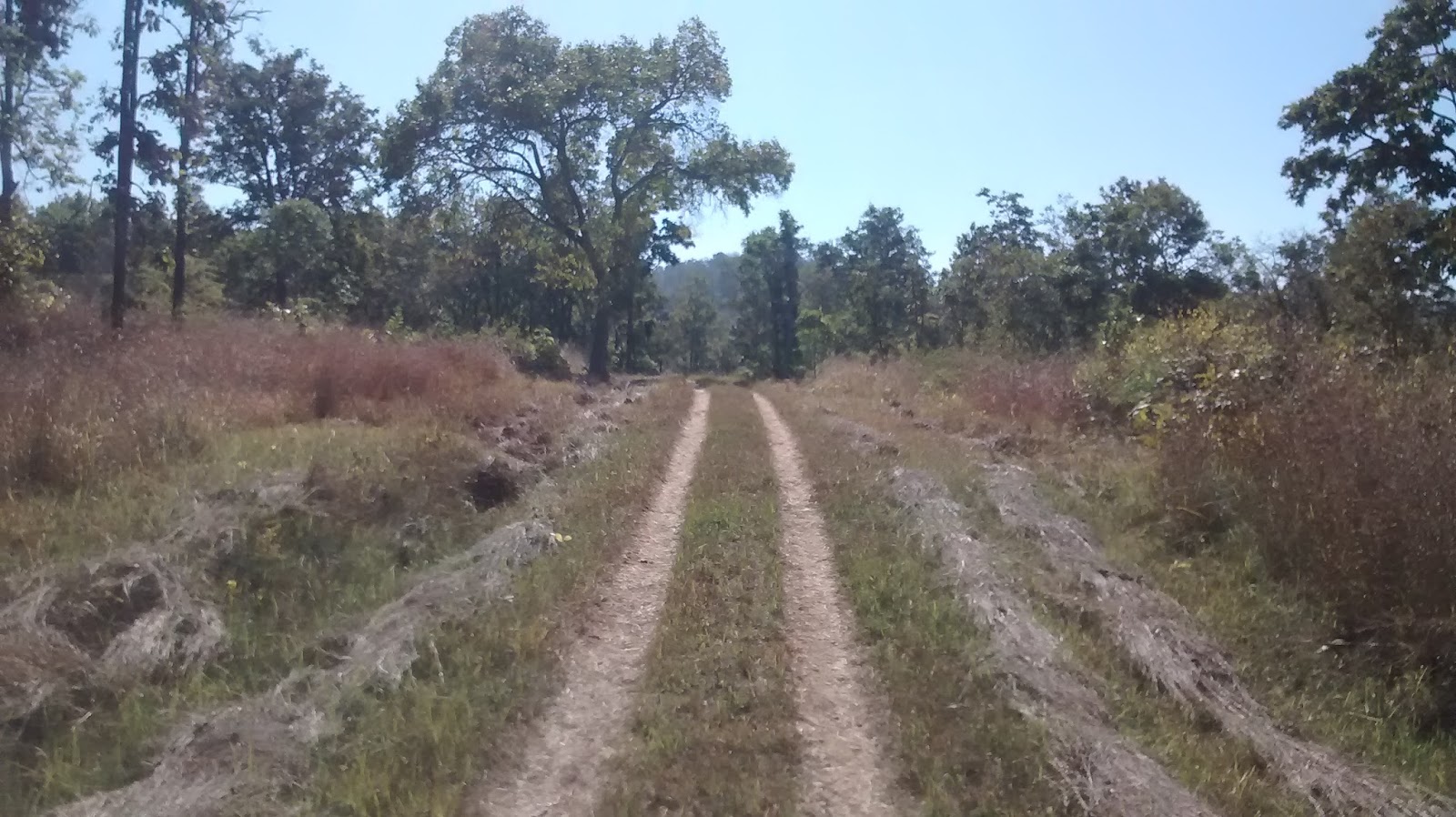
Driving down to Kundwara Forest Rest House is one fine way to discover the damage agriculture has brought about. The RH is situated near Baghraji (Bagh=Tiger) a hamlet named after the tiger. And this nomenclature is not due to a fig of imagination, in the past, this destination was full of big cats and diverse wildlife in large extant forests that were part of the Central Indian Highlands. Most of the forests in Central India and elsewhere are pockmarked with settlements and the fallout on surrounding forests is evident. The crown cover is absent and so is the wilderness.  

                                                                           Nursery

Even to the uninitiated, the strip of forest on the hills and its absence in the plains nearby rings an alarm bell, the sordid saga of degradation brought about by humans. Twenty years back I had seen tigers on the descent before the RH. Then throughout the night in the Scary darkness of the Dak Bungalow, I heard the mating calls. The sound made in heaven and the sighting were instrumental in the discovery of tigers where they had lost ground a long time back.       

Kundwara RH is now a hub of picnickers and enthusiasts on nature trails. The romantic British-built RH has been replaced by a modern construction that does not gel with the surroundings. The path leading to the brook in the middle of the forests is good enough for nature walks but the tigers and other animals are missing replaced by a bunch of picnickers and nature lovers. The nearby Laver River was inhabited by marsh crocodiles, pythons, and other aquatic life. This exotic rivulet is devoid of wilderness and completely dependent upon humanity that prevails in the precincts. Spotted Deer though scarce are sometimes visible on the drive and the chinkaras which I used to see often are much scarcer their meat is easily available leading them to near extinction here perhaps. 

"Nothing much here except the chitals," the guard informed me. "Even the tigers you have seen are not here anymore. Migrated perhaps." 


I remember very much the big cats were attracted by the water in the nursery in the summers. A well-armed Thakur from a nearby village used to score the jungles in search of a game. He told me of his escapades whence hunting was not illegal, and for a small fee, VIPs used his services to bring down already beleaguered wildlife. This should have stopped post Wildlife Protection Act 1972 but as he told me he cannot let go of hunting even if it is illegal. I am told he was brought to the book by a vigilant and daring officer. 


Post-booking criminals and wood loggers the administration is often pressurized by local political goons to let go. The brave resist and are subsequently punished by the local politicians reminding us that democracy has not been able to dilute the power of feudal and the local bigwigs. Anyway, the reserve forests notified as such do not hold much clout as the Protected Areas and National Parks do. Belonging to lower conservation rung they are subject to much exploitation, encroachment, and wildlife crimes with the criminal getting away using bribes, using powerful contacts, and the weak laws that prevail.    


Central India abounds in reserve forests beside a few PAs of repute. The reserve forest like Kundwara suffers from neglect even the local nursery beds were rotting with neglect and half-grown plants are left to die without any plantation efforts being made. This is a precious waste of public money and plantation exercise should be conducted only under responsible supervision or not at all.  

Anyway, the RH is well-maintained and the staff is polite and welcoming. A day can be well spent here on holiday and Kundwara is excellent for bird watching. Bring your own food or else ask the staff to cook for you if you have enough rations. The strip of forests will remain and the corridor it forms with other reserve forests and with Bandhavgarh though weak may last for quite some time.   


These rest houses surrounding small eco-units should play an active role in ecotourism in India. Kundwara already popular with tourists could fetch revenue for the development of the nursery, protection of the forests, and upkeep of the RH. The administration should follow suit with RH prevailing in scenic local or eco-units and use them for revenue generation while at the same time dispersing holidaymakers from already crowded tiger reserves.   

Kundware is about forty km from Jabalpur Airport on the Kundum Shahpura Highway. While driving from Jabalpur you have to turn left from Tilsani township (30Km) towards Baghraji in order to reach the RH. Permission should be availed from the DFO Jabalpur. RH facilities are provided on basis of permission availed.

====================================================

Uday Works as Freelance Naturalist and Blogs on conservation, tigers, and environmental issues.

He also provides SEO and Website Content in English.

He can be contacted at:

Mail: pateluday90@hotmail.com
 Mob: 09755089323


Monday, January 30, 2017

Phen Wildlife Sanctuary - A Diminished Tail Light

Phen WLS - Micro Core (KTR)

Courtyard House Guests (Kanha) - Sudhir Pawar & Family

The bright sparkling sun hits us as we emerge from the dusty Raipur Highway and enter Phen Wildlife Sanctuary a verdant paradise and heaven.  Albeit smaller than its neighboring core Kanha Tiger Reserve, the forests are connected to some degree by buffers Motinala Supkhar Range, & Garhi Forests.  The natural corridor (Kanha Achanakmar) formation is reminiscent of the era whence the Central Indian Highlands was one large tract of forests teeming with wildlife.   

We are greeted at the Gate by the forest staff who gave us a much-required brief on the forests and their wildlife. A pair of gold-mantled chlorosis welcome us alongside. Filled with exuberance we leave for the safari after a short repast.    
Phen Ecosystem

This was my first visit to Phen, and the scope of making new discoveries was exciting. Barely one hundred and eleven square kilometers in the area the conservation unit is full of promise.    

"A good place to sight leopard, sloth bear and wild dog". The staff informs us. 

"And the tiger?" I butt in needlessly. 

"We can make a presence of two from roars and pug marks."  Sure enough, we come across generous lay of pug marks of a tigress on the game round.   

The guardians of the ecosystem number only two or four if you add vagrant or un-traced tigers. Anyway, that did not dampen our excitement as we believe in a holistic experience. The tigers, like at many places in India have lost ground here, but a more promising future can be accorded with the right conservation efforts.  

Phen WaterBody
Hilly, and packed with dense canopy, the topography is a turbulent terrain with hills, grasslands, and deep valleys. The forest comprises tropical moist deciduous mixed, Sal and bamboo. Intermittent water bodies in form of Phen River, smaller rivulets, water holes, and moist grounds are the lifeline of the ecosystem.  

While relocation of some villages has already taken place some are yet to be trans-located. 
  
The park is vital for tiger conservation in Central India. The health of the ecosystem and minimal disturbance is suggestive of a perfect tiger landscape, albeit the prey base is poor - probably due to extensive hunting and poaching in the past.  With an improvement in the prey base, the big cats will get more space for survival. Large herds of spotted deer have already been trans-located from Kanha. 

Phen Canopy
Phen Wildlife offers excellent scope for birding besides safaris. The trip can be accommodated along with a tiger safari at Kanha National Park. The distance is two and a half hours of drive from KTR along the Bicchia, Motinala Raipur Highway. The micro core is at a distance of 15 km from Motinala.  
Phen Images 
Bamboo

Directors Picturesque Cabin


Forest

Jungle Road


Grassland

Rest House View

Water Body
Trip &  Accommodation

Highly recommended for leopards, sloth bears, and wild dogs alongside great birding. There is no accommodation at Phen, but a rest house at Motinala can be availed.

Accessible from Kanha Tiger Reserve this is a good way to spend a day off from a hectic safari routine. Also, visitors without entry pass at Kanha can make a day here. Full-day and half-day safaris are available at less cost.  Please contact Kanha FD Office at Mandla.    

Please carry all eatable that can be consumed at the rest house and at the Gate. Jeep availability can be made from Kanha. 

More Information Phen  Micro Core

Thursday, September 8, 2011

Best Options for tiger safari in Central India

The best options for tiger safari in the state of Madhya Pradesh are three. Obviously Kanha, Pench and Bandhavgarh. But what can you add more to your journey?

The best way to reach these tiger reserves is landing at Jabalpur Airport or Rail Head which is an overnight journey from New Delhi. The flight takes approximately 1.25 hrs to Jabalpur from New Delhi and nearly the same from Mumbai. Jabalpur is well connected from Mumbai by rail. It is well connected with Kolkutta and many other towns. But one fact remains... you have to book in advance or you do  not get reservations.   

Most inbound tourists drive straightway to the reserves from the airport of rail head. If you are going to spend the night at Jabalpur and have sufficient time then visit Marble Rocks for boating and sightseeing. It is about 21 km from the city and transportation is easily available. Another option is Nauradehi Wildlife Sanctuary which is about eighty km and a day trip can be made for birding and wildlife safari. Jabalpur has much to offer in sightseeing but that needs a few days off stay.

Kanha or KTR Khatia Gate is about 156 km from Jabalpur if you are staying at Mukki Gate then travel 30 to 40 km more.  From this reserve it is back to Jabalpur for flight/train unless you plan to stay here for an extension to Nauradehi WLS or Marble Rocks.

Those going straight to Bandhavgarh can visit Khajurhao Temples from there on. The temple town is connected by flights well. Panna Tiger Reserve is close by about 45 km and so is Ken Gharial Sanctuary these places are worth a visit.

Bandhavgarh is connected by overnight train with New Delhi from Umaria Station which is about 32 km from the Tala Gate. BTR is connected with KTR by 5 hrs drive and from here Pench is about 5hr drive.

Pench is connected with Nagpur (80KM) which is an Airport. Nagpur is connected to Jabalpur by rail and road. Pench, Kanha tour is an option for those wishing to visit two preserves. Nagpur is an effective gateway to Southern India.   


Pachmarhi Hill Resort and Satpura National Park are close to Jabalpur. By rail and then by road Pachmarhi is about 4 hours journey. Satpura is about two hours from Pachmarhi and one hour from Pipariya Station. The gate is situated at Madai Village. This is destination where in tourism infrastructure has come recently and is yet unexplored. It is part of extended conservation unit called Pachmarhi Biosphere Reserve. Bori WLS and Pachmarhi WLS along with the tiger reserve encompass more than 4000 sq km to form this biosphere reserve which is a gold mine of diversity of all natural elements. 

Pachmarhi hill resort is an ideal summer holiday destination, utmost picturesque and cool. Natural formations, Hills and Valleys along with wonder spots form a spectacular pot pourri of scapes that enchant the visitor.  These are destinations where bird life is least explored.  

In order to visit these places tour operators of MP provide affordable tourism packages. For independent travelers making travel arrangements is a big hassle. Okay if done in advance. The hotels can help you with arrangements but  a package is anytime better.  

Useful Info: Winters are very cold hence adequate amount of warm clothing: mufflers, caps, gloves, jackets  should there in your baggage. In the interior areas many consumer products, medicines, wines, banking facilities may not be available so do your shopping in advance at Jabalpur or New Delhi.