Friday, March 31, 2017

Leopard Surprise

Pete & Kay Sutton UK 
Guests Courtyard House
Kanha National Park India 


It was in the previous evening round that we heard clamorous alarm cries at the cross road that leads to Sarhi Zone on left and Kanha Zone to the right. We had waited for a long time but nothing materialised. From the frequency of cries we could surmise that the sambar and chital deer had spotted a leopard in the thick canopy.  

Nothing emerged after waiting a long time. Disappointed we left so as to exit the park in time. Predators as shaped by nature are extremely unpredictable and can rarely be spotted at the same place twice. Well there are exceptions. 

Next day morning we were at Kisli Zone and were on mission to find Munna the ageing but dominant male tiger. Tracking tigers is an ultimate test of patience, split second decision and experience that one gets with due time and sincere application.

We were at Nainsingh Nala a wooden bridge that runs over a dried stream but does sustain water a few feet away in the neighbouring canopy. This canopy has become a vital point in our search for tigers and with great success. Two males have been spotted after a long long wait.     

So far there was no sign of Munna, and as usual we decided to score the neighbouring area. 

"Let us go to the crossroad where we had heard alarm cries last evening!" I instructed. This was just a surmise that something could wait so long.  Never give up easily and utilise all the time allotted for each and every search that you can make during the tiger safari. Jeeps arrived and departed and we waited. Our surmise was strengthened by the fact that a leopard had been sighted on this morning  round here.  

As the clamour of the jeeps ended a stony silence pervaded. The jungle sounds are incredible and challenge your hearing apparatus like no other situation can. In the mysterious wilderness of the Indian jungles sound waves from distance skim weakly over surface, and throw a challenge to your hearing apparatus. Long wait for big cats can be tiring and boring at times. I regaled my guests with the distant sounds that emanated from the jungle around us. "That's a barking deer! Probably sighted a tiger and going all bonkers!" 

Well in immediate surrounding it was all pin drop. If you as much make a rustle sound shifting in the vehicle you can lose valuable audible clues. But we sat absolutely still. It was a long wait but we did it.      

Then the cacophony erupted, a sambar called frantically, and the sound resounded amongst the still tall stands that were the object of our gaze.  As the calls continued we began to gaze between the stands, and it was rewarding. Our guide spotted what appeared to be a mongoose. "Pl hand me the binoculars." "Its a leopard!' The magic words all naturalists like to hear.  I peered hard and spotted the second cub emerging from the bush and heading into another.         

Excited but in full control we decided to park at a distance from where we thought the big cats will emerge. The strategy paid off. Thinking the jeep had left the leopard family continued to approach the jungle road. "Keep an eye behind," I told the guests. They did, and within a short span of time they called in unison "leopard!"  

Images by Pete & Kay Sutton 

Leopard Mother

Pensive Look 

Leopard Cub looking at us  

Panther Cub 

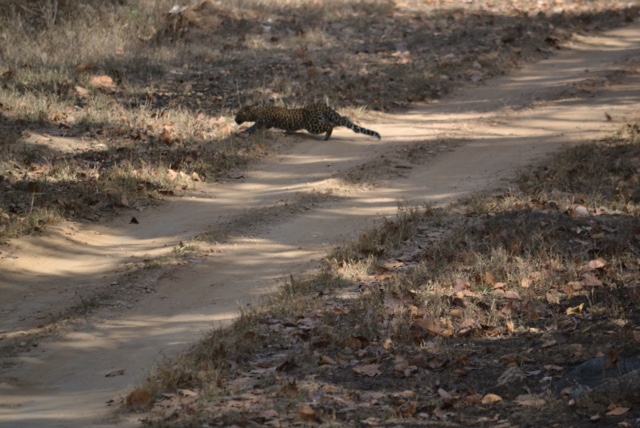
Cub Scurrying Past like a Mongoose

First to emerge was the mother. She came out, inspected the surroundings, and made sure that we were at a safe distance. She then signalled her cubs to continue following her. The first cub to arrive was probably male judging from its size. It stopped to gaze at the strange sight of the green monster.

This wild animal's threat perception is acute and ends up saving its lives amidst the tortured terrain of the dense jungles habituated by tigers. After a good look at us it began to crawl like a mongoose in order to enter the bush across the road.   

The second cub visibly smaller took no chances. It crossed over from a distance and scurried through. Cameras clicked. The wait was over. We had been rewarded with a magnificent experience that would take eternity to replicate.      

"Whew! Lets move on." And we did for another escapade in the wilds of Kanha National Park in India.

Monday, January 30, 2017

Phen Wildlife Sanctuary - A Diminished Tail Light

Phen WLS - Micro Core (KTR)

Courtyard House Guests (Kanha) - Sudhir Pawar & Family

The bright sparkling sun hits us as we emerge from the dusty Raipur Highway and enter Phen Wildlife Sanctuary a verdant paradise and heaven.  Albeit smaller than its neighboring core Kanha Tiger Reserve, the forests are connected to some degree by buffers Motinala Supkhar Range, & Garhi Forests.  The natural corridor (Kanha Achanakmar) formation is reminiscent of the era whence the Central Indian Highlands was one large tract of forests teeming with wildlife.   

We are greeted at the Gate by the forest staff who gave us a much-required brief on the forests and their wildlife. A pair of gold-mantled chlorosis welcome us alongside. Filled with exuberance we leave for the safari after a short repast.    
Phen Ecosystem

This was my first visit to Phen, and the scope of making new discoveries was exciting. Barely one hundred and eleven square kilometers in the area the conservation unit is full of promise.    

"A good place to sight leopard, sloth bear and wild dog". The staff informs us. 

"And the tiger?" I butt in needlessly. 

"We can make a presence of two from roars and pug marks."  Sure enough, we come across generous lay of pug marks of a tigress on the game round.   

The guardians of the ecosystem number only two or four if you add vagrant or un-traced tigers. Anyway, that did not dampen our excitement as we believe in a holistic experience. The tigers, like at many places in India have lost ground here, but a more promising future can be accorded with the right conservation efforts.  

Phen WaterBody
Hilly, and packed with dense canopy, the topography is a turbulent terrain with hills, grasslands, and deep valleys. The forest comprises tropical moist deciduous mixed, Sal and bamboo. Intermittent water bodies in form of Phen River, smaller rivulets, water holes, and moist grounds are the lifeline of the ecosystem.  

While relocation of some villages has already taken place some are yet to be trans-located. 
  
The park is vital for tiger conservation in Central India. The health of the ecosystem and minimal disturbance is suggestive of a perfect tiger landscape, albeit the prey base is poor - probably due to extensive hunting and poaching in the past.  With an improvement in the prey base, the big cats will get more space for survival. Large herds of spotted deer have already been trans-located from Kanha. 

Phen Canopy
Phen Wildlife offers excellent scope for birding besides safaris. The trip can be accommodated along with a tiger safari at Kanha National Park. The distance is two and a half hours of drive from KTR along the Bicchia, Motinala Raipur Highway. The micro core is at a distance of 15 km from Motinala.  
Phen Images 
Bamboo

Directors Picturesque Cabin


Forest

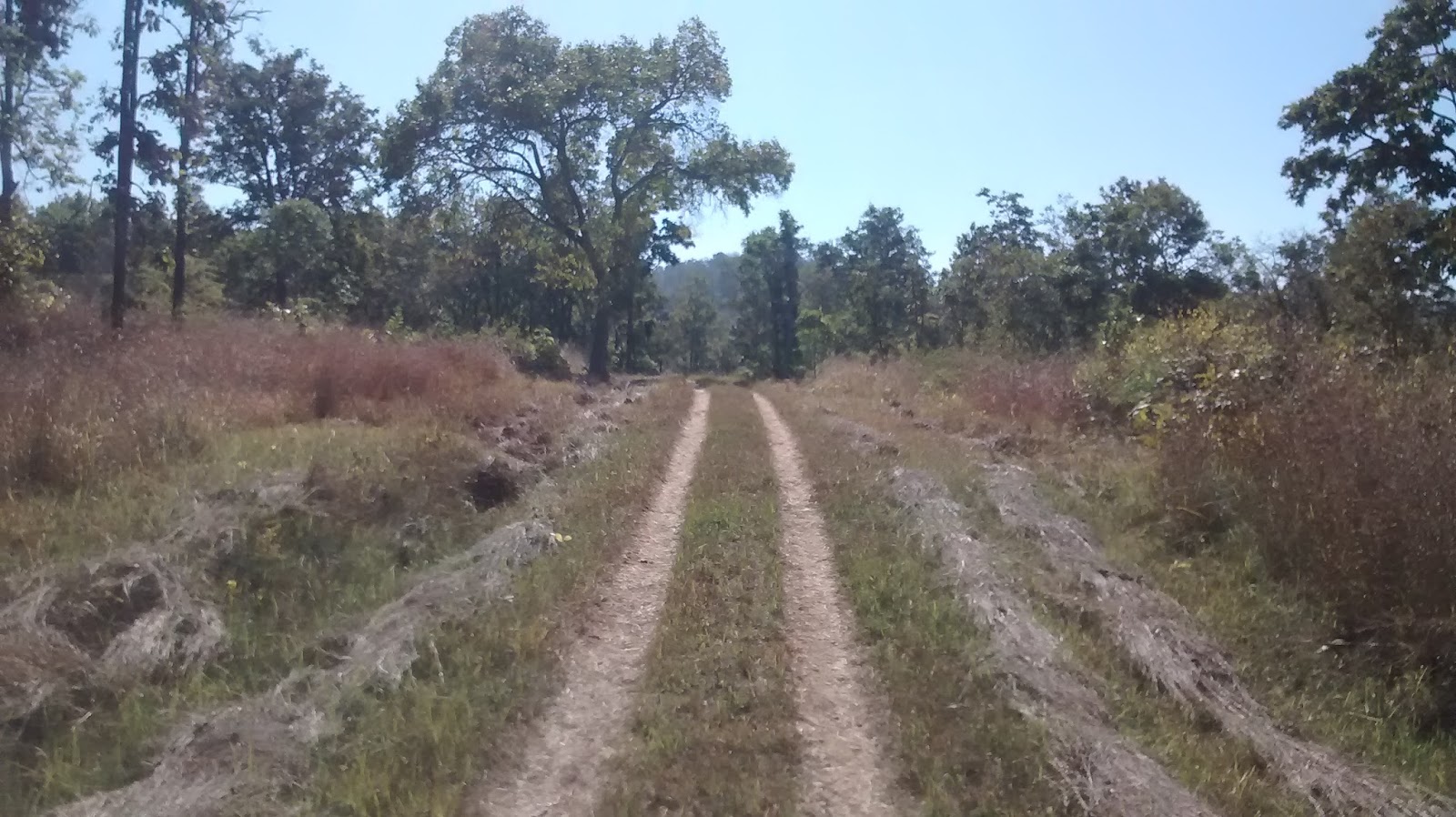
Jungle Road


Grassland

Rest House View

Water Body
Trip &  Accommodation

Highly recommended for leopards, sloth bears, and wild dogs alongside great birding. There is no accommodation at Phen, but a rest house at Motinala can be availed.

Accessible from Kanha Tiger Reserve this is a good way to spend a day off from a hectic safari routine. Also, visitors without entry pass at Kanha can make a day here. Full-day and half-day safaris are available at less cost.  Please contact Kanha FD Office at Mandla.    

Please carry all eatable that can be consumed at the rest house and at the Gate. Jeep availability can be made from Kanha. 

More Information Phen  Micro Core

Wednesday, January 11, 2017

Wildlife Photos India


I have here a collection of photos of wild animals and birds. These are images belonging to my friends and acquaintances. The intention is to display hard work that goes into the imagery and yes the cost involved.


Striped Hyena - Ghanshyam
Langur Monkey - Dag Larsson


Desert Fox - Ghanshyam Singh
Leopard - Marie & Andrew
Indian Wolf - Monu Dubey

Tiger Teerath Singh 
Bison - Money Dube

Tiger Teerath Singh 
Wild Dog - Nandita Amin

Kanha Tiger  Teerath Singh 
Cinnamon Bittern - Prayut Mandal 

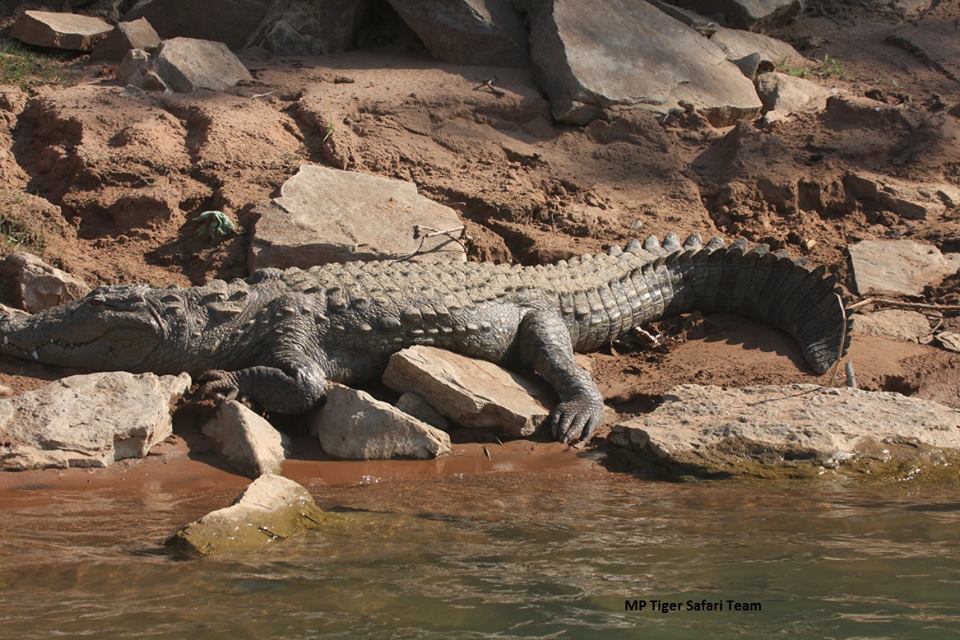
Marsh Crocodile Teerath Singh 
Swamp Deer - Ruchi Patel

Sambar Deer Teerath Singh
Shreyas D - Common Pochard

Sunday, January 8, 2017

Food Chain - Biotic/Abiotic Components & Tigers

Understanding Ecosystem in Tiger Landscapes 

The article's emphasis is on tigers surviving outside the protected areas in India. This is more of a simplification of the biotic components that prevail in an area highly stressed by human and livestock use.    

To understand this phenomenon we have to first understand the food chain in its simplest form. The food chain is best explained using a pyramid. 

How the creation and transfer of energy take place.  

1) At the lowest level are the autotrophs the living beings that use abiotic elements like sunlight, soil, water, and Co2 in order to produce energy. These are also called producers. Examples are plants, grass, herbs, shrubs, some microorganisms, and trees.   

2) Consumers or primary consumers subsist on the autotrophs so as to enable the transfer of energy. Herbivores are an example. Deer, Wild Ox, Bison, Elephants, Primates, and so on.    

3) Secondary Consumers are small predators and omnivorous creatures who subsist on primary consumers. Examples are foxes, jackals, wild dogs, raptors, etc. 

4) Tertiary Consumers are large predators which subsist on primary consumers and to some extent on secondary consumers.   Like Tigers, Lions, Cheetahs & Leopards, some bears, etc. These are also known as Apex predators, Normally these are designated as indicator species since their presence is a sign of a healthy ecosystem.    

5) Decomposers or scavengers feed on dead organisms they are small predators, hyenas, vultures, eagles, corvids, bacteria, and so on. 

Each layer from 2nd stage acts as a population control mechanism, in order to maintain an equilibrium in the environment. All components are instrumental in maintaining humidity/moisture and the composition of gases. Hence tigers are major control elements, and as top predators, they are indicators of a healthy ecosystem. I think this should justify conservation to all minds, Further understanding should arise by reading literature from acclaimed field biologists, conservationists, etc.    

When the tiger habitats contain a perfect ecosystem, the animal's survival is assured...in presence of protection from nefarious human activities like poaching. Land grab is another major threat to ecosystems all over. Niche habitats are destroyed by expanding human settlements, industrialization, and agriculture. We have lost large tracts of grasslands, marshlands, estuaries, rivers, marine ecosystems, and forests...all on a massive scale.    

In areas outside the critical tiger habitats, multiple pressure arises from agricultural practices, human habitation, livestock, and waste including toxic chemicals. The latter is a result of the widespread use of toiletries, fertilizers, and pesticides. Fumes emanating from vehicles, cooking, and noise pollution also contribute to damage to some extent. 

Livestock competes with natural inhabitants for vegetable matters and is instrumental in damaging the fragile ecosystem. They have been seen to easily outnumber the natural consumers reducing the prey base for predators including the tigers. In most of the buffer areas of our NPs the big cats are dependent on cattle and other livestock.  Besides conflict with man, they are susceptible to contagious diseases.

Tree felling in order to feed livestock is another practice that reduces the canopy. Denuded land is easily subject to loss of topsoil, and proliferation by weeds like parthenium or carrot grass and lantana.  As a result, altered weather can inhibit the breeding of tigers along with a reduced prey base. 

Another reason for denudation is our dependency on wood for energy, furniture, and construction.  In the past, clear felling was resorted for commercial logging resulting in wide-scale denudation as done by agricultural practices. Mining has the same impact as the latter besides contributing to hazardous environmental pollution.  

Hence we depend on tigers as well as all life forms for our survival plus not forgetting the purity of abiotic elements.  

Lack of planning has resulted in the indiscriminate use of our land and not leaving the niche habitats inviolate. As we aim for high economic growth further pressure is created. PAs are good examples of wise land use but we need this on a larger scale to preserve all that we can.   

Humans should minimize land use and let the Earth flourish. 

This article is in order to create an impressive group of thinkers, nature lovers, and environmentalists. A large voice/pressure group would mean the implementation of better policies that would save critically endangered species like the tiger in India and elsewhere.     

Tuesday, December 27, 2016

Wildlife Tourism And Local Communities

Wildlife tourism though earlier considered to be the prerogative of the elite has come far down the line. It has assimilated in its wake many fruitful aspects with the passage of time. Though still promoted with hiccups, and often seen from a narrow perspective, the industry has empowered local communities like none has.

It also augurs crucial foreign exchange through thousands of wildlife enthusiasts from overseas. Tiger tourism is on the wishlist of an uncountable number of travelers all over the Globe. 

I have been visiting tiger reserves for more than three decades and have seen the positives. The ecosystems have grown to their completeness and roundabout holistic benefits have accrued. There has been a tremendous rise in converts as far as awareness of our environment is concerned. The reserves have also experienced a turnaround in animal populations (read bio-diversity). A new vocation has been generated in conservation research and skills of exploration i.e. guiding, birding, photography, etc among the youth.

Though tourism is not contributing factor, at least not directly, then safaris have become a learning experience for populations with no idea of how the ecosystems work, and how nature contributes to the preservation of our immediate environment. The people who have worked hard to preserve our inheritance have brought about this turnaround.  
Tribal Family - Courtesy Neeraj Vegad 

On one sight of the big cats and other predators, the first impression that is done away with is the vermin concept. I too used to think of tigers and leopards as bloodthirsty animals that would devour human beings on the first go. I now fear the ever-burgeoning unruly traffic and hoodlums in our society a far greater threat than being accidentally mauled by wild animals. The activity has also brought forth the National Pride that we hold in our incredible inheritance,        

I remember witnessing my first tiger at a very young age. It was a dead tiger, it lay listless at peace in its final slumber. It was legally hunted at Nauradehi WLS in MP before the legislation, but still, to me, it appeared an unpardonable crime against nature. I was too small to understand the implication of this heinous misdeed. The hunter moved amongst us...with his story of valor.. and had us running around him. This team of hunters visited us every year along with a wealthy relative far removed.  (sic).  The legislation put stop to this. 

Why I am writing about all this?

Well, our impressions about other life forms eventually shape our policies and our attitude towards them. Today modern education has inculcated teachings about things precious to our environment, earlier it was not so. Contemporary conservation is based upon equity...what we value, and the literature at our behest. India has been blessed with ancient conservation ethos but that has not proven to be enough...look where we stand today?    

In absence of (regulated) wildlife tourism, awareness about ecosystems would have moved back into a deep recess. Our attitude towards wilderness would have been uncaring and drastic...well it still is the case for many people. Secondly in a populist democracy, hard facts have to be drained down the gullets of those who administer this country...with syrup. 

It is the hotel/tourism industry that has been at the forefront of local employment apart from the administration...namely the forest department. The work experience and training imparted have been contributing factors towards empowerment. This has subsequently resulted in greater job opportunities and a hence better standard of living. Such initiative has been taken by the Kanha administration in conjunction with an NGO as well, and trainees are finding job opportunities in the industry all over. There may be many more such examples.   These are aspects that are rarely talked about and little appreciated.

Most of the employees are locals who have the developed skill to work in many faculties. This has come about with time and tourism. With experience and skill development they have become part of vocations and small businesses as well. And some in the tourism industry do distribute fruits of labor towards local infrastructure in form of donations or contributions.  

Benefits have accrued to the displaced lot as well as those living in the periphery.  From being in far-flung remote areas they have been connected by the hospitality industry with the mainstream and contribute to Nation development greatly.     

Tiger Conservation The Buck Stops Here

The passing of legislation (Wildlife Protect Act 1972) and creation of protected areas, and the Project Tiger Program were milestones that laid the foundation of nature conservation in India. For the first time after independence the country had a serious look at the status of its wilderness. 

Subsequently a series of corrective measures were taken. Tiger was at the helm of conservative initiatives. The beleaguered animal had lost lot of ground, thanks to indiscriminate hunting, poaching and extensive loss of habitat.

The creation of protected areas was a master stroke, especially the inviolate core zones. In the core zones no human habitation except that of the forest staff is allowed, all activities relating to forest produce do not take place. As a result the ecosystems have vastly improved. The outer ring of the forests contains the buffer zone which is an amalgamation of forests patches, villages, fields and public road network. The buffer forests are patchily linked with  the regular forests, status of which is anybody's guess. 

Tiger Image Courtesy: Mukund Yadav


With proper initiatives, the the big cat has gained some ground in the recent times. Many well managed parks have seen a rise in population. But with the success have arisen problems galore. 

The buffer zone is inept in containing the swelling population of big cats and the prey. There is a regular decline in the forest cover due to illegal logging which has reduced the habitats into fragments often degraded, some of which are completely nonviable.      

The human population in India is swelling here like anywhere else and this is hampering the movement of wild animals. The extreme biotic pressure is weighing down on the wild  inhabitants of the ecosystems. The loss of space as degradation increases is apparent, so is altered behaviour seen among the big cats.    

If we have to see a constant rise in population of tertiary consumers space is vital. The maximum number of conflicts with humans occur in the buffer. Animals do not understand the concept of protected area, for them any good habitat is worth moving into. The presence of humans in large numbers and their activities are discouraging for a tiger seeking new pastures. 

The tiger is sensitive to human presence like the hard ground swamp deer. Though the big cat survives along with humans its breeding and life span are reduced. The conflict amplifies whence it is forced to prey of livestock.  In many of our tiger reserves a large number of livestock are regularly preyed upon, and besides the human antipathy generated the big cat becomes susceptible to disease transmission and poaching as well.         

Animals have been electrocuted, snared, shot and exterminated by poisoning their kill. (Sometimes exterminated legally). Even if some PA's may not be under the scanner of organised poachers opportunists are present everywhere and the cases are on the rise.     

Hence if we wish to increase tiger population in India, we have to conserve effectively all the remaining habitats irrespective of their status. Though it is impossible to create extensive inviolate grounds, conservative initiatives need a paradigm shift as far as human inhabited habitats are concerned.  

Some of the macro solutions could be control and reduction of human populations, alternative to pastoral lifestyle, alternative fuel supply, restriction on construction and commercialisation. Many laudable steps have already been taken but require a greater impetus. In time to come more solutions will emerge.   

Wildlife tourism in buffer zones has been lauded by many conservationists. They believe greater protection measures will augur as a result of increased importance of the status of habitats there. A rise in equity is certain to increase the importance of our wilderness hence well managed tourism does play a part.       

(But safaris in the buffer zones are a poor alternative to the experience in the core. Hence there are few takers.The habitats here do offer good bird watching experience.)    

Friday, December 23, 2016

Does Rise in GDP Absolves us of Environmental Hara-Kiri?

The ongoing destruction of natural places in lieu of development is at the behest of environmental concerns in India. We have already lost large tracts of forests and grasslands to human settlements thanks to burgeoning human populations. Clear felling was another blow that did further damage in earlier times.  

In present times managing our environment is a prerogative of the ruling class. Our policies are populist and marred by ever-growing human needs and concerns. Nature does not understand human inadequacies; it is sensitive, fragile, and perishable.  The long-term consequences of destroying the remaining ecosystems in the country are foreseeable. The unstable climate and plunging health indices are warning us to awaken before it is too late.   

A species lost is lost forever. The sad state of the tiger is an indicator of our environmental health not only that of the ecosystem that it is limited to.  The increase in the population of lions in Gujarat is nothing to be proud of in absence of requisite habitat. The World is losing a huge number of species along with large tracts of precious forests with each passing day.  This should act as an eye-opener for us in India.    

Uncontrolled mining and uncontrolled use of natural resources will certainly lead to disastrous consequences, and its effects could be felt by generations. This is much after the short-term benefit of the materials has come to an end. 

The greenhouse effect and the unstable climate in recent time is as a result of a sum total of our negative approach toward the conservation of nature. Cities reeling under choking smog and pathetic living spaces are a perfect example of resources being over overburdened.  

Economic growth is of utmost importance to the Nation of 1.25 billion people. But that does not negate environmental concerns and absolve us of committing hara-kiri.             


Sunday, December 18, 2016

Do Away With Exotic Pets

Paradoxically this habit prevails even in countries most sensitive to human issues. Keeping exotic pets is an invidious and obsessive hobby of people in many countries. It may be of no consequence if the animals, birds, reptiles, and insects are treated with utmost care and love.

Until we do not accord a status of equality to all life forms heinous crimes will continue unabated. Such issues do not cause political or social upheaval sadly.     

This habit is one of the causes of species becoming extinct or critically endangered. Though innocuous it may seem, the demand for exotic pets is giving rise to illegal trade in endangered species. The time and effort spent by agencies to stop or curtail this maddening phenomenon are tremendous - financially and physically.

The rise in wildlife crimes is due to the demand for exotic species, body parts like bones for medicine/cosmetics, body adornments, talismans, and of course drawing room items (stuffed butterflies) sic.

The desire to consume exotic/endangered life forms is suggestive of cultural inadequacies that should be corrected timely. This malady is widely prevalent and can be brought under control or stopped by creating awareness, especially through electronic and social media.     

I do not know how many of the pet keepers are aware of the gory consequences, and untold misery suffered by these creatures, many of which are certain to become extinct and hence lost forever.    

Discouraging such hobbies and the hobbyist is the first step to the prevention of illegal trade in wildlife. Stepping up the pressure on people for auguring protective legislation in place is of utmost necessity.   

India does not allow the killing of wild forms as well as keeping them as pets.  This sensitivity (Ahimsa) is attributed to Vedic Culture and hence the unique conservation ethos prevalent for thousands of years. Vegetarianism also helps.

But the global demand, certainly, has given rise to a criminal nexus (India) engaged in illegal exports of life forms. The status of the tiger is critical due to the demand for its bones in China and other Asian countries used as wonder medicine sic.  
Bunty Jain - Bengal Tiger

Say no to pets before thousands of species perish. Say no to exotic food containing highly endangered species. Say no to cosmetics containing animal parts.....Say No to all that harms other life forms.         

Thursday, November 17, 2016

Charged By A Massive Tiger


This happened not for the first time. 

I was on safari with guests from Courtyard House Kanha. Jennifer, David, Heather, and Mark are all enthusiastic travelers from New Zealand.  

The evening ride was organized at Khatia Zone ironically not a preferred one for most. But recently, tigers and leopards have been seen here besides sloth bears, nilgai, barking deer, and the common animals of Kanha.  The area lacks water bodies that retain water during the scorching summers. 
\
The evening was interesting with some good sightings but no tiger. Since most of the travelers to the reserve come with this majestic predator in mind, I had some thinking head-on about coming game rounds. 

While some distance away from the Mocha township a man on a motorcycle waved frantically at us to catch our attention.  

"Tiger Ahead!"

I believed the man since Munna the dominant tiger now vanquished often roamed in this area. In no time we reached Budbudi Nala only to be confronted by locals and a retinue of forest staff. We could not see the tiger till the ranger pointed to a bush.

He was sitting in between the opening of two bushes. In the dim light, we could see him pensive, staring straight at us. My guests had their first look at the magnificent predator.  Calm prevailed as the ranger informed us that he was Munna.

"Well he looks very big", I informed the guests. My suspicion proved right as the calmness was shattered by the deafening roar as the tiger rushed towards us on all fours crouched as only the cats can. It all happened in a split second and none of us saw him get up from where he was stationed.  

Stunned by the assault we kept looking at him in awe and wonder.  He covered a few meters and then retracted but before we could settle down he rushed again this time more viciously and with greater intensity. He came to about fifty feet near us. In that dim light, photography was not possible.

In an instant, the crowd moved far away from the scene of action. Trepidation ran deep among one and all. The snarl and the hiss were blood-curdling. The huge tiger retracted once again and remained crouched ready to charge...which never came.    

"This is Dabang," I exclaimed. Being a cattle lifter he is of aggressive dispensation as all his likes are. He was charging at our jeep and that of another stationed near us.

Dabang is the largest tiger seen so far at Kanha National Park. He had earlier charged us with greater ferocity last June. The charge was close distance and it was terrifying. This was my third sighting of the big cat, much earlier I had seen him at a bison kill on Karia Ghatti Road. He was grimacing and snarling menacingly then.

The ranger signaled us to move on and we did. Much relieved that my guest had seen a tiger and experienced a rare action in making.

The next day the animal was seen near the Ghangar Nala on Bahiar Road which leads to the Courtyard House.  At 3.50 pm. A big passerby crowd had gathered and witnessed another charge on a passing vehicle. The tiger had then moved into the forest leading to the Nala.

The cattle lifters survive among the livestock of impressive size and hence grow big and aggressive, often confronted by the cowherds. Unlike Dabang which is closer to human settlements, most of them live in buffer forests scattered around the core. These are inhabited by people and their livestock. Unlike the core the buffer is not much under scrutiny, man-animal encounters and poaching often occur.

With the ever-increasing population of tigers and leopards, the management of buffers augurs a new look.