Monday, January 6, 2014

New Year with Karai Ghati Tiger

Thirty First December & First January spells crowd at Kanha Tiger Reserve in MP. Even after limiting the number of vehicles the park was swathing with a great numbers of gypsy plying on the road.

We had been allotted the Sarhi Zone and hence decided to go via the Karai Ghatti. I was adamant that we go via the Karai Corridor, the guide was also in favor hence there was no pride lost. We advanced on the cold day surprising this was the least cold winter I had ever experienced on 1st January.    

Karai Ghat is one of the picturesque ride in the park. It is mixed forest with Bamboo and Sal here and there. The zone is well inundated by Sulkum and other tributaries of  major rivers like Banjar. It is dotted with numerous water bodies that form small lakes ideal for big cats in the summers.  

We were cruising along the Sarhi Zone on the Maua Dabri Road. There was hardly any jeep on this road and we were at the forefront. It was a pleasant day thanks to the rising sun. Our eyes were all the time glued to the forest glades as well as small narrow strips of grasslands that we came across. 

I had hoped for something to happen today. "Hope something exciting happens tomorrow." I had told my guests over dinner the last night at Courtyard House Kanha. Paul Fear and Alison Baines from UK had already seen a tiger on their safari in Kanha Zone. They wanted more, who does not?

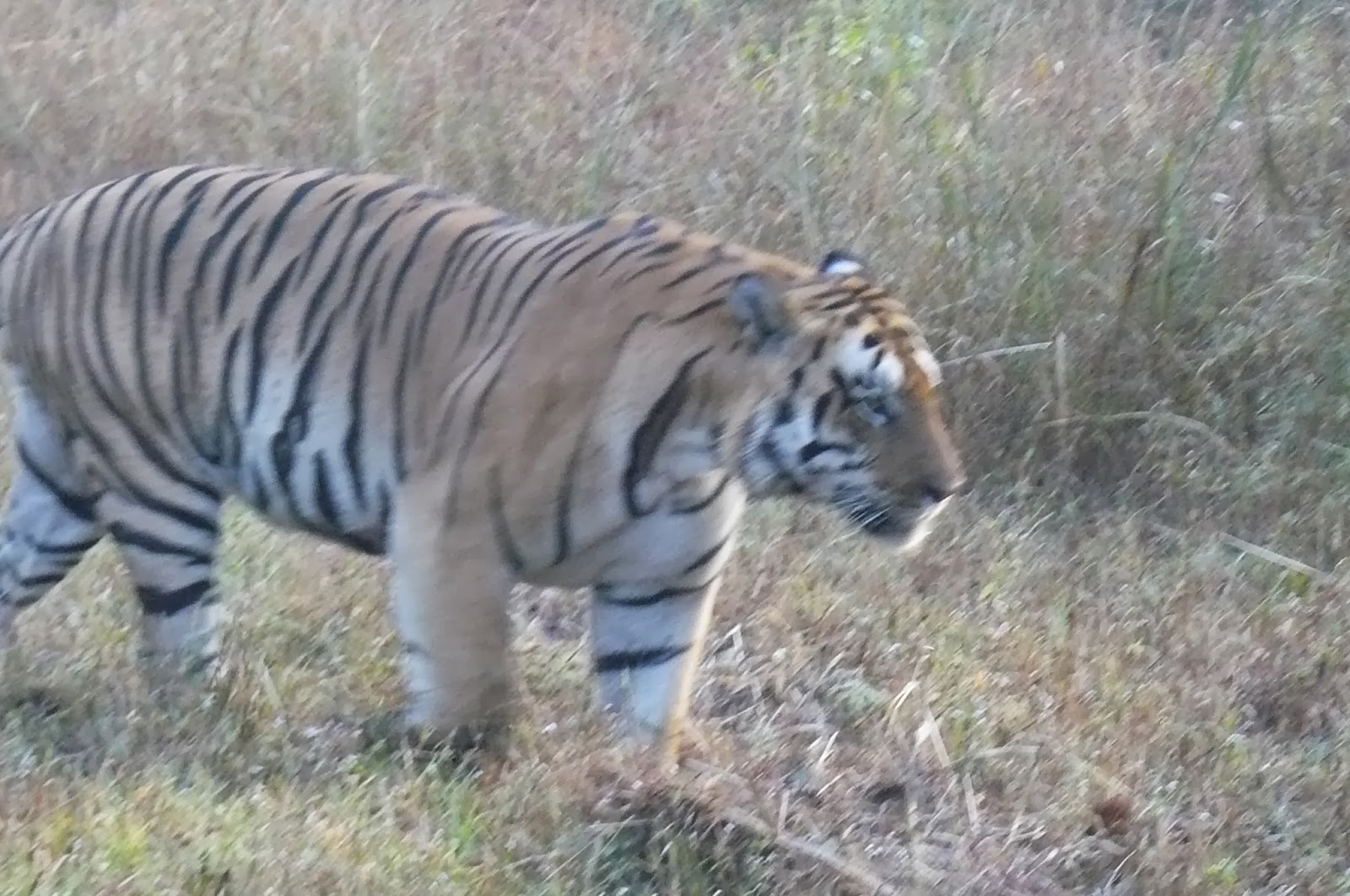
On the finest patch of forest that something exciting happened. The tiger emerged like an apparition in the mist laden ambiance. We could see him heading towards us. It first appeared like a termite mound some distance away. But the termite mound was moving right towards us. WOW!

"That's a tiger," I informed my guests. With baited breadth. 

The big cat came towards us as we moved the reverse gear in order to maintain a safe distance. The majestic cat took my breadth away. "It is not Munna", I whispered to the guide. 

"It is larger than Munna," the guide whispered."And in prime."

Munna is one of the largest tiger seen in the Kisli Range and neighborhood. It is aggressive and does not give way to the jeeps at all. The Maua Dabri tiger was definitely larger and in prime being around six years in  age.          

This was one of the most mesmerizing spectacle I had ever witnessed in my life time of wandering in the jungles of India.  The lithe graceful charismatic creature was a breadth taking sight and invoked fear. In the soft sunlight it shone like a magical delight. The reddish orange brown fur coupled with pure white was at its shiniest best. In the natural surroundings the beast looked captivating as it came upon us with a gentle stride. We were constantly reversing in order to maintain a safe distance. But in case of hesitation, I observed that the tiger moved towards the bushes on the edge of the jungle road. It did not mock charge or come very near to us. 

"It is busy,"I told the guests."Territorial marking". The tiger was spraying pheromones along with his urine on the leaves and grass. In the ethereal moment my guests could admire and photograph the majestic creature. Paul & Alison were kind enough to send me the images captured by them. 

I have added images of that majestic tiger below so that you can be a part of my exotic journey in the tigerland called Kanha.
                                    
                         Tiger Photographs - Paul Fear UK


Monday, December 9, 2013

Tigress on the hill

In the Kisli Range at Kanha National Park in MP there are two hills famous for tigers. Dig Dola and Sal Ghat the latter is named after numerous Sal trees present along with associates and bamboo. Dig Dola is named after a rock balancing on another.  This mountain has more of bamboo but practically the topography is the same. 

Some water bodies intersperse these mountains and the dense canopy in the valleys provide ideal cover to the tigers. The dense canopy also makes tiger sighting difficult although these areas are dominated by big males. Sub adult males sired by the dominant tiger and few tigresses some with cubs inhabit these mountains. 

The climb uphill is a rugged jungle path which twists and turns precariously along the edge. The "S" turns make the road ahead almost invisible and you can be surprised by a big cat if not careful. Leopards also inhabit the area but they are very shy and rarely seen. 

The tree line begins right where the road edges and some patches of small grass are often encountered. The dominant tigers are often encountered on the road. Munna the present male is often seen here by people on  tiger safari. This tiger maintains a large territory in the Kisli Range which keeps on changing. The tigresses are shy and rarely seen. 

We missed a tigress on Sal Ghat as she refused to come out of the bush. We heard her calling as I have mentioned in my earlier blogs. This is the tigress I wished to see and one fine day the wish came true. We where climbing uphill from the Saunf Meadow on Dig Dola Mountain trek whence we came across a group of jeeps at the Siliari Tank. 

"There is a constant ring of alarm cries,'' the guide on other vehicle informs me. We decide to wait but in futility since the tiger was deep inside the grass near the tank.           

"Move on." I goad the driver. "Lets move"

I surmise that the tiger is too deep and disturbed to come out hence it is futile to wait. The tempting thought of empty road downhill is the second incentive to keep driving. And as luck would have it a couple of kms  and we see a tigress coming straight at us. 

This is the Dig Dola tigress that we missed so often. She is shy and nervous and strangely does not vanish into the forests.  A large cat she appears to be pregnant? "Surprisingly big for a tigress," I inform the guide and he too confirms that she is pregnant by the bulge in the belly. 

The tigress keeps coming towards us and warns whence we are too close due to steep incline. A terrifying grimace, but then eases down as sufficient distance is maintained. We maintain a distance of twenty meters and my guests from Slovenia have time of their life photographing the big cat. The tigers have markings that differ and this female has thin stripes on white brows.

After giving long moments of filming the tigress vanishes into the jungle. One last look and we move on to our luxury hotel in Kanha for a comforting accommodation. The tiger safaris are tiring mind you,
Tiger at Kanha By Uday Patel
the jeep ride can be excruciating at times.

The guests are extremely happy having got amazing pictures of the big cat in Kanha. The evenings are spent over drinks and bonfire both helping us to contain our joy and the bitter cold.               

The menacing leopard of Kanha

Kanha Tiger Reserve - MP - India 

Our earlier trip to Mukki Range in Kanha National Park was devoid of big cat sightings. The range is unique since it holds extensive grasslands and two important water bodies. There is an old rest house built during the British times and worth a stay. The Mukki Gate is about 35 km from Khatia Gate and can be approached from inside as well as outside. The forests are much visited from people of Raipur in Chhattisgarh State of India and those who stay in hotels on Mukki near the park.  

Our recent trip to this range boiled with excitement. My guests were from Europe from a country called Slovenia. Both were professional photographers and one of them was also a tour operator. At Mukki we saw two tiger cubs near a water body. Probably the tigress was out hunting as we could not get any signs of her presence.    

Earlier we had seen two tiger cubs of Umarpani Female at Kanha meadow but the images where not satisfactory. The tiger family kept a distance and most often hidden in the bush. But the cubs near Babathenga Tank at Mukki were quite in the open and we could get some fine images. 

Satisfied and much happy we had a fulfilling breakfast of cheese and vegetable sandwiches, aloo paratha and fruits. Post breakfast we moved on to return to the Khatia Gate via a long stretch of jungle road. 

The unexpected happens, we were still in the confines of Babathenga Tank on the Zila Fireline in the Mukki Range. Driving casually and quite relaxed after having an onerous task accomplished we were ambling across that road at 20/km per hour. This is the prescribed speed of the park and allows your sensory apparatus to work more efficiently.     

Somewhere across the Zila Fireline, I spotted a leopard crossing the road few feet away. There was just enough time to react and I asked the driver to stop right at the spot from where the crossing took place. I was expecting that the big cat would have melted away in the bush. This did not happen!!!!!!

The surprised leopard was starring at me. The guide, driver and two lens men were taken by absolute surprise. Stunned into silence by fear is what I will describe the scenario as. Having heard me shout, "Leopard" the big cat sat there in "about to spring" position starring menacingly at me. I was on the seat. The eyes shone bloody as cryptic patterns created by strands of sunlight  formed on the animal. The chiseled canines,  deadly claws and the musculature,...few would like to view from so close. Given a choice, I would maintain a safe distance.

This is what was least expected although big cats do behave aggressively at times. I slid down behind the driver unnerved. But the lens men though out of wits were at their job with such a wonderful opportunity knocking at their cameras. But the guide was apprehensive as he could sense my trepidation. And soon the leopard was encircling our open jeep.   

This was a dangerous moment for the spots could strike. At a distance of six feet we were a sitting duck. The guide sensed trouble and shouted full throat, "HAAT." The leopard slid into the thick bushes and vanished for good. The driver was already moving forward during the episode in order to maintain a safe distance of 20 meters but then things happened too fast.
Leopard Photo by Teerath Singh
For some time there was stunned silence as we got out of the big cats range. The leopard could have gone unseen but for my alertness (Ahem!).  I turn toward my guests, my face beaming with pride, "so" I manage to speak. Still in a state of surprise they poke fun at me...yeah...ok...good. They had got super delicious shots of the leopard which we could see at the Courtyard House.

The rest of journey was full of exciting moments as we came across many animals of Kanha National Park.   

Thursday, November 14, 2013

Munna Tiger at Kanha

We are at Kanha on tiger safari. My guests from Sweden and India are excited and intrigued. This is their first tiger safari in India and expectations are high. We climb up the Sal Ghat Road in the Kisli Range hoping to see Munna and a female that often arrives here.   

With their cameras ready the guest priority is the tiger which disappoints me. I would like to give equal importance to birds of Kanha. Searching for tigers in their wild habitat is a tough task whence they are not stressed out to be on the move.  But there is always a chance of sighting one on the jungle road,

As we move forward we see no signs of the big cat but plenty of other game like sambar, spotted deer and many birds. We continue driving uphill on the torturous trek my eyes glued for moving leaves or rustle in the bush. My ears are alert to catch the tiger vocals...it is a desperate bid in this season as tigers do not move much unlike the summers.   

The jungles of India always hold big surprise to those with patience. About half way up the Sal Ghat we come across excited chatter of jeeps the ensuing commotion is suggestive of the big cat. We hold our ground as Munna emerges behind the jeep and heads toward us. 


The tigers are not very tall and maximum height is two and half feet. This helps them in ambush as they can easily hide in the grass and bush. Seen upfront the size is not evident. but when we saw this animal sideways we were stunned by the size. The huge tiger is about 250 KG and dominates the Kanha Park by its sheer size and strength.

We drove on reverse as we have to maintain a distance of twenty meters by the park rules. The tiger walks very fast and it came upon us very close. Oblivious of the jeeps and commotion the animal kept on invading. This is the moment whence the inexperienced are frightened. Big male tigers do not bother about safari jeeps albeit they are aware. You have to give ground to these tigers else they come frighteningly close. In case of delay in moving away the tiger slips into the adjoining forest. It is truly a gentleman.

Munna is a dominant tiger and moves around the major portion of the park with brazen impunity. He has sired many cubs through tigresses in his territory. As long as he is strong he will hold on to his kingdom and eventually lose to an emerging male. This is how nature works the survival of the fittest through best gene selection.   

My guests were happily clicked away to their hearts content. Things are not always the same after seeing this big cat. We moved on silently happy and excited after the marvelous tiger tour at Kanha National Park in Central India. Back at the Courtyard House accommodation in Kanha I could look at the images. The images sent by our guests are included in this blog.           

On subsequent jeep safaris my guests came across a sloth bear with two cubs. The sighting is no less exciting for true nature lovers. Animals big and small are charismatic creations of nature and we should admire them. Kanha Park is popular with birders from all over the globe. Keep a good pair of binoculars on safaris.           

Monday, October 14, 2013

Misssssssssssed the cat! By a whisker!

Brown Hawk Owl
Leaf Bird - Tirath Singh

Langur - Tirath Singh
The discovery of the Brown Hawk Owl (Ninox scutulata) a Northern Taxa was exciting. We were on the spot at Dumna Nature Reserve in Jabalpur on the usual Sunday birding. We could not see the owl that day but were satisfied by images taken by Prayut and Aishwarya Mandal. These two young guys have a knack for locating birds not checked listed earlier in Jabalpur in MP State. They have discovered Bar-headed Geese, Whimbrel, and a group of Ruff(?) besides this owl.   

Leopard - Tirath Singh
We spent a lot of time searching for avian species in the nature reserve. Dumna Nature Reserve is named after the Dumna Airport since it is on the way. The nature reserve encompasses 200 hundred hectares of mixed forest along with the Khandari Reservoir. The water body is large and is meant to supply water to some areas of Jabalpur City. But there are forests and small water bodies all around. 

The Khandari Reservoir is home to freshwater crocodiles, turtles, and various species of fish. In winter it is visited by many wintering and resident waterfowl. About five hundred Gray Lag Geese can be seen here alongside, wigeon, red-crested pochard, lesser whistling teal, nakta, northern pintail, common pochard, garganey, spot bill duck, and Eurasian wigeon. 

The surrounding forests are natural and once formed an intact ecosystem that was home to leopards and tigers. These forests formed a contiguous patch around the extant of the city. This is no more the case since the forests are badly denuded. The Dumna forests are subject to rapid construction hence another protected area for deer park has been earmarked for conservation. The fate of the forests now resides upon humans with greed for the land. The creation of triple IT or IIIT has denuded a lot of lands and continues to do so. There is a five-star hotel proposed for development by MPTDC? If true then it will be a further blow to the wildlife in the area. An immediate stop to all construction activity is a must in all green patches of Jabalpur.     

This is a stretch of about ten km and leads to the Dumna Aiport. There are some water bodies surrounding the airport as well as the reserve forests. This area is in the news for the regular sighting of leopards. A leopard has been filmed on the airport road by some enthusiasts. On numerous occasions, we have seen crocodiles in tanks, barking deer, wild boar, spotted deer, langurs, and rhesus macaque. In spite of regularly frequenting the area, we had not come across the big cat. A few years back I had seen a leopard with three cubs at Imzhar Ghati Forests near Pariyat Reservoir. 
     
Our birding trip led us to these forest tracts after we had a good look at the greenish warblers and a Eurasian Oriole family.  We came across several birds like shikra, white-eyed buzzard, white eye, rufous treepie, gray hornbill, and long-tailed shrike. It was a dull birding day on eve of Dusshera and we were busy discussing things besides birding. On our way back we noticed a group of people standing near the restaurant being built for IIIT.  Ignoring the crowd we moved on till Prayut called us back using the mobile. " Some guys have seen a leopard pair nearby" he informed excitedly. So we drove back to the spot but the big cats were nowhere in sight by then. 

The group was chattering excitedly and we could make out that they had seen the spots. "Just here, whence you passed us by. Look near the pole about hundred yards that were where the pair was idling," one of the guys informed us with baited breadth. Other people joined him in the confused chorus pointing to various directions where the big cats could have vanished. "You should have stopped upon seeing us," he spoke. "Your binoculars could have fetched them close."                          

We searched the canopy for some time and then gave up. We could not see the spots that day but there will be endless visits hence better luck awaits us I am sure. As we drove back in silence we traversed through huge buildings that are changing the landscape of these once pristine forests. Total disregard for our natural places is causing havoc and endangering prime forest animals in India. 

Tuesday, September 3, 2013

Leopard in Jabalpur - Video

These video speak of return of wildlife or beleaguered status. The leopard roams around the periphery of Jabalpur City towards Khamaria Forests, (Dumna) Airport Road, Mandla and Bargi Townships. It is heartening to note the animals presence. Much earlier tiger roamed around the periphery of this city. 

With reference to the second video why do newsmen not highlight humans making inroads into the home of the wild animals?  

Wednesday, August 28, 2013

Tiger Trouble - Live Stock Killings

It is quiet often that tigers come out of their hidings from dense forests in order to kill live stock. There are many instances of cattle kill by tigers in brought daylight right in front of the villagers.  This often calls for retaliation by the villagers during the kill or after it. The irate live stock owners often poison the carcass in order to seek revenge for the loss of their cattle. 

In many cases the tiger is at the kill with hundreds of villagers gawking at it. This is a dangerous act since there have been cases of people being killed by tigers on kill. This usually happens whence villagers venture too close to the big cat. These animals are intolerant whence eating and they charge in fear.  

The villagers encroach tiger habitats with impunity in periphery of many tiger reserves. This invites conflict with big cats inhabiting the area. Often the cattle are killed or the big cat chased away by the herdsmen.  This is an ongoing problem in tiger habitats and no solution has yet been found.   


Charismatic Wildlife of Central India

Male Tiger

Sunset at Bandhavgarh

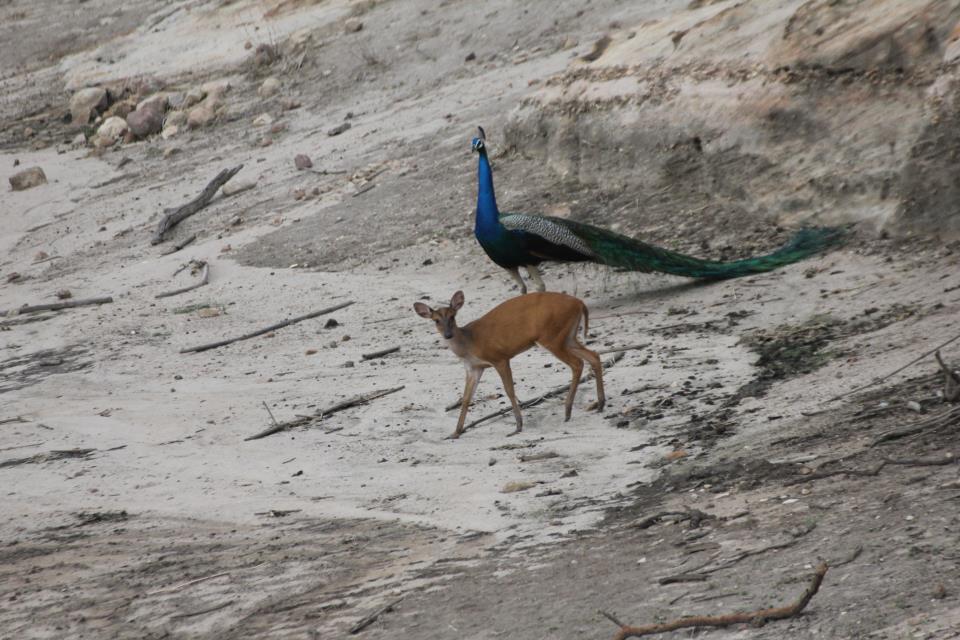
Barking Deer & Peacock

Mugger Crocodile

Great Stone Plovers

Leopard at Kanha

Leopard on Tree


Tiger at Tadoba

Sloth Bear

Tiger at Bandhavgarh

Tiger Near Water Hole
Tiger is Grass
Tiger Road Crossing

Wild Dog at Tadoba
Central India or the State of Madhya Pradesh and part of Maharashtra abounds in enchanting wilderness and amazing wildlife. The animals and birds can be seen at tiger reserves which are of World Fame. Most popular tiger safari destinations in Central India are Kanha, Bandhavgarh and Pench National Park.

Other tiger reserves in MP are Panna and Satpura while sanctuaries such as Bori and Nauradehi are slowly gaining popularity. The charismatic wildlife can best be enjoyed at tiger reserves with proper tourism infrastructure. Places like Bandhavgarh, Pench and Kanha National Park are well equipped for tourism. 

The Tadoba Tiger Reserve is in the state of Maharashtra. Tadoba Tiger Reserve is an emerging tourism destination. With the establishment of budget and luxury hotels in Tadoba tourism for tiger safari is increasing. The reserve is part of Central Indian Highlands which were ones a contiguous patch. Tiger sightings are very high in this reserve thanks to less restrictions imposed. 

For wildlife photography Kanha and and Bandhavgarh are the best. The former for its tigers and abundant wildlife and the latter for its tigers and picturesque settings.    

Photo Credits Teerath Singh

Sunday, August 18, 2013

Tiger Family at Bandhavgarh

This video was taken during Bandhavgarh tour organized by MP Tiger Safari in the State of Madhya Pradesh in India. The little cubs follow their mother obediently straying away could be dangerous. This video was shot at Banbei in Bandhavgarh and is a rare sight.