Showing posts with label reserves. Show all posts

Tuesday, May 11, 2021

Dying Tigers

Tigress Killed

She was choked to death in the cave, the one place she had chosen to give birth to cubs, but fate had another story chalked out for her. Upon discovering the tiger's lair, the poachers mercilessly clogged the opening and set things on fire. She was not incinerated but rather suffocated by smoke that had filled in the cave. She was killed along with cubs in her womb. This sordid saga is not just one event, there is an ongoing onslaught on the endangered beast in India. 

In a spate of few weeks, some more tigers have been killed, and this is alarming. Often the murder is passed off as a territorial fight or due to old age, how many of these narratives are true God only knows! Who bothers since the big cats are no political liability, the incidence could just pass off as unfortunate.

Killings using guns, snares, live wire, and poisoning the kill of the beasts are ongoing year on year. In a spate of eight years around seven hundred tigers have died, and almost half have been killed leaving the rest accounting for natural deaths. 

The figure of seven hundred is ominous with most of the deaths taking place in Central India and Maharashtra, incidentally these states account for a robust number of big cats. In some other States, the population is sizeable and so are the deaths but States are not in the context in this write-up. With the increase of 750 animals between two nationwide censuses the deaths equal them, or maybe if the unaccounted or missing ones are taken into account we are losing more tigers than conserving them.    

Even if we do not enter into the nitty-gritty of census and the growing numbers, the large number of deaths should be considered alarming. Add to this wrong labeling in case of poaching's being declared as territorial fights the figure rises exponentially. 

This points to lacunae in the management practices with regards to the conservation units all over India. Once we get over our obsession with tiger tourism, which by all means is innocuous with the regulation in place we have to dive in as to what is going wrong. 

We can call the poisoning of cattle or other livestock killed by a tiger a man-animal conflict. But live wire, snaring, hunting by gun or other weapons is not a man-animal conflict it is poaching or pure murder and a crime. This is going on for too long in India for comfort, and no concerted effort is being noticed for the amelioration of this deadly scourge. 

Why this neglect?

This is not a pure case of neglect there are gaps in our protection mechanism. And the solution is at the macro level.  

The number of such incidences could be reduced if the local staff or ground staff is proactive, alert, and effective. The latter aspect is missing. The post is part of a huge government sector called the forest department and is under the aegis of State machinery.  Still, under colonial makeover, the department functions in isolation and is not proactive enough to invite public involvement hence there is no voice as a result. Most of the news generated is by an instance of tiger death and at best limited to the incident often without many details. 

Hierarchical Alienation

Hierarchical alienation is evident since some of the top brass function in isolation surrounded by a coterie which includes the ubiquitous babus. Add to this there is substantial political interference, and corruption for which not all, and the department as a whole, cannot be blamed. There are honest and hard-working people in the whole hierarchy starting from the top. But those corrupt mar the functioning and this impacts conservation initiatives.              

Hierarchical alienation leads to lower staff which is most instrumental in the protective mechanism work in complete isolation, and in a weakened position. There are two reasons: lack of support from the higher-ups since many least bother to work at ground level, and an ineffective legal mechanism. I had been pointed out these lacunae in the system by the ground staff many times. The enormity of administrative work could be another reason for the lack of interest in the field.    But let's keep in mind the dedicated honest work loving in the management the reason behind success in an increase in numbers. I am not judging everyone under the same lens since a lot of commendable work has been done.

Corrupt officials and subordinates interfere in the functioning or are lax in their attitude. Some in the management of tiger reserves are just there to while away their time with no interest in conservation, while some are not fit enough to undergo rigorous physical and mental demands of fieldwork. As regards this, it has been pointed out time and again that placement should be subject to merit. But this is not happening as favoritism, personal preference and political influences are still being talked about. Readers should note that political/administrative pressures and demands are very much prevalent in this ecosystem. Special privileges especially as regards tourism must come to an end.

 Core Vs Buffer

The anomalies in the core or the inviolate area are much less, and greater administrative cohesion is seen. This is due to a better sense of duty, pride in the heritage, and public pressure that is constantly hovering. 

The buffer is the convergence point where outside influences creep in. The outside group comprises of political goons, mafia, and detractors mostly those under severe threat perception, or under the influence of organizations that do not agree with conservation practices. 

We must also note that a good number of locals are bereft of wilderness, treat predators as threats, see herbivores as food, and have the least interest in conservation. This leaves out dedicated officers and ground staff who nevertheless carry out their duty to save the animals that survive between humans. To the benevolent group, we must add the staff, guides, small businesses benefiting from tourism and the number is sizeable. This group is supportive of all conservation initiatives and put in efforts to make them a success. 

The beat guard or forest guard is most susceptible to threats, negative influences, stressful working conditions, and as mentioned earlier he works weakened. This leads to a weak protection mechanism in the buffer where most of the tiger deaths are taking place. Few incidences do take place in the core as well especially in areas near the buffer. The borders of our tiger reserves are porous and people can enter easily as not every nook and corner can be guarded. 

In most of our tiger reserves, in spite of demands for parts due to TCM or other reasons poaching is less. Few small times poachers do exists and kill tigers accidentally wide a mechanism meant to obtain game meat. But this is happening regularly and modus operandi is live wire or snares. The ultras wherever present prevents sound protection.            

Revenge for man/livestock kills can be termed as man-animal conflict and this is done using poisoning of the half-eaten carcass. As a preventive measure, the tiger kill is removed so that in absence of predator poising will have no impact and this is working effectively in the periphery of the reserves. But for other maladies, there is no solution yet.    


================================================

Uday is a blogger and offers Seo + Content For Digital Marketing Services. 

He teaches digital marketing (SEO) in Jabalpur.

He freelances as a naturalist/birder at Kanha National Park. He loves to write about travel. 

He can be contacted at: 

pateluday90@hotmail.com

09755089323

Author


Sunday, February 21, 2021

Preventing Extractive Tourism in Tiger Lands?

Tiger Tourism Pros & Cons

In the tiger lands or the reserves, tourism is the butt of contention for its detractors. Yes, there appears to be a small tribe that includes some officials and a few organizations who do not believe that any form of recreation is deserving in our tiger reserves. 

Alternate tourism in the buffer or now eco-sensitive zone (ESZ) does not seem to be promising and could reduce tourism to naught sinking local economies back to primitive status as before the advent of tourism.  This area is subject to biotic and abiotic pressures on its limited resources and space.        

Although cumbersome legal interventions in the past were unwarranted the impact has been remedial as far as the dangers of extractive or mass tourism are concerned. This does not imply that legal battles are imperative. 

The credit for reducing carbon footprints in the reserves by restricting mass tourism goes to the sagacity of our legal system and wildlife managers - the wise men that are at the helm. Equity is of utmost importance as far as the preservation of natural lands and its denizens are concerned and tourism accords it without fail.  This also clears the fact that what pays stays, a harsh reality indeed. 

The reserves generate a lot of revenue from tiger safari and the funds are plowed back into conservation activities managed by local labor, and regular and permanent staff. Fund flow as salaries providing livelihood.     

The tiger reserves are remotely situated but not far removed, most of them are engulfed by dense humanity in the surrounding livestock included. Well-fed people respond better to natural surroundings the fragile ecosystems. Thus economic activities can never be thwarted or subdued beyond a limit. 

Tiger tourism in India has proved benign, for years of inception, no noticeable damage has occurred in the ecosystems. On the contrary big cat population and prey, density has increased and habitat recovery is noticeable. The recent entry caps have further assured the validity of preservation laws.       

Thus the vision of detractors is at best myopic and seems to ignore the harsh reality of a free economy. All income generation activities are for survival and thus unavoidable. We can at best regulate and restrict in order to save the environment and the local infrastructure from the immense pressures of mass tourism. 

Tourism in Tiger Reserves    

Tiger Tourism is already regulated, the permit system and cap on vehicle entry are all environmentally friendly measures that substantially reduce carbon footprints. Fewer vehicles on drive mitigate pressure on wildlife and enhance the safari experience as well.  

Mass extractive tourism is always a threat to the local environment where the environmental consequences are oft-ignored. This is due to the belief that mass tourism augurs immense benefits to the local economy in spite of exploitative tourism practices. But in a rich man's world where travel is a privilege of the upper crust more in the post-vaccine rollout era, the tourism hot spots are turning back into an unmanageable hub of activities. Paradoxically unregulated tourism is the biggest damage monger to the environment and to the local infrastructure.     

In natural places by local infrastructure, we should not restrict ourselves to roads and bridges and the concrete structures that eventually crop up. The ecology-rich areas and natural resources come under the purview of local infrastructure, and the maximum damage occurs here...irrevocable in most cases. 

Tiger Tourism Concerns & Remedies

No pressure should be exerted upon crucial aquatic systems, deforestation should not take place, agrarian practices should improve but not expanded, livestock rearing should be organized such that biotic pressures are mitigated, urbanization is the bane of eco-sensitive areas and alternate habitation should be encouraged. 

Prevention of debilitating industrial activities is of utmost importance in order to prevent deforestation and pollution. Commercial activity should be nature-oriented like encouragement to arts and crafts. Local hospitality ancillaries are vital for tourism everywhere hence monopoly should be discouraged. Real estate exploitation is a reality in such hot spots nevertheless the tribal lands are well protected by law.      

All this appears to have been copied straight from some ecologist's write up but this is beside the point. The desire to move in the perceived right direction is stressed out here. This article simply points to a rethink as far as wilderness management is concerned in India.               

Threats & Perceptions

The Threat Remains in Buffer Zones. The term buffer zone itself is defeatist in nature with no remedial action deemed possible. Considered as a leftover fragment of the intact ecosystem in the core this is where livestock rearing and agrarian practices are permissible. Space is also for the survival of sink populations of wild animals chiefly the tiger. But cohabitation in modern times at best seems a romantic illusion. Some species are very sensitive to human interventions and animals like the swamp deer for example cannot simply survive in the buffer. Sturdy wildlife does survive in green pockets in stressful circumstances giving rise to man-animal conflict. Tourism in the buffer is another plus point.     

Although the translocation of human settlements in the outer ring or buffer appears to be an instant panacea this is not a pragmatic approach. Alternatives have to be found for better preservation of the reserve keeping in place the inviolate area or core as sacrosanct.      

Small or large-scale industrial activities have not yet entered most of the reserves I have visited, but the threat remains. Our belief that urbanization is development in terms of concrete infrastructure and economy is mired in fallacy. The policymakers see all regions including the places of natural importance as uniform entities and thus insidious urbanization is creeping in. With no alternate framework specific to places of natural importance the die is cast.   

Exploitation: Corollary to Mass Tourism 

Mass or extractive tourism is often linked to the exploitation of local resources and manpower. This stands true in most circumstances but this corollary does not apply to the tiger reserves or protected areas in India with restrictive and regulated tourism.

Low salaries and extensive working hours as some point out are due to capitalism is not the case in the reserves. If there are such instances then competition is a great leveler and hard-working locals who grasp diverse skills are not facing any problems and their status is at best robust. As a matter of fact, due to empowerment, the local youth is moving out to cities for better opportunities.      

Small is Good

In this writing up there is a message for wildlife resorts that large establishments will never see the daylight. In keeping with environmental concerns, vehicle entry limits are not going to be enhanced. Hence room requirements would be low-scale except in the rush. 

Courtyard House Kanha - Responsible Lodge

Creating a small establishment or responsible lodge is
 the order of the day. It has become imperative to keep accommodations small. Perhaps a larger establishment would need to bring down the number of rooms. This will help reduce carbon footprints and improve nature in the surroundings.        

===========================

Uday Works as Freelance Naturalist and Blogs on conservation, tigers, environmental issues.

He also provides SEO and Website Contents in English. He teaches Digital Marketing in Jabalpur in Summers.

He can be contacted at:

Mail: pateluday90@hotmail.com
 Mob: 09755089323


Monday, April 27, 2020

Covid-19 : Why Close The Tiger Parks?

After the frightening and murdering pandemic, we have developed cold feet and long ultra-sensitive ears. In this predicament, we have forgotten that the economy cannot be halted for long irrespective. Yes irrespective of the damage this bugger is doing, things will have to move on - albeit a paradigm will have to set in which will make us and the wildlife less susceptible to the pandemic. And we have enough time! Well nearly!

I have read that some people are interested in the closure of the tiger reserve during this pandemic which seems to cross over a year or more.

I am writing here (as an amateur) to plead for tiger tourism in our reserves. The show must go on!


The news of tigers being affected by coronavirus should not create panic since the conditions are different and so is the country. In the USA there are five thousand big cats in custody many in a private capacity and not part of an institution, such is the nature of policies that the country abides with.   

At the most, we should learn how to save tigers from this deadly pandemic from that incidence in captivity. We do have disease diagnostics and treatment centers for wild animals in India. 


People who are advocating the closure of National Parks and WLS for tiger tourism are displaying a haphazard and frenzied assessment. There are some points to consider regarding why tourism should be continued in these wildlife havens in India. 

  • Tourists by regulation have to maintain distance from wild animals, especially tigers during the excursion.     
  • A large workforce that comprises the management - Rangers, beat guards, vets, officers, and sundry labor will not be stopped from entering the core zones. This aberration would certainly lead to poaching, wood logging, and frequent trespass within the core.  Hence nobody will be able to prevent nearness to these animals in the core. 
  • Human intervention often required will again bring the vets and helpers in close contact with the wild animals.
  • In the buffer zones there is no check on human activities, hence chances of big cats and other animals closing up on humans are maximum. Closing tourism in the park will not prevent these incursions.  
  • Most important we have forgotten the economy of the guides, drivers, and local small businesses. The resorts may not find it feasible to pay the staff they will definitely be reduced to the bare minimum.

    This extensive lockdown and the time of reopening of the parks in October 2020 have given us a lot of time to get things in proper order. And our Governments have been very alert and sincere in tackling this malady that would certainly act against harsh economic measures.

    The detractors will anyway find out how the wheels of the economy churn in spite of the pandemic. It is simply impossible to halt economic activities for a long time. I am talking about people who survive on daily wages and those with little savings. They will have to gear up to work pandemic or no pandemic. Mind You!

    Another factor we have to consider is that people in India are less affected by the pandemic, I mean infected. Secondly, a distancing and preventing mechanism is taking place. And most important tests and diagnoses are in place or increasing substantially in the country. This is the biggest safeguard against the further spread of disease.

    I am sure International or inbound arrivals would not be allowed to enter India without confirmation of their status.  Those who are found positive whether in their country before going on board, or in India upon entering will not be allowed to enter the parks as well.

    Local staff, I believe the forest department would have already tested them. The staff pertaining to a local institution in shops and commerce will have to carry a green certificate having been tested in recent times. 

    Those who are aware of our ecosystems and understand wilderness know very well how strong the immunity is among wild animals. Tigers and megafauna have immunity far stronger than humans and certainly those surviving in the harsh conditions of the wild World.

    I am writing as an amateur naturalist...but we have the right thinkers amongst our wildlife managers and policymakers hence sagacity will prevail.

    We must carry on with the show next October Onward!   
================================================
Uday Works as Freelance Naturalist and Blogs on conservation, tigers, and environmental issues. 
He also provides SEO and Website Content in English.
Uday Teaches Internet Marketing Classes in his hometown of Jabalpur in the Summer.  
He can be contacted at: 
pateluday90@hotmail.com
09755089323

Thursday, April 23, 2020

Responsible Tourism and Tigers

Tiger Conservation Our Responsibility

Well, we are responsible for the sad state of tigers in India and the World over. While the conditions in India are improving with the increase in the population of big cats still the animals are nowhere out of danger. Yes, they are still endangered and still critical. Their population can slide down with a single step missed or a wrong foot forward. Such is the precarious status of the magnificent predator all over.  A lot depends upon our attitude towards this animal A Pride of India. A lot depends upon how the policies are shaped by those at the helm. A lot depends upon our sincerity to conserve this amazing creature on Earth and an utmost fascinating one at that. 


The seventies brought back this animal from the brink whence the Wildlife Protection Act 1972 and Project Tiger were initiated by the Government of India. Butea there are lot many issues still present which create a threat to the species' survival. 

While human activities and our irresponsible nature are responsible for the plight of many life forms. The resultant climate change or global warming is affecting the survival of many life forms globally and mass extinctions have become a reality. Now pandemics have also become a reality and that too in a vicious form as seen in the case of Covid-19 or coronavirus.


Sustainable Tourism

So every responsible step we take we will end up saving many life forms. Tourism is a major economy in India that earns substantial revenue from overseas and local visitors. Thankfully in India, at least tiger tourism is regulated. Yes visit a tiger reserve and you will know. 

But responsibilities have to be on a wider scale encompassing all those involved. This would encompass you and me, tour operators and hoteliers, and the people around the reserves. All elements mentioned above can bring down the extinction rate significantly.

The responsible tourism principles advocate:

  • Smaller Carbon Footprints
  • Accommodating Locals in Jobs 
  • Create New Eco-Friendly Livelihood Options
  • Conservation of Natural Resources
  • Rewilding 
  • Community Initiatives 
  • Contribute to Ongoing Community Initiates
  • Empowerment of Local Communities
  • Local Infrastructure Development Assistance
  • Renewable Energy Initiatives   
  • Maximize Purchase of Local Produce 
  • Encourage Handicrafts Development
  • Assist in Modern Dairy Farming 
  • Assist in Horticulture 
  • Proper Waste Disposal 
  • Minimize Use of Energy
  • Minimize Use of Natural Resources 
  • Assistance to Forest Management 
  • Compliance With Protected Area Guidelines
  • Compliance With Excursion Rules
In times of restricted entries in the park, smaller properties that leave minimum carbon footprints should be encouraged. Community initiatives and infrastructure development like empowering schools and hospitals, training locals in various disciplines for a sustainable career, and more. All these activities are within the reach of resorts and tour operators with a robust balance sheets.    

Courtyard House Kanha Community School Initiative 

The battle to save the big cat is multi-fronted and holistic, the local communities and the management are in the frontline. As people of India, we too are responsible for our heritage and should act in tandem with green practices in the confines of our homes, neighborhood, and society.

Economy & Conservation 

When the wheels of the economy churn conservation are at their best and nothing churns it better than tourism. Without equity, none will survive including the tigers. Albeit the conservation of species is based on scientific principles in the contemporary World this will lose ground.
Local Labour - Road Works
This archaic perspective of tourism being the antithesis of species conservation is at best myopic and should be done away with.

Our Protected Areas

Take the example of protected areas most of which have now become intact ecosystems and an appreciable increase in the population of different species including the tiger has taken place. This has come about by creating an inviolate space and restricting human activities. An extensive protection mechanism helps ward off poachers, wood loggers, and their heinous acts. 

The contribution to the local economy is in all perspectives phenomenal and has to be seen to be believed. Take the example of  Kanha National Park. In the seventies, during my earlier visit, all the villages lined up along the road to Kanha, and inside were a spectacle of extreme poverty and cut off from the mainstream society....not now. Those who consider the economic upliftment here as minimal need to conduct a proper survey keeping in perspective the era before tourism became popular. The parks are receiving substantial funds due to tourism and that is impressive by all means.


The vision of detractors is poor and steeped in a conservative attitude. Many in the bureaucracy find tourism a nuisance and a hindrance in conservation activities, this is nothing but a colonial stance.

There are many NGOs mostly human rights activists who have little knowledge of how beleaguered ecosystems are repaired and how they function. They are not adept at understanding animal behavior, especially of species which are shy of man. They are well some of them are detractors of tourism and the core area concept reserved for other life forms to breed and survive in peace. They seek human footsteps everywhere. A very human-centric attitude like some of our politicians. 


Regulated tourism is an inseparable aspect of conservation now and the sooner we realize it the better. It accords equity to the tiger and other animals in the minds of people. It encourages local participation in the preservation and protection of their heritage.  Most important it runs the local economies and empowers people belonging to various strata. It helps remote communities join the mainstream society in India and bring them into the nexus of social benefits and related gains.

==============================
Uday Works as Freelance Naturalist and Blogs on conservation, tigers, and environmental issues. 
He also provides SEO and Website Content in English.
Uday Teaches Internet Marketing Classes in his hometown in Jabalpur in Summer.  
He can be contacted at 
pateluday90@hotmail.com
09755089323
===============================

Thursday, August 15, 2019

Tiger Conservation: Unspoken Sentinels The Forest Guards

I remember a long time back whence I was freelancing with Tigerland Resorts at Kanha National Park, I was assigned a group of schoolchildren from New Delhi. The group also included teachers from the DPS School who obviously were the caretakers for the tour. 

The tour comprised safaris and lectures on wilderness, a sort of awareness campaign full of fun and interesting experience for the children. 

On the first night, the teachers refused to sleep in their rooms facing the jungle. Well, the staff was instructed to sleep in front of the doors and the matter was taken care of. 

"We will be eaten by a tiger!"

Dead tired, I promised to discuss it with them the next day. All I had to state the next day was the fatalities, murders, road accidents, and robberies. psychopaths, nuts, killers, fast cars, and blah blah dangers which they confronted daily or rather each given moment in the Metro.

"It is unlikely a tiger would kill you if you sleep here in the room or venture out on foot every day. The rural folks trudge into these forests for collecting wood every day without fear. The forest guards move alone in these forests to protect wildlife.

People die because of accidental encounters or due to deliberately impinging on the animal's private space. But these incidence are rare as a matter of fact very rare. You are  a thousand times safer here, so please all through your stay be at peace." They did!      

The true sentinels are the front-line staff the forest guards, deputy rangers, etc. They are the people who traverse or scour through the forests on foot looking for snares, traps, local goons, illegal minor forest produce collectors, and yes sophisticated poachers and ultras. That is a huge burden on two small feet and a feeble body.

Forest Hut & Guards
In the deep confines of the forests, they trudge on foot, on bicycles, and on motorcycles. In the tiger land, this would be an extreme adventure for most of us, not for the guards, they are on duty that need extreme courage, sincerity, and dedication. Coming across tigers, other wild animals, and reptiles is frequent, for some it may be on daily basis. But they are well versed in the ways of the wild and keep themselves safe.   

Whence we revel in the ever-increasing tiger numbers these are the people who deserve the awards and the glory for successful tiger conservation in our country facing extreme odds, and adversities of unparalleled nature whence compared with dwellers in the cities.  The threat is not from animals, the threat is from intruding humans, poachers, criminals, etc. As stated above. 

The threat from animals is of a different nature head-on charge is a rarity, they have to avoid accidental encounters the most which the guards are good at. An odd aberrant behavior may be the reason for a tiger killing a guard. Yes, this does happen but once in a blue moon...but we humans are more likely to die of accidents, criminal charges, or an act of terrorism.

We especially the reporters should abstain from vilification of wild animals in case of tragic encounters, we are no longer in their food chain and accidental killings should be seen from a rational perspective. Habitual man-killers are anyway incarcerated or killed.

Sometimes the forest guards have to face the wrath of the locals whence a big cat kills a man who has come too close. Yes, most of such killings are in self-defense whence a threatened tiger finds a man very close for comfort, or whence villagers try to snatch away the kill.        

Like our soldiers who face the violence of the worst kind, the sentinels being discussed here also face threats to their lives...remember they are unarmed. In some of the tiger reserves, the threat is from ultras while that from organized sophisticated poachers too is prevalent albeit not extensively in India. As a precaution, the foresters move in a group or in the company of another. But whence occasion arises they have to move alone.

The hard life of labor and constant patrolling -even in challenging weather day and night- is what our foot soldiers do in the tiger reserves keeping it safe so the wild animals thrive. They safeguard the ecosystem as a whole. They also supervise small construction works like building dams, roads, waterholes, canals, etc. The foresters are responsible for the safety and well-being of the laborers who are involved in the construction works.

They are the virtual arms of the mechanism that keeps the reserves alive and kicking. Like the patrol elephants, they keep an eye on the wild animals and the forests and report to the higher officials or the camps nearby for assistance or attention.   

Most of the foresters live in patrolling huts or fire-watching camps deep inside the forests. For items of basic necessity, they depend upon feeble supply chain mechanisms or acquire it themselves whence they visit the small towns nearby.  They are always at the beck and call of any emergent situation that arises in the deep confines of the forests.

Far away from emergency care and their families, they live in isolation but nevertheless fulfill their duties without fail. They are the stars of the conservation units and deserve appreciation and all benefits that can be possibly accorded to them.

Some of the foresters are excellent animal trackers and have an in-depth understanding of animal behavior. They are very good at recognizing the floral elements present in these biodiversity hubs. I have been interacting for many years with our front-line warriors and never felt a lack of resolve or spirit amongst them to protect the magnificent ecosystems that the country has inherited.

The forester's job involves multitasking for they can work as clerks, tourism supervisors, maintenance crew, hosts for filmmakers and esteemed guests, and assist the veterinary staff whence the need arises.

Hail The Heros!!
==============================
Uday freelances as a naturalist and loves to write on tiger conservation and environmental issues.
Contact: pateluday90@hotmail.com
09755089323

Friday, July 19, 2019

Of Tourists & Tourism in Our Tiger Reserves

Kanha National Park sets a fine example of how to manage tourism in the core area.

This sentence above is enough to get the gist of the article to follow. I am pro-well-regulated tourism and this article is pro-tourism. Those who disagree should read more carefully. 

Thankfully destructive hunting days are over, and better alternative tiger tourism has taken over. I am unabashedly using the phrase tiger tourism albeit a holistic approach depends upon how the industry presents a visit to the reserve and of course our own attitude. Tour operators and hoteliers should present safaris as holistic comprising many aspects of the reserves. They should not guarantee tiger sightings at all and promise a more fruitful and wholesome experience.  

Swamp Deer

A singular obsession for sighting tigers should not be there but it will remain, for some species attraction is natural and fascination with a specific animal or bird is quite obvious. Ironically many of the initiated follow the path of tiger obsession including some of the senior officers, VIPs, and other privileged souls with an interest in photography and with all the prerogative in their control. 

This singular obsession with our National Animal is natural, thanks to the status that has been created in the past. That it is at the top of the food chain and an apex predator naturally incurs a lot of interest among visitors. It is not only the morphological attraction, the historical pathway that has reduced the footprints of this magnificent beast making it rare and endangered. And hence an object of desire.

Tiger


The animal's own charismatic/behavioral appeal is responsible for its obsession with the carnivore. For some association with Hindu religious identities or myths is the reason for attraction though much less a reason as compared with others. The animal is part of many myths and stories and has inspired many writers too. Kipling Stands out! Globally there is a desire to see this animal at least once in a lifetime. What is wrong?   

I have read articles by the erudite that lament the fact that the tiger cannot vote! This is a simple summation of its standing in our country and elsewhere. 

Jeep Safari
Why cannot people see the tiger and admire it in its natural surrounding? 

Those who advocate a ban on tourism or limit it to impractical means do have a right to express an opinion but the positives far outweigh the negatives.  

Does not tourism and the popularity of the carnivore create equity that we understand and the politician certainly do?. 

Without tourist (read public) appeal the status of animals would not have been a big botheration for those who consider it as a speck on the horizon. There are many at the helm who consider conservation as an irritant...I hope you get the point. 

With ubiquitous warming and subsequent climate change, environmental concerns should be imperative that those at the helm should be well aware of. To make matters worse global ecosystems are being ravaged on a massive scale ....and tourism has nothing to do with this at least in India.  

It is the importance/obsession or fondness for the animal among the common man that propels the administration and our policymakers into sincere action. The vote bank should lend a voice for better conservation practices and a concern for our wilderness. To negate public pressure in this country is like acceptance of incompetence and negligence with gusto. 

Public pressure matters and will continue to matter. The dreadful remedy that thwarts the rise of public concern is to curtain all that is happening by barring public access like in the totalitarian states, and in this case, thwarting sustainable tourism. In our country, a closeted approach is often followed as regards the management of things. 

Pertaining to my first sentence tourism is conducted as per rules and regulations at Kanha National Park. This I have been observing for more than two decades. My first visit to the park was probably in the year 1972 or maybe earlier. 

A few of the tiger reserves which I will not name since my visitations have been limited there, the safaris are horribly managed and an atrocious attitude follows - there is literary a free for all. This is why tiger tourism is looked down upon but this does not stand true for all reserves.      

Setting A New Tourism Paradigm

We as the public have to understand that we must cooperate with authorities and strictly follow rules and regulations of the reserves. A singular obsession with the big cat does not deliver much, a holistic approach will really be interesting and will create greater awareness.  

The reserves have so much to offer so indulge in birding as well as in megafauna and take interest in the microcosm that prevails in these biodiversity hubs. Enjoy every aspect of the reserve, and follow the guide and the naturalist. All creatures big and small are beautiful and worthy of admiration hence making your safari holistic. 

Do not encourage to break the rules in your haste to see the tiger or other megafauna. This is a problem in some reserves. 

Stay at responsible resorts which follow green principles. Those that do not or have encroached should be shunned. Overall keep your carbon footprints small by avoiding materialism or things of luxury during your stay. Remember sustainability counts use water carefully, do not use materials that are not biodegradable, do not waste food and consume fewer fossil fuels and rely on alternative energy.  

Tigers perhaps will come out of the endangered status one day and we will continue to have an opportunity to look at nature's amazing creation along with other creatures in their habitats. 

Let us be wise and restrained!
=================================
Uday works as a naturalist and loves to blog on conservation and environmental issues. 
Contact: pateluday90@hotmail.com
9755089323

Saturday, September 15, 2018

Dissecting The Tiger Reserves

The news is infrequent but the consequences are deadly. Already a large part of our land mass has been stripped of all-natural ingredients and more are being subjected to them. Politicians and bureaucrats do not accord consideration to the land which has been deprived of an ecosystem bearing or is too difficult to be comprehended as of ecological importance.

The dispensation exhibits limits of ill-planned approach, lack of logical thinking, no care for our environment, and declining wilderness. Economic upliftment is an urgency often aimed without proper planning and with total disregard for remaining natural landscapes. Populist governance is a bane of democracies all over the World not only in India, otherwise a time-tested meritorious system of governance.    

Large ecosystems under the ambit of conservation and right under the public eye do survive the rot, but this is not true entirely. Dissecting our tiger reserves, National Parks, and wildlife sanctuaries under the road and rail development programs are considered as a prerequisite since that is imperative to our goal of economic development. 

During the Raj inaccessible lands were ripped apart by road and rail construction leaving the forest lands open for depredation and its wildlife for easy culling. The rulers had only one aim in mind and that was to generate revenue from a usurped Nation. But the land in question belongs to us and certainly does not justify the emulation of policies of our erstwhile masters. But that is what we are doing since independence. 

After all, it is just a strip. Is this well under the limitation of sustained development in green corridors? The impact of the decimation of such strips of forest lands is disastrous, but it does not appear to be so whence the quantum of land destroyed is considered inconsequential, and the imbalance and disturbance caused are considered negligible. Whence the conservationist cries hoarse this is equated with the parable cry wolf!     

The fact is even an ill-planned minimalist approach to urban development in green corridors or protected areas can augur fatal consequences and in some circumstances that negative impact may be futuristic. For example, we have seen the impact of massive deforestation resulting in global warming in recent times. 
Teerath Singh 
Plans are often accepted and implemented by managers and bureaucrats with no insight into how ecosystems or natural lands work. They have no idea about the biodiversity prevailing in those places. They have no knowledge about the sensitivities of other life forms and their survival. Technical and economic viability is the key consideration taken into account, and yes the beneficial political fallout could favor the ruling dispensation. In the hurry to implement the projects, wildlife mitigation is not taken into account while executing the projects or at times they are never placed on the information table for the general public, NGOs and conservationists.  

Teerath Singh


We cannot continue to see development through a single prism, a multifarious approach toward the management of our lands should be accorded priority keeping in mind the health of the environment as a whole. Hence before we lose our natural lands a more circumspect policy should be in place which would mitigate conflict between wildlife managers, NGOs, and conservationists. This would be a sign of less damage being done to our natural lands if not entirely - under the developmental goals.  

Monday, July 31, 2017

Tiger Conservation - Role Park Elephants Play

The elephant trudged laboriously traversing tortured terrain to reach the tiger. The animal restless and cornered was in an extreme state of stress surrounded on both sides by giant pachyderms with humans on top.  After some pictures and a look, we returned back. The Tiger Show was over.   

The practice came much under protests. The stress on the elephant and the tiger were palpable. But this practice was a precursor of the shikar days whence the hunters rode on the elephant back to shoot the helpless predator. But the tiger show was much more innocuous since here the animal did not lose its life.    

Tiger has to be seen to be believed!

In times of loss, the show worked wonders.

Many myths were shattered especially among the common man as well as the decision-makers. The animal came out of a malicious opprobrium of being bloodthirsty and an enemy of men. To many one look was enough to understand its role in the ecosystem. That the carnivore only killed for food that too - it was limited to the prey base - came out as a relief for those who considered it as vermin. Man-eating is an aberration that happens much less frequently than a fatal road accident.      

Anyway, the tiger show was stopped for good and a new mechanism of tracking has been discovered by guides and naturalists that enables to see the big cat in its natural surroundings. This is much less stressful thanks to set regulations and rules in the reserves.   

The mahout or elephant riders were disappointed, the tourist offerings went missing. Nevertheless, the pachyderms had an intense role to play. They became the sentinels of the reserves. Now used extensively in patrolling, they safeguard the tiger heavens. They are also instrumental in conservation efforts thanks to the accessibility that they offer in the dense canopy. They aid and assist scientists, guards, conservationists, and filmmakers in the arduous task of reaching the animals in the deep recess.     

To mitigate stress the animals are used mostly during the daytime and the off period offers rest and more time to look after the young ones.  There are elephant camps set up within the reserves which reduce the distance and offer privacy. The mahouts with their knowledge of the wilderness also regularly study the big cats in their areas and report any incidence or anomaly that could require human interventions.   

In India capturing elephants in the wild is banned hence the camps act as nurseries to keep the stock going. Animals are indispensable for conservation work. Some parks do permit elephant rides where the tourists get good views of the habitat. But this is subject to availability.   

The park authorities and the mahouts look after the animals with care and consideration. They are sighted with much joy by foreigners who have never seen an elephant.  

Tuesday, August 23, 2016

News: MP National Park Tiger Safari Rules & Rates

MP (Central India) National Park Tourism Year 2016  1st October 2016 Onward


The tourism in tiger reserves of Madhya Pradesh has been accorded a big boost thanks to friendly changes by the State Government. 

The rates have been reduced and the charges for foreign visitors have been made same as that of Indian. The changes in rules and regulations are surely to enable more people to make incursions in the parks as well as at reduced cost (foreigners) on sharing basis for Indians 

This is bound to draw greater number of tourists for tiger safari and birding. The conditions for jeep safari though seem complex will prevent tourists from turning back empty handed. This will certainly benefit the hotels industry as well as empower the locals with greater work and benefit sharing. 


Applicable to Tiger Reserves = Bandhavgarh - Kanha - Pench - Panna - Satpura - Panna. 


Please have a look:        


Start Date for online booking begins 22nd Aug 2016 at 11am through MP Online Portal. This is the State Government website. 

 The Park Entry Fees will be Rs. 1500/- Per Permit  

There will be no more Premium Zones in Kanha & Bandhavgarh National Parks..

Single Seat will be introduced with 10% Quota from Online Tickets. In this case the person making the bookings will have to pay 1/6 of the charge while the rest five will pay the rest of the amount 1500 - 250.    

Tourists interesting to share the safari cost with others can do so at Add On Price of Rs.1500. For additional five tourists this will come to Rs.250 per head. For just one Add On Rs.1500 has to be paid.  .

Single Seat will be introduced with 10% Quota from  in Current Bookings.

Add-On Facility will be continued with following changes ...

In the original ticket, minimum 2 tourist names are must with the photo ID.

There will be no need to pay Add Charges for each guest. On payment of  Rs. 1500/- as One time Charge the rest of the guests can be accommodated. subject to maximum six guests per jeep. .

· Only One Time Edit, will be possible. Come one or come all at one go.

On the lines of railways wait listed ticket will be introduced. Only 25% of the Day’s Ticket Quota, will be issued as WLT. These tickets will stand cancelled, if not confirmed before 6 days of date of travel.

In case of foreigners passport is required for entry every time. For Indians any photo ID of the tourist will be acceptable during verification at the gate window. .

10) Guide Charges will be Rs. 360/- for each game ride. 

There will be no entry fee for children up to 5 years. Half entry fee is applicable for children between 5-12 yrs.

All the rules are applicable to game ride in the Khatia Zone but the excursion charges could be less. 

Jeep Safari 

For one game ride the cost will now come up to Rs.2500.00. The charge may be greater if the guests are picked up from the hotel.   

Note* Please conform these details from authentic sources least there are some discrepancies.   

Friday, August 14, 2015

Searching For Tigers!!

Tigers are conspicuous by their presence and illusive by their movement. As naturalist guide I am entrusted to search for tigers for my guests by Courtyard House at Kanha. This job we have to do as to make the day for the visitors..     

This is one of the most difficult jobs and at times thankless, but thrilling as well. Nevertheless I do come out with startling finds frequently in the deep recess of the woods of our reserves. I am no tiger expert like the field biologists who spend considerable time studying the big cats. But nevertheless our creed deserves kudos for understanding strands of tiger behavior - psssssssssst - as much as guides can do. 

Tigers thrive in dense forests which are usually encompassed in the reserve called core zones. The outer layer called the buffer zone is supposed to accord some sort of protection from the marauding humanity.  At places where the buffer is reasonably intact and is populated by fewer villages tourism has been introduced.

At Pench  National Park the buffer zone is subject to night safaris while at Bandhavgarh this zone offers safaris during the monsoon. These are positive developments since activities in outer layer means better future for neglected areas suffering from undue biotic pressure and man animal conflict. This tourism also takes off the load from the core zone. This also means more employment for the guides and drivers who are usually locals.   

As per NTCA guidelines tourism is restricted to twenty percent of the area of the reserves. This area is further divided into zones in order to manage vehicular movement. Hence we move in area limited by the tourism zone we are allotted.    

As you get experienced you sharpen your tracking skills, learn from others and get assistance from the network of drivers and guides on other jeeps. Searching for tigers tests your sensory apparatus as well as your logic and understanding of the behavior pattern, and movement of the hunter and hunted. It is imperative to understand the movement of individual animal in the area of expedition and their preferred timings as per the weather. At the same time one has to take into account the vehicular movements including park staff and the foresters on foot.
Red Eye Male Tiger - Paul Fear at Kanha

Pench Tiger - Dharmagiri

Tigress With Cub - Dharmagiri Pench

Tigress + Cub - Dhramagiri

Tigers are highly individualistic in their nature. At times I have been surprised by big cats exhibiting almost human like grasp of their ecosystem. While dominant males and experienced females are uninhibited the rest are extremely shy - especially the young ones and cubs. In fact most of the tigers are frightened to bone in presence of humans.        

Alarm cries, pug marks, spoor, smells, sounds and tree markings are tell tale signs of the presence of the animal. The movement of this animals is irregular except during the summers whence water shortage arises. But most of these carnivores are restricted to a given area for a long time, especially the dominant males whilst breeding mothers keep on changing places locally.    

People come from far and wide to see the tiger. Whether they are regular tourists, naturalists, wildlife photographers, conservationists or plain fun loving holiday makers, the big cat is always on the menu and on every visit I must add. 

Most of the reserves in India receive few birders or tree watchers albeit these are excellent for both.      

Wednesday, August 28, 2013

Tiger Trouble - Live Stock Killings

It is quiet often that tigers come out of their hidings from dense forests in order to kill live stock. There are many instances of cattle kill by tigers in brought daylight right in front of the villagers.  This often calls for retaliation by the villagers during the kill or after it. The irate live stock owners often poison the carcass in order to seek revenge for the loss of their cattle. 

In many cases the tiger is at the kill with hundreds of villagers gawking at it. This is a dangerous act since there have been cases of people being killed by tigers on kill. This usually happens whence villagers venture too close to the big cat. These animals are intolerant whence eating and they charge in fear.  

The villagers encroach tiger habitats with impunity in periphery of many tiger reserves. This invites conflict with big cats inhabiting the area. Often the cattle are killed or the big cat chased away by the herdsmen.  This is an ongoing problem in tiger habitats and no solution has yet been found.   


Charismatic Wildlife of Central India

Male Tiger

Sunset at Bandhavgarh

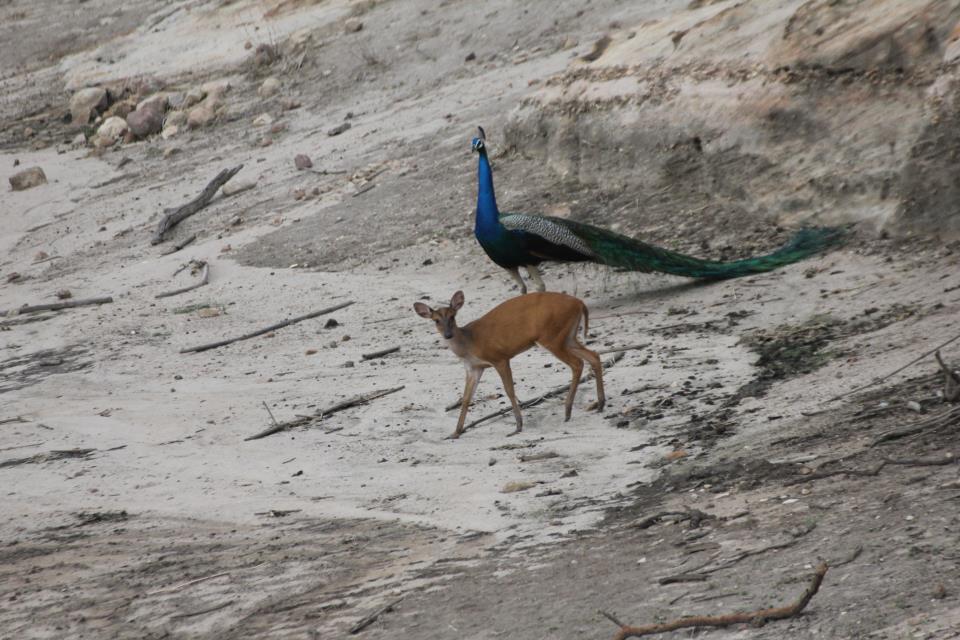
Barking Deer & Peacock

Mugger Crocodile

Great Stone Plovers

Leopard at Kanha

Leopard on Tree


Tiger at Tadoba

Sloth Bear

Tiger at Bandhavgarh

Tiger Near Water Hole
Tiger is Grass
Tiger Road Crossing

Wild Dog at Tadoba
Central India or the State of Madhya Pradesh and part of Maharashtra abounds in enchanting wilderness and amazing wildlife. The animals and birds can be seen at tiger reserves which are of World Fame. Most popular tiger safari destinations in Central India are Kanha, Bandhavgarh and Pench National Park.

Other tiger reserves in MP are Panna and Satpura while sanctuaries such as Bori and Nauradehi are slowly gaining popularity. The charismatic wildlife can best be enjoyed at tiger reserves with proper tourism infrastructure. Places like Bandhavgarh, Pench and Kanha National Park are well equipped for tourism. 

The Tadoba Tiger Reserve is in the state of Maharashtra. Tadoba Tiger Reserve is an emerging tourism destination. With the establishment of budget and luxury hotels in Tadoba tourism for tiger safari is increasing. The reserve is part of Central Indian Highlands which were ones a contiguous patch. Tiger sightings are very high in this reserve thanks to less restrictions imposed. 

For wildlife photography Kanha and and Bandhavgarh are the best. The former for its tigers and abundant wildlife and the latter for its tigers and picturesque settings.    

Photo Credits Teerath Singh