Showing posts with label threats. Show all posts

Sunday, November 20, 2022

Holy Cow Stray Dog Menace & Feeding A Danger to Humans And Wildlife

Stray Dog Menace

Indian Wild Dog 
In Africa, stray dogs, and domesticated ones near major wildlife habitats like Maasai Mara are vaccinated against rabies and other deadly disease. 

Do we take such steps?

"My guess is as good as yours. I guess we do not," Well though it is difficult to say that such vaccination programs are not being carried out by authorities, nevertheless, the dog menace remains a big threat.  Dangers lurk the most in our urban areas and villages where the stray dogs roam free and multiply at will. 

Deer in Danger

They have started to form packs to hunt down the deer that roam in the forests and those that enter human settlements. Among the most threatened species is the chital deer or the spotted deer (axis axis). They are being hunted down by roaming dogs all over India.

Feeding Wild & Stary Animals

Indians have a penchant for feeding animals without discerning whether it is good or bad for them. Some consider feeding stray and wild animals as a sacred act that will reflect positively on health, wealth, and happiness as a result of good Karma. 

We consider the cow holy and that is good, nothing to ridicule. But should we let them survive on throwaways or garbage? Stray cows are a major danger on the roads everywhere, and an International Embarrassment, the owners after milking them leave them on the streets to roam around. The free-roaming cattle are jeopardizing traffic which is leading to a very high number of road accidents and deaths. Is this how we treat our holiest animal? 

Shelters for Stray Animals & Vaccination - Cows & Dogs

There should be proper shelters for street cows, and why not for stray dogs if we cannot sterilize and vaccinate them. For example, in absence of proper vaccination, the dairy industry is under threat from lumpy skin disease. The cattle around the reserves have led to the transmission of rinderpest, and foot and mouth disease killing a large number of bison and swamp deer in our forests.  

What impact disease-carrying stray dogs are having on the dhole has not been studied? Field biologists contend with research on the instincts and behavior of wild animals in natural surroundings. I hope they are including diverse threat factors especially socio-economic, and political impact created by dense humanity around our forests.   

Reason Behind Feeding Wild Animals 

Feeding human fodder to Hanuman Langurs, rhesus macaques, and other wild denizens impact their natural instincts and food consumption habit. I have seen scores of langurs and rhesus macaques lined along highways, tourist places, and busy streets of bazaars awaiting morsels thrown by humans. This unnatural assemblage has created a major threat and nuisance all over India.

Hinduism and many indigenous ideologies are inclined toward nature. The sacred elements it considers worthy of holy status comprise other life forms. This is a good belief since the ideology and religious dogmas teach us to respect all life forms that make up the living planet called Earth. 

Sensitivity towards other life forms is exalting, but there has to be a line drawn somewhere. Offering human food to stray dogs, or wild animals is not a good practice.  Animal adoption as in Zoos, or domesticating a stray dog is the answer. But this does not mean letting them free on the road, they should be offered sanctuary within the house as we do with the pedigree. This is the answer as some NGOs with a court injunction and our own ahimsa does not allow the culling of stray dogs. 

Threat to Dholes or Wild Dogs

The greatest threat is perhaps to the wild dogs or dholes in our reserves, and some nonprotected areas that constitute conventional reserve forests. The frequent human habitats in search of prey.
The wild dog population is vacillating in the reserve, and the forests outside. Even in Kanha, where I was working as a naturalist, the packs usually seen in robust numbers are missing from many traditionally dominated areas. Some of them are losing ground with humanity strangling the remaining crown cover in the buffer beside transmitted diseases. Is the reason behind the dwindling status? 

I think the same stands true for these least studied animals in other reserves and National Parks. 

Will they go down like the Great Indian Bustard, the Indian Wolf, and the Hyena in India?     

Interferences & Conservation Policies 

In India, conservation is impacted by statutory compliance as defined by injunctions, political interventions, and by the pressure of some biased NGOs. Nothing else matters, those Field Managers who do not comply with the limits are literary shown the boot by higher-ups, and the politically powerful lords. Field management practices for the wardens are not a free-hand endeavor, they work under shackles, some are good, while others hinder conservation initiatives.    

Conservation policies are not straight-lined policies as we the common citizen believe. The frameworks depend upon many factors that include the impact on financing bodies, vote banks, religious sensitivities, cost, linear development projects, and precedence to human rights over rights of other life forms. 

Some good work is being done on the conservation front by ruling dispensations. But! We are also responsible! Let us admit that we are selfish, and run after the moolah. And, the other life forms, the amazing biodiversity is entirely at our mercy as has been happening for centuries. Nothing Surprising.

But it is not right to blame everything on the Government we as common citizens should also aid in preserving nature in our vicinity, and help secure remaining natural spots in neighborhoods, villages, farmlands, towns, and cities with fervor. 

In most conservation imbroglios macro solutions work the best. Can we as intelligent voters provide them?   

===========================================================================================================

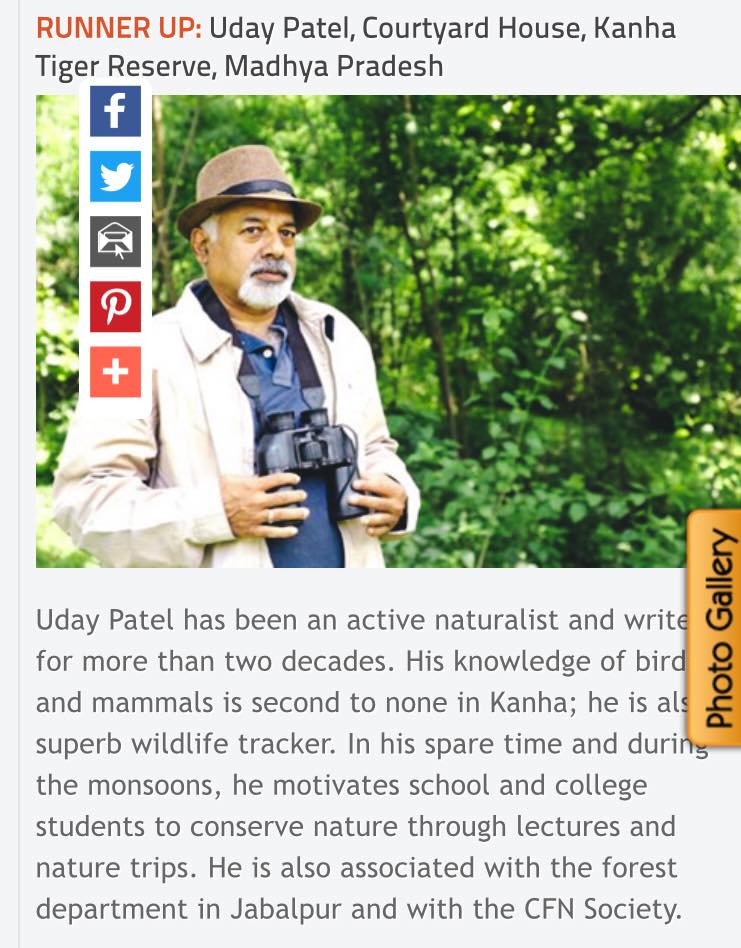
Uday has worked as a naturalist for a number of years at Kanha National Park in Central India. He is fond of writing on conservation issues and is a storyteller for the common man. 

Uday works as SEO for Digital Marketing and Content Writer. He also teaches digital marketing in Jabalpur. He is closely connected to nature as a naturalist.    

He can be contacted at:

Mob/Wattsapp: 09755089323

pateluday90@hotmail.com

Sunday, August 15, 2021

Wildlife Conservation: Threat Perception between Them and Us

One-Sided Story

In spite of periodic failures, the tiger population in recent times has begun to rise. This seems to be a continuing phenomenon despite many wild souls dying because of human apathy or natural causes. If the reports are to be believed, the leopard population in MP and a few other states seem to be on the rise. This rise is difficult to understand since the predator is constantly being killed at the hands of poachers and as a victim of man-animal conflict. Anyway, let's keep our fingers crossed.  

Poaching is purely a crime, and cannot be dragged under the banner of man-animal conflict. The killing of tigers and leopards by man and vice versa is perplexing since both subscribe to a food chain that is not directly in conflict if the ban on hunting wild animals is taken into consideration. 

While the death of a predator rarely causes much alarm, the death of a human being is reactive and often creates extreme upheaval within society. The browbeating that takes place often bends the system responsible for the protection and conservation, it is unfavorable towards the perpetrator and thus it is victimized to no end. It is either incarcerated or translocated to unfamiliar domains or at worst some trigger-happy elites are invited to shoot it down. This is an ongoing phenomenon, and the besieged animal is hardly able to comprehend the punishment accorded to it. Animals do not kill humans since for many we are not part of the food chain. They fear man and shun proximity. 

Threat Perception the Biggest Threat          

Threat perception is a natural phenomenon among the living akin to the response to external stimuli. Both are victims of the fear of the other and when this happens in extreme both kill. This is making wildlife conservation a difficult proposition, especially in a country like India. Heavily populated, extremely poor, and thrust closer to the wilderness by livelihood pursuits the man-animal conflict is much aggravated by biotic factors. Agriculture in the land that previously was part of the prevailing ecosystems and livestock incursions increase proximity between humans and predators. In spite of policies that make translocation possibly the ground reality has not changed much. This is due to the slow execution of translocation of the human population from vital core due to political infringements, court cases, and on many occasions overzealous NGOs?     

Translocation promises to eliminate human interference in the core while there is no policy to translocate population from immediate surroundings or the outer ring which we call the buffer. 

Creatures having lost their erstwhile homelands and food unwittingly transgress into what has become  human domains. They are killed, maimed or incarcerated brutely.     

This has become a regular tamasha in India with newsmakers worsening the situation with their greed and prejudice towards other life forms. Videos and images of predators being hounded out by lunatic hordes are propagating a wrong message among the people and making us subject to ridicule overseas. We nowhere can boast of the conservation ethos promoted by the ancient Vedas anymore.   

Clearing, wildlife corridors, thinning out the population in the buffer zones, and stopping linear infrastructure build-up which intersects our reserves is a near impossibility since the threat perception ails political dispensations too making them chicken out. Anyway, politicians in India have all to lose from unhappy voters but not from the predators as they have no right to vote. We are enamored by unbridled development as well and thus critics should not leave us out, especially the urban lot. 

Animals kill humans because of threat perception and most often proximity aggravates. Humans have all the comprehending power not to fall victim to a threat posed by a predator in proximity since that has been the case for ages.     

While we should not kill wild animals and do so only under extreme danger we have the ability to mitigate such instances. Wild animals on the other hand rarely cross over their domain but it does happen and at times humans are killed or maimed. Those who are in favor of extreme action against such killers are doing a disservice to mankind since all life forms are vital for an environmental balance upon which our well-being is maintained. 


Hence like automobiles kill people by accident so do animals in unavoidable circumstances. We cannot eliminate both. Hence answers have to be found beyond the ongoing rhetorics and the clash between the two should be mitigated. Translocation of populations that have ingressed is only one such answer another solution is to develop a code of conduct that will aid in minimizing conflicts. These are the imperatives that our planners have to incorporate and execute with sincerity if an environmental balance has to be maintained and our heritage wealth to be conserved. Legal laxity as regards wildlife crimes should be taken care of as well.       


The Youths Take Over

Rhetoric never works and there has to be an action on the ground. Thankfully in our country, the youth is taking interest in ecological matters, and a number of committees or societies have been formed pan India to discourage practices that go against nature conservation. The impact is visible in the interest shown in the conservation, the rising number of PILs, and write-ups against haste. This collective effort is certainly going to keep the establishment on its toes. This will force the policymakers to rethink as well. 

The next-gen is going to be much more nature aware but what do we leave for them?    

==========================

Uday freelances as a naturalist and loves to write about tiger conservation and the environment.

He also provides SEO and Content and teaches  Digital Marketing in his hometown Jabalpur. 

Contact: 

pateluday90@hotmail.com

9755089323

Saturday, July 3, 2021

The Dwindling Indian Wild Dog

Shahdar Range Sehora

The even-paced stride under the glaring light of the rising Sun in a pristine forest was a spectacle unparalleled. The sightings of a tiger I had experienced many times paled whence compared with the flight of this dainty carnivore. Lustrous golden brown with a black bushy handsome tail dhole as the wild dog is called in Hindi is one of the most charismatic predators on Earth. Lightweight and lithe, the creatures weigh less than twenty kilograms yet carry a punch that could bring down prey bigger than them. 


This was in Shahdar Range in Sehora Tehsil of Jabalpur District. The year was 1990 and we were frequenting ranges in Sehora District on tendu collection drive.  At that time there were 12 tigers reported in Shahdar Range and adjoining ranges. There was a dense population of prey and perhaps bison at that time in these forests under high biotic pressure. The area is now under Bandhavgarh Tiger Reserve? The present status is unknown. Have we lost the forests and wild animals to urbanization or destruction?  I have not been to this erstwhile? tiger landscape since my first visit.   


 The predator's flight path was in opposite direction and we witnessed the spectacle for a long time before the pair vanished into the woods. When we first ventured into this region we were least expecting to encounter wilderness like that which usually exists in the core area of the reserves. Most of the forests outside the protected areas are subject to wood logging, forest fires, poaching, and illegal quarrying by brick manufacturers. Authorities have lax control of such patches because of a lack of dedication in some, political infringement, and inherent corruption among some.   


Surprised by such abundance, I felt like being in ancient India whence wilderness was rife all over. We nearly encountered a tiger whence he killed a cattle belonging to a local sarpanch. But the wild dogs are shy, and we saw them only in less disturbed range of Shahdar Hill.

The Dhole (Cuon Alpinus

Overshadowed by the tiger and the leopard, both endangered in India, the dhole or wild dog is equally threatened.  The location I describe here although under project tiger now, was a commercial wood-logging site. In such areas, a constant protection guarantee in absence of conservation initiatives is much to be concerned about.  

Dhole on Prey - Image Teerath Singh

The focus is on the core or critical tiger habitats in Indian reserves, and neglect of sink areas is palpable. However, I feel the status of wilderness is much weighed down by the core-centric approach for the real conflict in the extended neighborhoods. Animals like the dhole are rarely localized in the core. The populations spread far and wide, they are restricted only by the crown cover since the canid is not an open area or scrub predator. 


During my visits as a naturalist in Kanha National Park - incidentally one of the best managed proactive conservation units - I have been keeping an eye on the population dynamics of this carnivore for a long time and surprisingly have come to the conclusion that the population is paradoxically unstable in the core itself. I am as good as any amateur naturalist and my conclusions are much more based on perception than facts and figures.  But in the case of wild matters observation or seeing is believing. 

Please note, visitors and naturalists have no access to regions outside the tourism area. But regular forays in the tourism areas are enough to gauze the status of predators in a given reserve since the population as a whole is interconnected and subject to constant local migration. In the extreme cases of prey depletion, the population declines naturally, only to recover whence the prey density becomes stable. This is not the case with Kanha.    

The dhole frequent the buffer or outer rings of the reserves, I have seen them often near human habitation in Kanha a number of times. They frequent the buffer zone safari area near Boda Chappri and nearby villages.

Conflict & Conservation 

Of the global population of around 2500 animals, more than sixty percent survive in India. Conservation span as regards Cuon Alpinus is minimal, pan India. Though recent concern augurs hope that the animal may not arrive at the same status as the much-threatened Indian wolf. 

The pack hunter may recover with help of studies and research that may sketch a productive conservation approach. But unfortunately, threatening factors are quite akin to the wolf.  

The conflict paradigm in the case of secondary carnivores that venture much further away from the protected core is far more perplexing than in the case of most of the tertiary carnivores like the tiger that remain confined to dense crown cover and rarely venture near human settlements in the daytime. The rapid decline in wolf populations and the threat posed to the leopards in India stand in parallel to what the dhole is facing.  Such carnivores cross over the manageable limits of our conservation reach. 

The status of the stray population of carnivores is much dependent upon the factors listed below: 

  • 1) Live Stock Predation 
  • 2) Historical Threat Perception 
  • 3) Vicinity to Human Habitation
  • 4) Disease Prevalence  
  • 5) Population of Dogs  
  • 6) Presence of Co-predators 
  • 7) Habitat Destruction 
The canid is extremely agile and shy enough to avoid human habitation but with fast-depleting forests and encroaching settlements, the dreaded encounter is inevitable. The wild dog is the loser and its fast-depleting population is no hearsay. 
'
The animal produces four or five pups at a  time during the onset of winter. There can be multiple breeding females, though the alpha pair hierarchy is well established. The canid is more of a clan hunter and calling it a pack hunter is not correct. 

The clan size I have seen in Kanha and Bandhavgarh was around fourteen adults. But these clans disperse to make it on their own, and that rings alarm bells among wildlife enthusiasts. The animal is loosely territorial, and the dispersal can expose them to conflict regions or areas with less prey which will hinder breeding.    


Dholes are social, and during breeding, they are often seen in pair that has separated. The gestation period of this diurnal hunter is around two months. With natural consent, this dog is a gory hunter and the prey is consumed often by the time the chase ends. 


This dog does not bark like the city-bred but communicates using sounds that resemble whistling. When alarmed the sound emitted is loud, raucous, and continuous it is like somewhere between a bark and long haul. 

Although there are no conservation initiatives, the predator down the line has recently become a subject of curiosity and a number of studies have taken place. A groundbreaking study has been carried out by A.J.T Johnsingh in Bandipur Tiger Reserve. More studies on the ecology of this predator have been done and are being carried out by imminent scientists and researchers.    

India desperately waits for positive outcomes or the canid will be added to the lone wolf story sooner than we expect. 

Wild Dog India - Image Nandita Amin 

=================================================

Uday works as freelance naturalist and loves to write on related issues. He also provides SEO and content writing services. He runs classes on digital marketing in his home town Jabalpur.  

He can be contacted :

pateluday90@hotmailcom

9755089323  

Thursday, August 15, 2019

Tiger Conservation: Unspoken Sentinels The Forest Guards

I remember a long time back whence I was freelancing with Tigerland Resorts at Kanha National Park, I was assigned a group of schoolchildren from New Delhi. The group also included teachers from the DPS School who obviously were the caretakers for the tour. 

The tour comprised safaris and lectures on wilderness, a sort of awareness campaign full of fun and interesting experience for the children. 

On the first night, the teachers refused to sleep in their rooms facing the jungle. Well, the staff was instructed to sleep in front of the doors and the matter was taken care of. 

"We will be eaten by a tiger!"

Dead tired, I promised to discuss it with them the next day. All I had to state the next day was the fatalities, murders, road accidents, and robberies. psychopaths, nuts, killers, fast cars, and blah blah dangers which they confronted daily or rather each given moment in the Metro.

"It is unlikely a tiger would kill you if you sleep here in the room or venture out on foot every day. The rural folks trudge into these forests for collecting wood every day without fear. The forest guards move alone in these forests to protect wildlife.

People die because of accidental encounters or due to deliberately impinging on the animal's private space. But these incidence are rare as a matter of fact very rare. You are  a thousand times safer here, so please all through your stay be at peace." They did!      

The true sentinels are the front-line staff the forest guards, deputy rangers, etc. They are the people who traverse or scour through the forests on foot looking for snares, traps, local goons, illegal minor forest produce collectors, and yes sophisticated poachers and ultras. That is a huge burden on two small feet and a feeble body.

Forest Hut & Guards
In the deep confines of the forests, they trudge on foot, on bicycles, and on motorcycles. In the tiger land, this would be an extreme adventure for most of us, not for the guards, they are on duty that need extreme courage, sincerity, and dedication. Coming across tigers, other wild animals, and reptiles is frequent, for some it may be on daily basis. But they are well versed in the ways of the wild and keep themselves safe.   

Whence we revel in the ever-increasing tiger numbers these are the people who deserve the awards and the glory for successful tiger conservation in our country facing extreme odds, and adversities of unparalleled nature whence compared with dwellers in the cities.  The threat is not from animals, the threat is from intruding humans, poachers, criminals, etc. As stated above. 

The threat from animals is of a different nature head-on charge is a rarity, they have to avoid accidental encounters the most which the guards are good at. An odd aberrant behavior may be the reason for a tiger killing a guard. Yes, this does happen but once in a blue moon...but we humans are more likely to die of accidents, criminal charges, or an act of terrorism.

We especially the reporters should abstain from vilification of wild animals in case of tragic encounters, we are no longer in their food chain and accidental killings should be seen from a rational perspective. Habitual man-killers are anyway incarcerated or killed.

Sometimes the forest guards have to face the wrath of the locals whence a big cat kills a man who has come too close. Yes, most of such killings are in self-defense whence a threatened tiger finds a man very close for comfort, or whence villagers try to snatch away the kill.        

Like our soldiers who face the violence of the worst kind, the sentinels being discussed here also face threats to their lives...remember they are unarmed. In some of the tiger reserves, the threat is from ultras while that from organized sophisticated poachers too is prevalent albeit not extensively in India. As a precaution, the foresters move in a group or in the company of another. But whence occasion arises they have to move alone.

The hard life of labor and constant patrolling -even in challenging weather day and night- is what our foot soldiers do in the tiger reserves keeping it safe so the wild animals thrive. They safeguard the ecosystem as a whole. They also supervise small construction works like building dams, roads, waterholes, canals, etc. The foresters are responsible for the safety and well-being of the laborers who are involved in the construction works.

They are the virtual arms of the mechanism that keeps the reserves alive and kicking. Like the patrol elephants, they keep an eye on the wild animals and the forests and report to the higher officials or the camps nearby for assistance or attention.   

Most of the foresters live in patrolling huts or fire-watching camps deep inside the forests. For items of basic necessity, they depend upon feeble supply chain mechanisms or acquire it themselves whence they visit the small towns nearby.  They are always at the beck and call of any emergent situation that arises in the deep confines of the forests.

Far away from emergency care and their families, they live in isolation but nevertheless fulfill their duties without fail. They are the stars of the conservation units and deserve appreciation and all benefits that can be possibly accorded to them.

Some of the foresters are excellent animal trackers and have an in-depth understanding of animal behavior. They are very good at recognizing the floral elements present in these biodiversity hubs. I have been interacting for many years with our front-line warriors and never felt a lack of resolve or spirit amongst them to protect the magnificent ecosystems that the country has inherited.

The forester's job involves multitasking for they can work as clerks, tourism supervisors, maintenance crew, hosts for filmmakers and esteemed guests, and assist the veterinary staff whence the need arises.

Hail The Heros!!
==============================
Uday freelances as a naturalist and loves to write on tiger conservation and environmental issues.
Contact: pateluday90@hotmail.com
09755089323

Sunday, August 11, 2019

Tiger Conservation: Urban Assault

Rising urbanization all over the World is seen as a gauge in a positive perspective...a gleaming example of development. 

An article on the UNDP website terms mega cities as centers of learning, culture, and innovation. Besides this, it surmises that these population silos are wealth/resource generators and production centers, and therefore of immense importance to human settlements connected with them. It also mentions that these silos boost holistic progress, look after the well-being of the societies, address poverty, tackle pollution, and create infrastructure.  This is UNDPs own view of urbanization which many may not agree with.

Urban Ghetto

Chaotic Traffic

The Rat Race

This is a constricted perspective of human development indices because we do not seek more pliable alternatives. The article does mention the poor quality of urban development that creates economic disparities, pollution, further poverty, hardship, and diseases, and most of them are environmental disasters. 

We all have realized this anomaly prevailing in the major cities bursting at the seams due to overpopulation and unchecked migration from suburbs, smaller towns, and now deep interiors. 

Yes, we all know this except the developers and those who reap huge benefits in terms of political agenda and the businesses amassing wealth. These are the privileged ones that unfortunately take to the helm and become city planners, developers, ruling politicians, esteemed citizens, and active propagandists that never fail to advocate reckless urbanization at any cost.  

The fall out of urbanized ghettos is limited to their surroundings and to some extent to the neighborhoods. 

Think carefully! 

In order to sustain one infrastructure another extended or connected is required...and then another till the network pathway leads to the deep interiors where our rural societies subsist on the bare minimum with rational utilization of natural resources, and where most of our tiger reserves or natural places are. 

The last leg is the micro-urban center greatly susceptible to unplanned and unchecked development or linear development to be precise. It is these micro-urban centers that eventually continue to expand haphazardly denuding and eventually swallowing the reserves.   

Over looked and accorded lesser importance our tiger reserves or other ecosystems are most susceptible to this developmental threat. The phenomenon is universal pan India and is rapid. 

In Project Tiger we have an ambitious tiger conservation program that is experiencing daylight at the moment...but the impending space constriction and environmental degradation due to rapid development is going to hinder the progress in time to come. 

We are so enamored by modern development as we see in this World that we have forgotten to set limits and checks which are of utmost importance. Though the inviolate core areas are safe at the moment, the stress is on the buffer (surroundings) where the stringent policy of protection and no commercial construction should be well in place. The region surrounding the core faces huge biotic pressure from human intrusion and livestock, and the forests are nowhere secure with wood logging and sporadic poaching. The settlements here are subject to expansion and the agricultural practices are old age with low yield. An alternative more environmentally friendly alternative for agriculture should be looked for as soon as possible. One solution is to promote the nonwood handicraft industry since some communities have proficient artisans. This is being done in many places but needs greater impetus.    

The vision of wildlife and humans subsisting in harmony living in the same space  is at best romantic and purely chimerical. This idea defies practicality in modern times with limited span of ravaged forests and grasslands. Some wild animals are too sensitive to thrive along with humans anyway. And then we know the ways of contemporary human society.   

At many tiger reserves due to peer pressure, tigers move into the buffer, and some have become permanent residents. With a sparse prey base, weak crown cover, and increasing tiger population the problems are further compounded.

Munna Tiger With Kill _ Gopal Desai 

Meanwhile, the urban assault continues relentlessly with no possibility of stoppage. This is a challenge that wildlife managers and the field staff will face till some mitigating measures are put in place.

==============================
Uday freelances as a naturalist and loves to write on tiger conservation and environmental issues.
Contact: pateluday90@hotmail.com
09755089323

Wednesday, December 20, 2017

Tiger Conservation - A Number Game

Tigers are elusive animals and amazingly apt at being unseen even whence in the vicinity. Their habitat preference aids in camouflage, an art that they have mastered anyway, and a structure along with enchanting color patterns makes the big cats practically invisible wherever they live.

The predator can sit or stay still for an amazingly long period, crouch low in small tufts of grass and walk silently unheard, even whence in proximity. It has an amazing ability to freeze and stay that way for an exasperating time span. The animal can virtually vanish at will from the human reckoning.   

I believe many tigers complete their life cycle and die without being seen or being recorded by the tiger counting mechanism or the field personnel. This also assures that the predators occupy a wider tiger landscape than we assume. The ghost of the darkness is an apt way to describe the magnificent beast for it is a nocturnal animal made so by necessity and to some extent by massive human intrusion everywhere they survive.        

In democracies, life forms that vote are the privileged ones, and hence others are always endangered or facing extinction eternally. The situation is not good in countries that are governed by autocratic or dogmatic beliefs as well. In fact, the tertiary predator is nowhere safe.      

Counting The Cat 

Earlier the cats in India and Russia were counted using only the pug mark method. This resulted in greatly exaggerated figures leading to a chancy complacency that was disastrous for conservation. With the advent of more scientific methods like camera trapping and DNA analysis, we are coming to more accurate figures plus and minus a few. This development has also led to the discovery of tigers elsewhere outside the protected areas in previously undocumented tiger landscapes. But do these exciting finds assure that the population in India is rising? 

Well Yes & No

The Tiger population is well managed in highly protected reserves it is rising there thanks to the efficiency of the staff, wildlife managers, and the political will prevalent generously to say so. On the other hand, there may be many habitats where the animal is still being persecuted leading to a reduction in numbers. Man-animal conflict, hunting, and poaching are still the factors instrumental in the critical status of the big cat. And yes, I have not forgotten the tremendous biotic and abiotic stress that modern man is imposing. 

Crown cover of most of the landscapes may be receding drastically hence habitat destruction is an ever going disaster in a heavily populated country like India. Dams, mines, and infrastructure projects are never going to see an end, hence the threat will prevail unchecked ever. 

With a virulent stress on development or rather unplanned rapid development that always takes place in haste to be repented at leisure.     

Tigress - Paul Diggins


A Nation hell-bent under prioritize, the beleaguered cat has no place on the list.        

Whence we count the big cats we have only one species in mind this is a gross miscalculation. There may be no more than fifty South China tigers in the wild as per reports. The Tigers have gone virtually extinct in Vietnam, Laos, and Cambodia. We have lost the Bali tiger in Indonesia, the Caspian, and the Javan. 

Around three hundred Siberian tigers survive in a small pocket, precariously under severe threat from poachers. India is the country that is home to the Bengal tiger with the largest number standing at more than half the global population. This species also survives in Nepal, Burma, and Bangladesh. The last figures registered an appreciable growth of around thirty percent let's see if it stays that way. The country is doing all that is possible to protect the carnivore in its protected areas.           

The drastic reduction in the habitat is the primary reason for the sad numbers of animals almost everywhere,  and this threat does not seem to be mitigating. Of the roughly seven percent of the habitat left, the threat of denudation, wood logging, and human pressure looms large. The animal needs vast space to survive. Are we willing to accord that do we have a policy which would enable increase the inviolate space badly required?

The populist governance prevailing in the country is incapable of doing this, containment will linger. The hopeless case of tiger corridors is evident so very much. This is due to a lack of political courage. We have rapaciously taken over all the land for our cause without generously allocating some for other life forms. There seems to be no hope regarding this, and it seems to be wishful thinking and may seem ludicrous to some.       

The largest and single most threat that looms precariously is the use of tiger parts in Chinese systems of medicine and not to forget the culinary preferences. There seems to be no encouragement that the CITES convention would ever be followed there.      

Albeit the picture seems like a doomsday prediction there is hope for the tiger at least in India. All it needs is stringent protection, political will, and apt management. We must not forget laws that govern illegal practices regarding wildlife...these need a paradigm change if poachers and hunters have to be discouraged effectively.