Stray Dog Menace
 |
| Indian Wild Dog |
Do we take such steps?
"My guess is as good as yours. I guess we do not," Well though it is difficult to say that such vaccination programs are not being carried out by authorities, nevertheless, the dog menace remains a big threat. Dangers lurk the most in our urban areas and villages where the stray dogs roam free and multiply at will.
Deer in Danger
They have started to form packs to hunt down the deer that roam in the forests and those that enter human settlements. Among the most threatened species is the chital deer or the spotted deer (axis axis). They are being hunted down by roaming dogs all over India.
Feeding Wild & Stary Animals
Indians have a penchant for feeding animals without discerning whether it is good or bad for them. Some consider feeding stray and wild animals as a sacred act that will reflect positively on health, wealth, and happiness as a result of good Karma.
We consider the cow holy and that is good, nothing to ridicule. But should we let them survive on throwaways or garbage? Stray cows are a major danger on the roads everywhere, and an International Embarrassment, the owners after milking them leave them on the streets to roam around. The free-roaming cattle are jeopardizing traffic which is leading to a very high number of road accidents and deaths. Is this how we treat our holiest animal?
Shelters for Stray Animals & Vaccination - Cows & Dogs
There should be proper shelters for street cows, and why not for stray dogs if we cannot sterilize and vaccinate them. For example, in absence of proper vaccination, the dairy industry is under threat from lumpy skin disease. The cattle around the reserves have led to the transmission of rinderpest, and foot and mouth disease killing a large number of bison and swamp deer in our forests.
What impact disease-carrying stray dogs are having on the dhole has not been studied? Field biologists contend with research on the instincts and behavior of wild animals in natural surroundings. I hope they are including diverse threat factors especially socio-economic, and political impact created by dense humanity around our forests.
Reason Behind Feeding Wild Animals
Feeding human fodder to Hanuman Langurs, rhesus macaques, and other wild denizens impact their natural instincts and food consumption habit. I have seen scores of langurs and rhesus macaques lined along highways, tourist places, and busy streets of bazaars awaiting morsels thrown by humans. This unnatural assemblage has created a major threat and nuisance all over India.
Hinduism and many indigenous ideologies are inclined toward nature. The sacred elements it considers worthy of holy status comprise other life forms. This is a good belief since the ideology and religious dogmas teach us to respect all life forms that make up the living planet called Earth.
Sensitivity towards other life forms is exalting, but there has to be a line drawn somewhere. Offering human food to stray dogs, or wild animals is not a good practice. Animal adoption as in Zoos, or domesticating a stray dog is the answer. But this does not mean letting them free on the road, they should be offered sanctuary within the house as we do with the pedigree. This is the answer as some NGOs with a court injunction and our own ahimsa does not allow the culling of stray dogs.
Threat to Dholes or Wild Dogs
The greatest threat is perhaps to the wild dogs or dholes in our reserves, and some nonprotected areas that constitute conventional reserve forests. The frequent human habitats in search of prey.
The wild dog population is vacillating in the reserve, and the forests outside. Even in Kanha, where I was working as a naturalist, the packs usually seen in robust numbers are missing from many traditionally dominated areas. Some of them are losing ground with humanity strangling the remaining crown cover in the buffer beside transmitted diseases. Is the reason behind the dwindling status?
I think the same stands true for these least studied animals in other reserves and National Parks.
Will they go down like the Great Indian Bustard, the Indian Wolf, and the Hyena in India?
Interferences & Conservation Policies
In India, conservation is impacted by statutory compliance as defined by injunctions, political interventions, and by the pressure of some biased NGOs. Nothing else matters, those Field Managers who do not comply with the limits are literary shown the boot by higher-ups, and the politically powerful lords. Field management practices for the wardens are not a free-hand endeavor, they work under shackles, some are good, while others hinder conservation initiatives.
Conservation policies are not straight-lined policies as we the common citizen believe. The frameworks depend upon many factors that include the impact on financing bodies, vote banks, religious sensitivities, cost, linear development projects, and precedence to human rights over rights of other life forms.
Some good work is being done on the conservation front by ruling dispensations. But! We are also responsible! Let us admit that we are selfish, and run after the moolah. And, the other life forms, the amazing biodiversity is entirely at our mercy as has been happening for centuries. Nothing Surprising.
But it is not right to blame everything on the Government we as common citizens should also aid in preserving nature in our vicinity, and help secure remaining natural spots in neighborhoods, villages, farmlands, towns, and cities with fervor.
In most conservation imbroglios macro solutions work the best. Can we as intelligent voters provide them?
===========================================================================================================
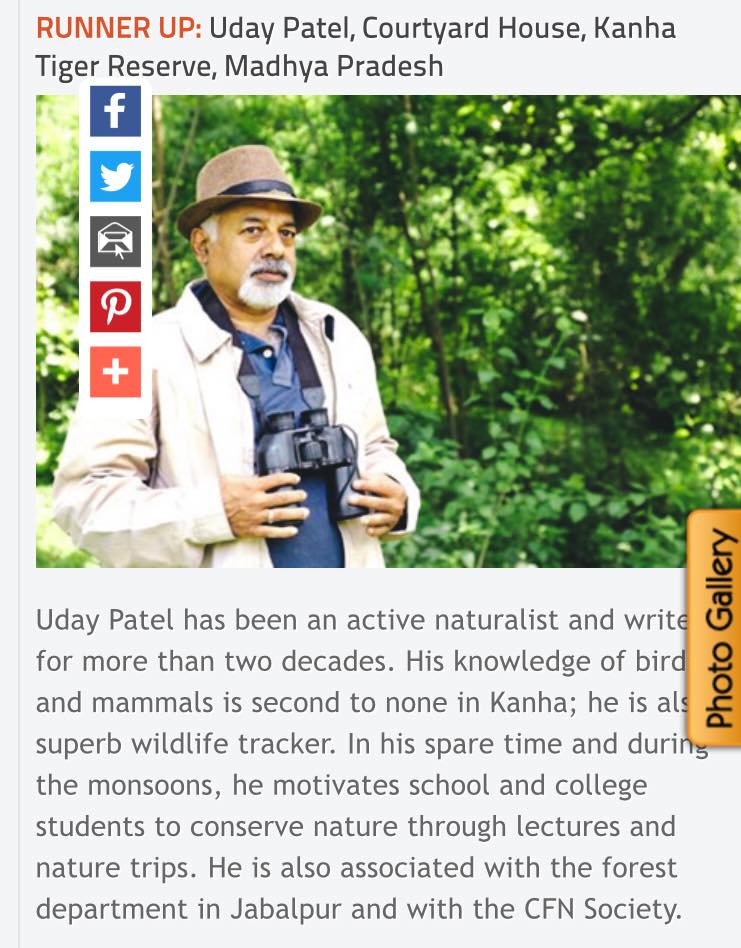
Uday has worked as a naturalist for a number of years at Kanha National Park in Central India. He is fond of writing on conservation issues and is a storyteller for the common man.
Uday works as SEO for Digital Marketing and Content Writer. He also teaches digital marketing in Jabalpur. He is closely connected to nature as a naturalist.
He can be contacted at:
Mob/Wattsapp: 09755089323
pateluday90@hotmail.com


