Showing posts with label dhole. Show all posts

Sunday, November 20, 2022

Holy Cow Stray Dog Menace & Feeding A Danger to Humans And Wildlife

Stray Dog Menace

Indian Wild Dog 
In Africa, stray dogs, and domesticated ones near major wildlife habitats like Maasai Mara are vaccinated against rabies and other deadly disease. 

Do we take such steps?

"My guess is as good as yours. I guess we do not," Well though it is difficult to say that such vaccination programs are not being carried out by authorities, nevertheless, the dog menace remains a big threat.  Dangers lurk the most in our urban areas and villages where the stray dogs roam free and multiply at will. 

Deer in Danger

They have started to form packs to hunt down the deer that roam in the forests and those that enter human settlements. Among the most threatened species is the chital deer or the spotted deer (axis axis). They are being hunted down by roaming dogs all over India.

Feeding Wild & Stary Animals

Indians have a penchant for feeding animals without discerning whether it is good or bad for them. Some consider feeding stray and wild animals as a sacred act that will reflect positively on health, wealth, and happiness as a result of good Karma. 

We consider the cow holy and that is good, nothing to ridicule. But should we let them survive on throwaways or garbage? Stray cows are a major danger on the roads everywhere, and an International Embarrassment, the owners after milking them leave them on the streets to roam around. The free-roaming cattle are jeopardizing traffic which is leading to a very high number of road accidents and deaths. Is this how we treat our holiest animal? 

Shelters for Stray Animals & Vaccination - Cows & Dogs

There should be proper shelters for street cows, and why not for stray dogs if we cannot sterilize and vaccinate them. For example, in absence of proper vaccination, the dairy industry is under threat from lumpy skin disease. The cattle around the reserves have led to the transmission of rinderpest, and foot and mouth disease killing a large number of bison and swamp deer in our forests.  

What impact disease-carrying stray dogs are having on the dhole has not been studied? Field biologists contend with research on the instincts and behavior of wild animals in natural surroundings. I hope they are including diverse threat factors especially socio-economic, and political impact created by dense humanity around our forests.   

Reason Behind Feeding Wild Animals 

Feeding human fodder to Hanuman Langurs, rhesus macaques, and other wild denizens impact their natural instincts and food consumption habit. I have seen scores of langurs and rhesus macaques lined along highways, tourist places, and busy streets of bazaars awaiting morsels thrown by humans. This unnatural assemblage has created a major threat and nuisance all over India.

Hinduism and many indigenous ideologies are inclined toward nature. The sacred elements it considers worthy of holy status comprise other life forms. This is a good belief since the ideology and religious dogmas teach us to respect all life forms that make up the living planet called Earth. 

Sensitivity towards other life forms is exalting, but there has to be a line drawn somewhere. Offering human food to stray dogs, or wild animals is not a good practice.  Animal adoption as in Zoos, or domesticating a stray dog is the answer. But this does not mean letting them free on the road, they should be offered sanctuary within the house as we do with the pedigree. This is the answer as some NGOs with a court injunction and our own ahimsa does not allow the culling of stray dogs. 

Threat to Dholes or Wild Dogs

The greatest threat is perhaps to the wild dogs or dholes in our reserves, and some nonprotected areas that constitute conventional reserve forests. The frequent human habitats in search of prey.
The wild dog population is vacillating in the reserve, and the forests outside. Even in Kanha, where I was working as a naturalist, the packs usually seen in robust numbers are missing from many traditionally dominated areas. Some of them are losing ground with humanity strangling the remaining crown cover in the buffer beside transmitted diseases. Is the reason behind the dwindling status? 

I think the same stands true for these least studied animals in other reserves and National Parks. 

Will they go down like the Great Indian Bustard, the Indian Wolf, and the Hyena in India?     

Interferences & Conservation Policies 

In India, conservation is impacted by statutory compliance as defined by injunctions, political interventions, and by the pressure of some biased NGOs. Nothing else matters, those Field Managers who do not comply with the limits are literary shown the boot by higher-ups, and the politically powerful lords. Field management practices for the wardens are not a free-hand endeavor, they work under shackles, some are good, while others hinder conservation initiatives.    

Conservation policies are not straight-lined policies as we the common citizen believe. The frameworks depend upon many factors that include the impact on financing bodies, vote banks, religious sensitivities, cost, linear development projects, and precedence to human rights over rights of other life forms. 

Some good work is being done on the conservation front by ruling dispensations. But! We are also responsible! Let us admit that we are selfish, and run after the moolah. And, the other life forms, the amazing biodiversity is entirely at our mercy as has been happening for centuries. Nothing Surprising.

But it is not right to blame everything on the Government we as common citizens should also aid in preserving nature in our vicinity, and help secure remaining natural spots in neighborhoods, villages, farmlands, towns, and cities with fervor. 

In most conservation imbroglios macro solutions work the best. Can we as intelligent voters provide them?   

===========================================================================================================

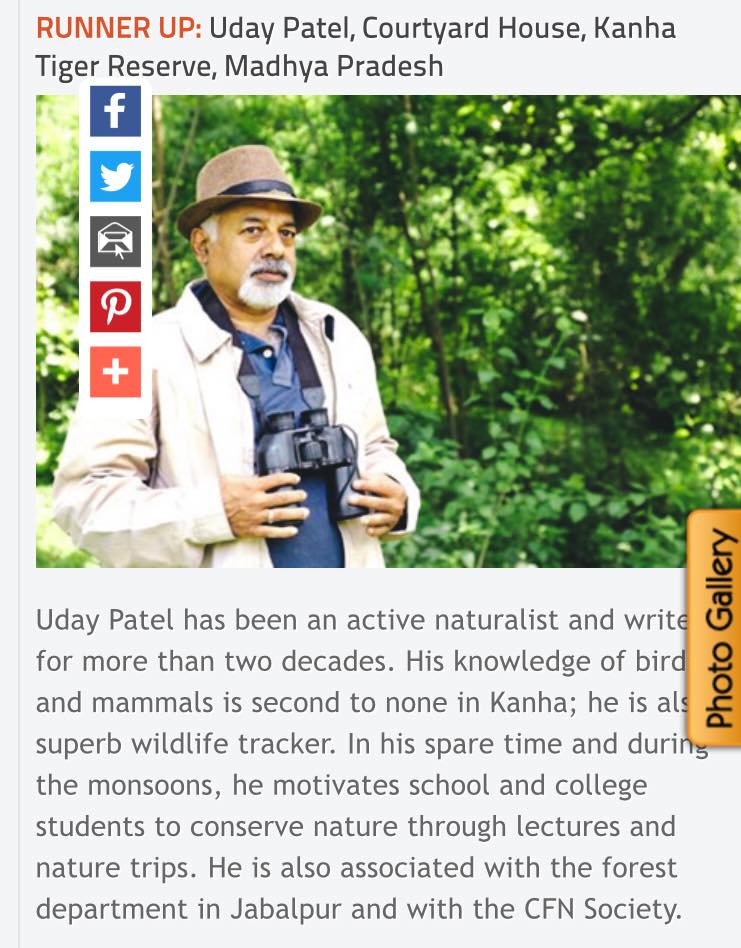
Uday has worked as a naturalist for a number of years at Kanha National Park in Central India. He is fond of writing on conservation issues and is a storyteller for the common man. 

Uday works as SEO for Digital Marketing and Content Writer. He also teaches digital marketing in Jabalpur. He is closely connected to nature as a naturalist.    

He can be contacted at:

Mob/Wattsapp: 09755089323

pateluday90@hotmail.com

Saturday, July 3, 2021

The Dwindling Indian Wild Dog

Shahdar Range Sehora

The even-paced stride under the glaring light of the rising Sun in a pristine forest was a spectacle unparalleled. The sightings of a tiger I had experienced many times paled whence compared with the flight of this dainty carnivore. Lustrous golden brown with a black bushy handsome tail dhole as the wild dog is called in Hindi is one of the most charismatic predators on Earth. Lightweight and lithe, the creatures weigh less than twenty kilograms yet carry a punch that could bring down prey bigger than them. 


This was in Shahdar Range in Sehora Tehsil of Jabalpur District. The year was 1990 and we were frequenting ranges in Sehora District on tendu collection drive.  At that time there were 12 tigers reported in Shahdar Range and adjoining ranges. There was a dense population of prey and perhaps bison at that time in these forests under high biotic pressure. The area is now under Bandhavgarh Tiger Reserve? The present status is unknown. Have we lost the forests and wild animals to urbanization or destruction?  I have not been to this erstwhile? tiger landscape since my first visit.   


 The predator's flight path was in opposite direction and we witnessed the spectacle for a long time before the pair vanished into the woods. When we first ventured into this region we were least expecting to encounter wilderness like that which usually exists in the core area of the reserves. Most of the forests outside the protected areas are subject to wood logging, forest fires, poaching, and illegal quarrying by brick manufacturers. Authorities have lax control of such patches because of a lack of dedication in some, political infringement, and inherent corruption among some.   


Surprised by such abundance, I felt like being in ancient India whence wilderness was rife all over. We nearly encountered a tiger whence he killed a cattle belonging to a local sarpanch. But the wild dogs are shy, and we saw them only in less disturbed range of Shahdar Hill.

The Dhole (Cuon Alpinus

Overshadowed by the tiger and the leopard, both endangered in India, the dhole or wild dog is equally threatened.  The location I describe here although under project tiger now, was a commercial wood-logging site. In such areas, a constant protection guarantee in absence of conservation initiatives is much to be concerned about.  

Dhole on Prey - Image Teerath Singh

The focus is on the core or critical tiger habitats in Indian reserves, and neglect of sink areas is palpable. However, I feel the status of wilderness is much weighed down by the core-centric approach for the real conflict in the extended neighborhoods. Animals like the dhole are rarely localized in the core. The populations spread far and wide, they are restricted only by the crown cover since the canid is not an open area or scrub predator. 


During my visits as a naturalist in Kanha National Park - incidentally one of the best managed proactive conservation units - I have been keeping an eye on the population dynamics of this carnivore for a long time and surprisingly have come to the conclusion that the population is paradoxically unstable in the core itself. I am as good as any amateur naturalist and my conclusions are much more based on perception than facts and figures.  But in the case of wild matters observation or seeing is believing. 

Please note, visitors and naturalists have no access to regions outside the tourism area. But regular forays in the tourism areas are enough to gauze the status of predators in a given reserve since the population as a whole is interconnected and subject to constant local migration. In the extreme cases of prey depletion, the population declines naturally, only to recover whence the prey density becomes stable. This is not the case with Kanha.    

The dhole frequent the buffer or outer rings of the reserves, I have seen them often near human habitation in Kanha a number of times. They frequent the buffer zone safari area near Boda Chappri and nearby villages.

Conflict & Conservation 

Of the global population of around 2500 animals, more than sixty percent survive in India. Conservation span as regards Cuon Alpinus is minimal, pan India. Though recent concern augurs hope that the animal may not arrive at the same status as the much-threatened Indian wolf. 

The pack hunter may recover with help of studies and research that may sketch a productive conservation approach. But unfortunately, threatening factors are quite akin to the wolf.  

The conflict paradigm in the case of secondary carnivores that venture much further away from the protected core is far more perplexing than in the case of most of the tertiary carnivores like the tiger that remain confined to dense crown cover and rarely venture near human settlements in the daytime. The rapid decline in wolf populations and the threat posed to the leopards in India stand in parallel to what the dhole is facing.  Such carnivores cross over the manageable limits of our conservation reach. 

The status of the stray population of carnivores is much dependent upon the factors listed below: 

  • 1) Live Stock Predation 
  • 2) Historical Threat Perception 
  • 3) Vicinity to Human Habitation
  • 4) Disease Prevalence  
  • 5) Population of Dogs  
  • 6) Presence of Co-predators 
  • 7) Habitat Destruction 
The canid is extremely agile and shy enough to avoid human habitation but with fast-depleting forests and encroaching settlements, the dreaded encounter is inevitable. The wild dog is the loser and its fast-depleting population is no hearsay. 
'
The animal produces four or five pups at a  time during the onset of winter. There can be multiple breeding females, though the alpha pair hierarchy is well established. The canid is more of a clan hunter and calling it a pack hunter is not correct. 

The clan size I have seen in Kanha and Bandhavgarh was around fourteen adults. But these clans disperse to make it on their own, and that rings alarm bells among wildlife enthusiasts. The animal is loosely territorial, and the dispersal can expose them to conflict regions or areas with less prey which will hinder breeding.    


Dholes are social, and during breeding, they are often seen in pair that has separated. The gestation period of this diurnal hunter is around two months. With natural consent, this dog is a gory hunter and the prey is consumed often by the time the chase ends. 


This dog does not bark like the city-bred but communicates using sounds that resemble whistling. When alarmed the sound emitted is loud, raucous, and continuous it is like somewhere between a bark and long haul. 

Although there are no conservation initiatives, the predator down the line has recently become a subject of curiosity and a number of studies have taken place. A groundbreaking study has been carried out by A.J.T Johnsingh in Bandipur Tiger Reserve. More studies on the ecology of this predator have been done and are being carried out by imminent scientists and researchers.    

India desperately waits for positive outcomes or the canid will be added to the lone wolf story sooner than we expect. 

Wild Dog India - Image Nandita Amin 

=================================================

Uday works as freelance naturalist and loves to write on related issues. He also provides SEO and content writing services. He runs classes on digital marketing in his home town Jabalpur.  

He can be contacted :

pateluday90@hotmailcom

9755089323