From Heaven unto the Earth a Land Divine
The Satpura Range Highlands
James Forsyth a wonderful storyteller becoming one perhaps by circumstance unlike Kipling, narrated captivating accounts of this divine land in Central India. If you travel towards Madhya Pradesh from Mumbai somewhere at about 300 miles the land bifurcates with one branch heading towards Allahabad in the Gangetic Valley in the State of Uttar Pradesh, and the other moves southwards towards the Nagpur City in Maharashtra. Ensconced between them lies a wild pristine 10000 sq.km forestland of Satpura Range, the crowning jewel adorns the precious gems of nature, steep hills, tabletop mountains, and charismatic glens through which flow a number of sublime rivers that originate in the mountain tops and have become the lifeline of the prevailing ecosystems. The dense green cover that adorns the mysterious region is due to moist tropical and dry deciduous forests comprising Teak, Sal, Bamboo, and mixed forest zones.
 |
| Map of Satpuras |
Holy Narmada River in Satpuras
Narmada basin perhaps encapsulates the greater part of this region known as the Satpura Range. The Vindhya Range runs parallel much to the North of Central India, and both converge at the Maikal Hills in a biosphere known as Amarkantak. The Biosphere Reserve encompassing Amarkantak is the origin of Narmada which traverses more than 700 miles to end up in the Arabian Sea. Another river that originates from here is the Son which diverts north towards the Gangetic basin and eventually merges with the river Ganga. Achankmar Tiger Reserve (Chattisgarh) is a part of the Achanakmar - Amarkantak Biosphere Reserve that span 3835.51 km2 and straddles the neighboring state of Chhattisgarh.
Narmada considered holier than the Ganges according to some has given birth to many robust civilizations in Central India. Like other rivers, it is the mother of the forests that maintain an equilibrium among natural forces and thus supports life including ours. From the holy river, a number of tributaries fork out that have become lifelines of this ecoregion in Madhya Pradesh. A large number of towns are based on the shores of the Narmada and are dependent upon it for their existence.
Most of the shores across the span were predominant with dense green cover but with increasing urbanity we are losing the forests and the long-term sustainability of this crucial water source is in question.
Captain James Forsyth’s – The Highlands of Central India
Captain James Forsyth was an acting Conservator of Forests in British India whence he narrated amazing discoveries of this elevated tiger landscape now in the State known as Madhya Pradesh. The vivid account of the forests and their superabundant wildlife are central to his narrative in the book "The Highlands of Central India". The book was first published in the year 1871.
 |
| Marble Rocks |
The book is a vivid account of all things wonderful that the Satpura encapsulates including the tribes that occupied the region. In the narrative, there is a definite hint of the superiority of his race but no mention deprecates the natives. The natives as he referred to local people are emphatically interwoven in the narrative wherever they are involved mostly as laborers or the local lords and tradesmen. The tiger is interwoven along with the tribal in almost every chapter such was the abundance of this majestic predator in the 19th Century.
 |
| Tiger |
As mentioned earlier the wildlife in the mountains was central to his focus as an ace hunter. Forsyth nevertheless, opened the remote and mysterious region to India’s urbanity, the Sahibs and the Brown Sahibs a privileged lot that could travel to hunt tigers and the country’s vanishing wild animals.
The book’s each and every page is a captivating account of the highlands. For the reader, each page is a journey into the exotic and the esoteric that Central India was in the 19th Century, the era in which the narrative is based. Each page unfolds the cryptic labyrinth of the mountainous core and its rugged tapestry, it also encapsulates myriad landscapes in plains and rivers, the natural formations of the region. The mountains loom higher than one can imagine and carry a countenance of forlorn sentinels frozen for eternity in the paradigm of time and space. They are a specter of lifeless giants yet they support myriads of life forms paradoxically they represent the harbinger of powerful forces that enliven the Earth
The rivers though not extensively described apart from Narmada are never demoted by the lack of reference.
Narmada Valley
The Gorge in Narmada – Picturesque Jabalpur
Forsyth’s description of Marble Rocks and the Gorge we now call Bhedghat is an ode to the natural formations as well as the beautiful city of Jabalpur. Of the gorge he wrote, the yonder blue sky light of the Sun reflects upon the rocks creating hues of colors that easily outdo a spectrum. The light that reflects at the bottom inverses clearly but breaks into thousands of quavering fragments in the encircling whirlpools that emerge as water surges against the rocks.
 |
| Marble Rocks |
It is difficult to duplicate Forsyth’s writing style and the overwhelming idiomatic phrases. Each chapter is lively with expressions that only the author could have envisaged, the colloquial is striking, yet the superabundant write-up never subdues meaningful descriptions and the narrative is mature. The readers have to go through the book to understand what I am trying to state.
 |
| Banjar River at Kanha |
On the gorge, he states that glossy white saccharine rock is seamed by veins of dark green and black volcanic rocks. Perhaps he forgot to mention deep crevices and oval pockmarks paradoxically shapely and graceful created by years of erosion. You see them as the boat rocks past on the pellucid waters.
Of the rocky formations, he describes the monkey leap (Bandar Kudini) as a chasm you come across while boating and he also mentions the mighty footprint in the rock belonging to the celestial elephant of Indra. He was aware of Hindu beliefs but there was no decrying. As you read the chapter on Narmada Valley you become aware of the author’s extensive knowledge of the geography of the country as a whole and not only Central India.
 |
| Boats on Narmada |
Most of the accounts of this enchanting valley revolve around his hunting trips and natural history references. His descriptions of wild animals chiefly the predators and the herbivore and of the local flora are extensive, no wonder he was an exceptional naturalist of his time.
 |
| Temple Complex - Narmada Origin |
His account of Rani Durgawati’s battle with the invading Moslems and the Chaoragarh fortification is worth reading. But this is more of a reference to the extensive fortifications on flat-topped scarp-sided mountains of the region South of Narmada and the rising tide of Moslem invaders hell-bent on conquering India. The construction describes matches that of Bandhavgarh Fort and is an interesting read. This also proves the tribal domination of inaccessible mountainous regions of Central India. The belief in Lord Shiva incarnation is evident in the narrative.
Mahadeo Hills- Surreal & Divine
Puchmurree the Crowning Glory
In this chapter, the author emphasizes the Hindu belief in Lord Shiva, and justifies the adobe of Shiva as being impassable, mysterious, and holy but frequented by wild beasts and goblins according to the tribal. Though superabundant with wild beasts the divine land was no home to spooky beings, it was the inaccessibility and the depth that was a frightening prospect. Even to this date, few will venture into the impassable forest, and the steep ascent, for they will lose direction in the deep ravines in the glens of Pachmarhi. This turbulent terrain characteristic is conspicuous by the absence in the inhabited plains including the Satpura Tiger Reserve a protected area.
 |
| Pachmarhi Landscape |
Forsyth’s journey into the Satpura Range began with the objective of building a hutment in the Mahadeo Hills. The British endeavor to escape the stifling heat of India is a well-documented fact and in time to come Pachmarhi became a cantonment. The impact of British presence is evident in the township bungalows that carry the British architecture with emphasis on geometrical simplicity and yet the aura of grandeur prevails. The salubrious climate, and the verdant greenery all favoured Pachmarhi becoming the summer escape, and eventually the summer capital.
 |
| Dhoopgarh Pachmarhi |
The description of natural formation found in abundance in the steep inclines of the Satpura is apt in the book. As you proceed you are confused as to who Forsyth was, was he a naturalist, an ethnologist or an explorer for the author exhibits all the specialties combined into one. As usual most of the chapter is dominated by the accounts of hunts, wild animals, and the flora. But lovers of Satpura would revel in his account of the Mahadeo Hill natural formations. The book is a bundle of diverse facets and Hinduism & aboriginal humanity find a distinct place in the whole narrative.
The Aboriginal Tribes
This chapter is dedicated to the tribes chiefly Korkus, Gonds, Rajgond, Baigas, and Bhilalas, and aspects of their customs and mores are well described. The religious beliefs turn syncretic and manifest in a mixed form due to intermarriages, and natural intermixing with Hindus. There is a mention of tribal beliefs and practices along with the influence of Hinduism. However certain population remained bereft of the religious influence and their existence in post-independence era is an ode to Hindu tolerance.
He mentions the creation of subsets of original tribal communities by the influence and religious conversion by the dominating Rajput warlords. There is no decrying the natural flow of subset creation and perhaps the influence was vice a versa since reverence to nature among the Hindus is well documented throughout the history of India beginning Indus Valley Civilization.
There is no conflict mentioned between the two entities rather the tribes were known to participate in the independence wars against foreign rule aka the British Raj. This was one of the reasons for the invasion of Puchmurree, and young Forsyth was instrumental in the conquest. Ironically, a museum has been built in his memory at the Pachmarhi plateau by the present dispensations. Indians forget and pardon!
The religious transformation is also suggestive of slow harmonization of communities in the remote India, the exception being large scale conversion of tribal elsewhere with the connivance of missionaries supported by the British.
While conversion completely erase local cultures and traditions by imposing the exotic, the tribal Hindu communities did not lose their cultural affinities rather a blend was created that was syncretic in nature and supported harmonious existence.
The Tiger Reserves
The destinations he mentions in the book include far off Chikaldhara Plateau and Melghat Tiger Reserve at some distance from Nagpur in Maharashtra of which the former though still endowed with wilderness is fast losing to urbanity while Melghat is a protected area preserved perhaps for keeps.
 |
| Gaur |
The book revolves around the Narmada Valley and the Tribal. The extensive right up is mostly on the remote inaccessible regions which he had the privilege to explore at the behest of the Empire. He also tables content regarding the Teak and Sal forests. The main reference in the teak belt is the Bori Forests while the Sal forests cover most of our tiger reserves.
 |
| Swamp Deer - Barasingha |
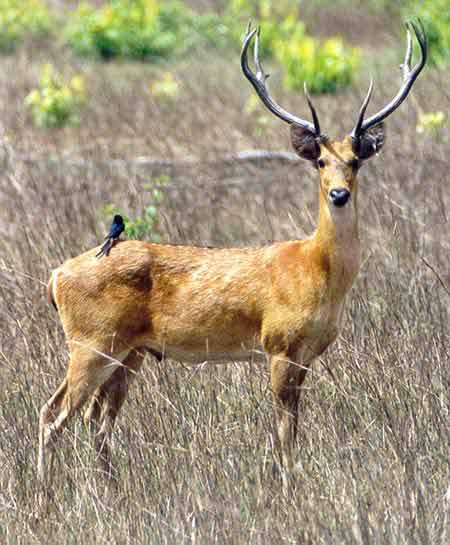
The Sal forests are represented by most of the tiger reserves in contemporary India, the Bori Forests are a wildlife sanctuary comprising primarily Teak. Bori is now a component of Satpura Biosphere Reserve. The region once contiguous now exists as fragments with varied crown cover.
The prominent reserves in the Satpuras are:
• Kanha National Park
• Pench National Park
• Satpura National Park
• Nauradehi Wildlife Sanctuary
• Achanakmar Wildlife Sanctuary
• Ratapani Wildlife Sanctuary
These are a hub of biodiversity in Central India and are most visited by domestic and overseas crowds every year. The reserves retain their charismatic glory but exist under the pressure of encroaching urbanity and livelihood concerns dominated by unorganized animal husbandry. Poaching is scarce due to the protection mechanism, nevertheless, the threat looms large due to the organized illegal wildlife trade networks and demand for tiger bones by TCM manufacturers. The major threat the wilderness faces is from the increasing man-animal conflicts as populations increases and livelihood pressures enhance the proximity between the wild animals and the people.
 |
| Tiger - by Peter Jones |
The best way to explore the present-day Satpura is to visit Pachmarhi, Amarkantak, and the tiger reserves mentioned. Jabalpur is the fulcrum for these wild journeys. The destinations are almost equidistance from Jabalpur Airport and the Rail Head. Jabalpur town has a remarkable tourism infrastructure. A stop at Jabalpur is for a much-visited place the Marble Rocks. The town is endowed with many natural stops that can be visited on an extended stay.
The Luxury Hotels:
Satpura Tiger Reserve:
• Forsyth’s Lodge
• Denwa Backwater Escape
• MPT Bison Lodge
Bori Wildlife Sanctuary
Forest Rest House
Pench National Park
• Tathatsu Resort
• Jungle Home Pench
• Mowgli’s Den
Kanha National Park
• Courtyard House Kanha
• Baghira Log Huts MPT
Achanakmar WLS
• MPT Resort at Amarkantak
Noradehi Wildlife Sanctuary is less than a hundred kilometers from Jabalpur and forest accommodations are available for a stay. Please contact Sagar DFO for bookings. A day trip is advised.
Hotels in Jabalpur
• Krishna Hotel Jabalpur
• MPT Kalchuri Hotel
The above-mentioned are family-safe properties in respective destinations. For greater scope please seek a referral or search online. For safari booking please visit MPOnline Portal.
About the Author the Highland of Central India James Forsyth
James Forsyth died young in London UK. His life span was from 1838-1871. Not much information is available about him except that he arrived in India as an army officer and was subsequently appointed as an acting forest conservator. His book published after death regales us with our own inheritance that he so vividly portrayed.
Read More:
========================================================
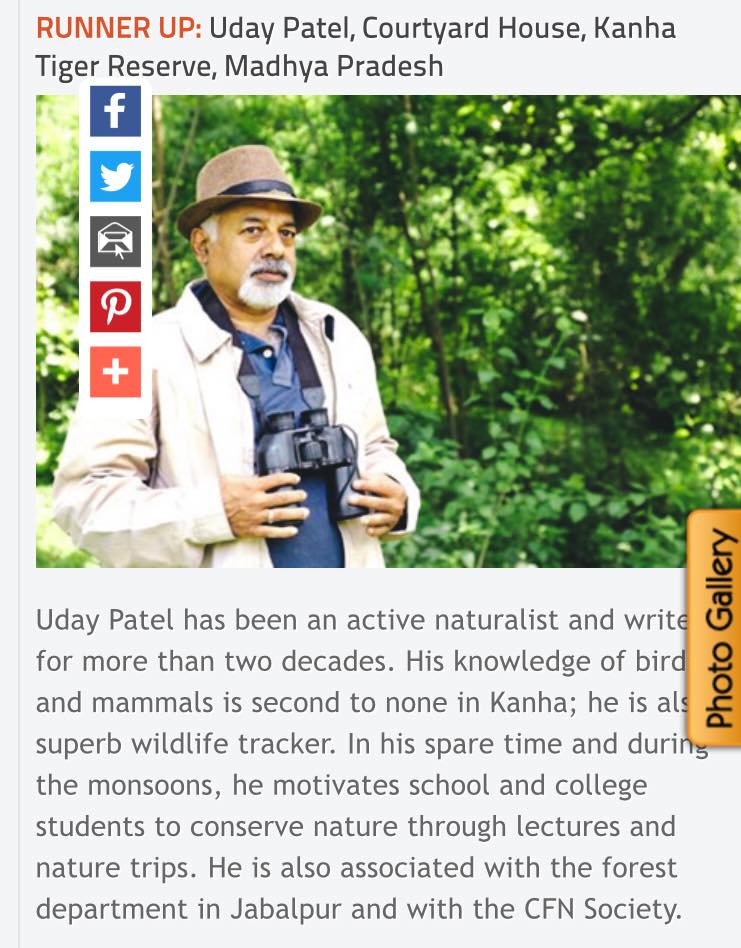
Uday has worked as a naturalist for a number of years at Kanha National Park in Central India. He is fond of writing on conservation issues and is a storyteller for the common man.
Uday works as SEO for Digital Marketing and Content Writer. He also teaches digital marketing in Jabalpur. He is closely connected to nature as a naturalist.
He can be contacted at:
Mob/Wattsapp: 09755089323
pateluday90@hotmail.com