Sunday, September 20, 2015

Wildlife Conservation - Why Tourism?

 "Let there be peace in the heavens, the Earth, the atmosphere, the water, the herbs, the vegetation, among the divine beings and in Brahman, the absolute reality. Let everything be at peace and in peace. Only then will we find peace."   - Atharvana Veda

 To many, this form of tourism seems more of a tamasha than an appreciable recreation. No doubt people come here for a holiday and fun. And the prospect of seeing the tiger excites one and all. Even seasoned naturalists like us revel in each and every sighting of wild animals, the tiger being the most cherished.  

Well, the crux of dismay among some, especially a few nongovernment organizations is the sense of exclusion that protected areas create and it is further compounded by a lack of understanding of this delicate web of nature. Some see human rights everywhere. This attitude is also prevalent among a few indolent staff of the conservation units as well who often have to bear managing the burden of tourism as it appears to them. The truth is that all forms of life have inherited the earth equally and they too need inviolate space. Hence almost eighty percent of the protected areas are not open for tourism.  

Just to ban this activity, massive movement of State machinery took place, not to minus the cost and efforts put up by the industry to preserve their precious investment and businesses. The effort to ban tourism may appear futile to people like us who are in favor, but then this whole exercise did result in redefining the activity. This was good for all, the conservation effort, staff, local employees, and of course the industry. Thousands of jobs and income sources were saved by the Honorable Court's decision.   

With the increase in the cost of safaris in the park, the concept appears to be more elitist in nature. But this line of thinking has descended from the shikar days since hunting was the prerogative of the upper class, the royals, and later whosoever powerful with mighty weapons of destruction.

With the legislation in force...fresh from the hunting era the privileged became tourists and photographers. But the prerogative was limited in scope in Independent India. As the industry expanded, the common man entered the arena, without guns but with a camera and a humble profile. The revelation dawned upon the public that they too could enjoy this sport albeit in a non-destructive manner.  

Bengal Tiger - Kanha National Park
This is what brought about a paradigm shift in the way wild animals were perceived. From vermin, they overnight turned into precious jewels of nature. Nature films and photographers also added to the positive change in attitude among the people at the helm and the common man. This changed attitude of the masses accorded further impetus to the nascent conservation efforts of that era. Augmented scientific research furthered preservation.    

Sloth Bear
We should not forget to pay tribute to our PM at that time Smt. Indira Gandhi. Her commitment to preserving dwindling strands of our heritage brought about rich dividends. So it was said, and truly, that tiger conservation was the saving grace of the wilderness as a whole. Habitats were preserved, ecosystems improved, and endangered species on brink of extinction gained ground. Swamp Deer at Kanha National Park is a fine example.


Hard Ground Swamp Deer

Not only did the industry gain from tourism, but the local communities also gained much more. The empowerment through training, skill development, and of course employment augured a better standard of living and access to education.   
Common Kingfisher

The hordes of tourists wiser by experience and hence knowledgeable become sentinels of nature. This brought about a change, initially by pressure but later by a sense of duty towards our environment among the wildlife managers. The recreation had a profound effect on the political setup and industrialists as well - nearly. 

Controlled tourism also garners a lot of funds, crucial for the maintenance and conservation of our precious resources and heritage wealth. By all means, a healthy activity has created equity for all that is wild in India.      

Images by Dinesh Makhija of Motel Chandan at Kanha.

Monday, September 14, 2015

Development: Is this not an issue?

I happened to pick up a book by Samar Singh a conservationist of repute titled "Conserving India's Natural Heritage". In his book he sketches the depredation of our natural lands and the conservation action that is taking place after realization. He rightly eulogizes our erstwhile PM Smt. Indira Gandhi for her committed approach to nature conservation. Because of her courage to plan, implement, intervene, prevent and impose such that many life forms and natural lands received a breather perhaps for eternity.          

In order to up the development scale we are reckless in our approach - the destruction of natural lands goes on. Be it greedy development, one sided human rights activities, sheer disregard for habitats...whatever. The Earth belongs to all life forms...how much space is being accorded to them...are we the judge?  
Indian Rhino


Langur

Tigress with cubs

Common Kingfisher

Vine Snake


Photo Credits: Dharmagiri - Jungle Home Pench.


The foreward by Shri M.S. Swaminathan acts as an eye opener. He writes that "Conservation is development and the basic support systems have to be seen as integrated whole". 

How many do?

Reckless development or exploitation of crucial natural resources resulting in depredation is nothing but  harakiri a genocide virtually. The brunt of dilapidated ecosystems and the cost incurred there in will be paid by the coming generations.  We have to learn to preserve our natural lands and also recover or return them back to a preserved state by action and policies and not by speech.  

Sustainable development means harnessing our resource for renewed availability and not one time go. The economic upliftment and empowerment of masses should not be at the cost of crucial life support systems. Already overburdened Earth with one species growing unchecked is devastating ecosystems all over. 

But all this rationality seems irrational to those committed to unchecked development resulting in depletion of crucial resources and gene pools which will be lost for eternity. 

.Give space to other life forms please           

Friday, August 14, 2015

Searching For Tigers!!

Tigers are conspicuous by their presence and illusive by their movement. As naturalist guide I am entrusted to search for tigers for my guests by Courtyard House at Kanha. This job we have to do as to make the day for the visitors..     

This is one of the most difficult jobs and at times thankless, but thrilling as well. Nevertheless I do come out with startling finds frequently in the deep recess of the woods of our reserves. I am no tiger expert like the field biologists who spend considerable time studying the big cats. But nevertheless our creed deserves kudos for understanding strands of tiger behavior - psssssssssst - as much as guides can do. 

Tigers thrive in dense forests which are usually encompassed in the reserve called core zones. The outer layer called the buffer zone is supposed to accord some sort of protection from the marauding humanity.  At places where the buffer is reasonably intact and is populated by fewer villages tourism has been introduced.

At Pench  National Park the buffer zone is subject to night safaris while at Bandhavgarh this zone offers safaris during the monsoon. These are positive developments since activities in outer layer means better future for neglected areas suffering from undue biotic pressure and man animal conflict. This tourism also takes off the load from the core zone. This also means more employment for the guides and drivers who are usually locals.   

As per NTCA guidelines tourism is restricted to twenty percent of the area of the reserves. This area is further divided into zones in order to manage vehicular movement. Hence we move in area limited by the tourism zone we are allotted.    

As you get experienced you sharpen your tracking skills, learn from others and get assistance from the network of drivers and guides on other jeeps. Searching for tigers tests your sensory apparatus as well as your logic and understanding of the behavior pattern, and movement of the hunter and hunted. It is imperative to understand the movement of individual animal in the area of expedition and their preferred timings as per the weather. At the same time one has to take into account the vehicular movements including park staff and the foresters on foot.
Red Eye Male Tiger - Paul Fear at Kanha

Pench Tiger - Dharmagiri

Tigress With Cub - Dharmagiri Pench

Tigress + Cub - Dhramagiri

Tigers are highly individualistic in their nature. At times I have been surprised by big cats exhibiting almost human like grasp of their ecosystem. While dominant males and experienced females are uninhibited the rest are extremely shy - especially the young ones and cubs. In fact most of the tigers are frightened to bone in presence of humans.        

Alarm cries, pug marks, spoor, smells, sounds and tree markings are tell tale signs of the presence of the animal. The movement of this animals is irregular except during the summers whence water shortage arises. But most of these carnivores are restricted to a given area for a long time, especially the dominant males whilst breeding mothers keep on changing places locally.    

People come from far and wide to see the tiger. Whether they are regular tourists, naturalists, wildlife photographers, conservationists or plain fun loving holiday makers, the big cat is always on the menu and on every visit I must add. 

Most of the reserves in India receive few birders or tree watchers albeit these are excellent for both.      

Saturday, June 13, 2015

Tigeress in the Ethereal Morning

I asked the guide to move through Salghat a low lying mountain with lot of Sal trees hence the name. It was a beautiful morning at Kanha National Park and as usual I was with my foreign guests from Courtyard House. A cool wind blew past us as me moved along the incline.

"Salghat?" 

"Yes', I said.

Driving very slowly we had  reached the cross road, I asked the driver to move towards Badrinath and head straight towards Sarvan Taal at Kanha Zone. We crossed over the striking grasslands of Kanha meadows and then reached a water body called Phuta Taal.  We continued.  

The transformation was electric, before we could see the tigress the drama unfolded. We found monkeys scurrying up the trees and then the hollow alarm cry of the spotted deer began. We knew there was a big cat on the way and rightly so. It emerged from the shadow of the trees neighboring the lake and headed straight towards us.   

The spectacular display of the swamp deer and its raucous cries was a rare event to witness as the tigress cut across the road past us. She continued to walk graceful emerging from thickets accompanied by dulcet roars. She came out in the open and then went into hiding behind the bushes. 

The event unfolded as she continued to move back past Phuta Taal at a graceful place totally ignorant of us and the frantic life all around her. The jeeps started arriving as we signaled them but there was no hurry, the big cat was aiming for a long walk and that it did. 

All the jeeps had rushed towards the Silyari Lake since Munna the male tiger was sighted a day before in the evening. I knew that there would be an undisturbed ground for the tigress to amble free...and so it happened. My guests from UK clicked merrily amazed at the turn of events.  Completely Zapped.
Tigress - Dinesh Makhija

Swamp Deer - Dinesh Makhija
         

Monday, May 18, 2015

Munna - Epitome of Tigerhood

Tiger Safari

"Nothing here," the forest guide said as we passed through the Silyari Lake and adjoining grasslands. "Well than lets go over to Nain Singh Nala," I said. "Nothing here as well no sign of the tiger," the guide said. The driver and the guide then set out to draw an elaborate route that would fetch a tiger. 

Our guest at Courtyard House was a wildlife photographer Micheal from UK and he wanted a real good shoot of the big cat. 

"We are going back," I said in a stern voice to make sure that my wish is accepted. The driver and the guide looked absolutely bewildered....crazy nut they must be thinking."But there is no sign of the tiger at all," the guide said. I remained quite. 

In the pin drop silence that prevailed I sat silently pondering over the possible movement of the tiger. "It is hot for the big cat to move," I told the guide who nodded in affirmative. "We will wait here for an hour and them move on to exit through as it becomes cooler." The guide was a nice man and he let me muse by the lake patiently. The driver sat smug and uneasy. He had to obey. He!He!

Micheal sat cool with full faith in me.       

All the jeeps had gone through ahead, a couple of them passed us. "What are you doing here? Any sign." No! "Then why are you waiting here?"

"For the tiger." I said." The vehicles sped through. My game plan was simple, the tiger Munna favors this lake and so I was going to score a critical tiger habitat at the right time. Hence we waited for the right time whence it was lot more cooler.

"Tiger," I said much to the astonishment of Micheal and others.In a frenzy we turned towards Nain Singh Nala.  The big cat has just descended from the hill and was coolly walking past another jeep that happened to be there. Micheal set to work by the time more and more jeeps arrived. But in the ensuing moment my guest had the choicest of the shots.        

Munna is a magnificent tiger who rule over the Kisli Range of Kanha National Park. He has sired many generations of big cats. Though aging now,
Munna Tiger By Dinesh Makhija
he exudes immense power and is a bundle of muscle. He is one of the largest male in the park. He is able to hold a large territory not only by strength but more so by his experience. Young males are trying to make in roads into his domain but not with much success.      

Friday, May 15, 2015

Mahua & Sloth Bears at Kanha

The Mahua Tree has a legendary status amidst the Flora of Central India and perhaps other places. This tree is sacred and is never felled by the locals. Most cherished by the tribal, it is a symbol of the fruits of labor. The fruiting tree is very popular since the fruits whence dried and fermented are capable of yielding a coarse brew that can be very strong. 

The locals are inextricably linked with the intoxicant and hence the tree. And so is the illusive sloth bear which can be often seen foraging under its cool shade at Kanha National Park. It is also a part of many rites and rituals amongst the tribal.
Sloth Bear - Dinesh Makhija
Well, this is a good time to see the sloth bear in the park and the buffer zone. The highly nocturnal animal is seen by many tourists in the grassy meadows and the dense canopy in search of fallen Mahua fruits.    

On my recent guiding trips in the months of March April and May, I was able to sight many of these magnificent animals. The quest for nutritious Mahua fruit fetches the sloth into the open else it is highly nocturnal.   The Mahua fruit whence eaten fresh is a good source of vitamins and minerals besides loads of antioxidants. 

The tribal are allowed to keep a certain amount of fruits in their possession which dry out as time passes. The taste is acrid and sweet and I have regularly consumed it during my guiding trip at Courtyard House in Kanha. The brew is distilled as and when required while a coarse oil is also obtained for cooking.

Besides excellent source of nutrition, the fruit acts as a mild laxative and helps lubricate your innards well. About five fruits consumed for a week does the trick, hence it proves very good for those on a hard stool. He!He!      

Much ignored and maligned for the strong brew this is a tree in waiting for the modern World to benefit from its enrichment.

Thursday, February 12, 2015

Ganesha on Tree

Nature takes bizarre shapes sometimes. Here is an image of tree trunk part of which is shaped like Lord Ganesha. See some more images by Ruchi Patel.

Black Stork
Bengal Tiger
Lord Ganesha Impression on Tree Trunk

Friday, January 30, 2015

Anshuman Singh

Anshuman Singh is a young lawyer based in Jabalpur in Central India. He is also a keen photographer and conservationist. At the forefront of conservation he participates with utmost sincerity in many activities relating to nature. He is active in initiating school children to nature conservation and birding. Here are some of the images by Anshuman Singh
Male Tiger

Pachmarhi Hill Resort

Painted Stork

Painted Stork in Flight

Tigress

Red Eye Tiger

Spectacled Cobra

Male Tiger

Male Tiger Kanha

Tigress

Patiha Female Bandhavgarh

Tree Planting + Indian Army

Umerpani Female Kanha

Verditor Flycatcher
 

The Tiger Story - Bandhavgarh

Leopard

Tiger

Male Tiger

Injured Blue Eyed Tiger and After wards

Blue Eyed Injured

Blue Tiger Bandhavgarh


Injured Tiger

Jeep Safari

Long Billed Vulture

Big Male Tiger

Tiger & Tree

Ruddy Mongoose
Alarmed Sambar

Save Tiger

Spotted Deer

Bengal Tiger

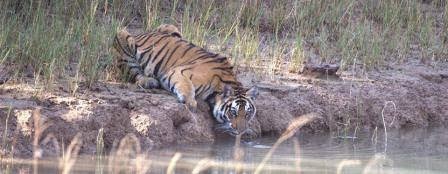
Tiger at Water

Tiger in Grass

Scent Marking Tiger

Snarling Tiger

Tiger Walk

Tige rin Bandhavgarh National Park

Wild Dog
Teerath Singh has been a great friend and client for website promotion. He is an equally great photographer, naturalist, and guide. Teerath Singh also operates a tour company called MP Tiger Safari in India.   

Bandhavgarh is a happening place and Teerath's Images keep telling exciting stories of the wild. Here is one incidence of a blue-eyed male tiger being injured in a fight and made to leave his territory. Well, this winter he is making a comeback. Territorial fights among the big cats could be a messy and bloody affair. See the images by Teerath Singh in this blog.